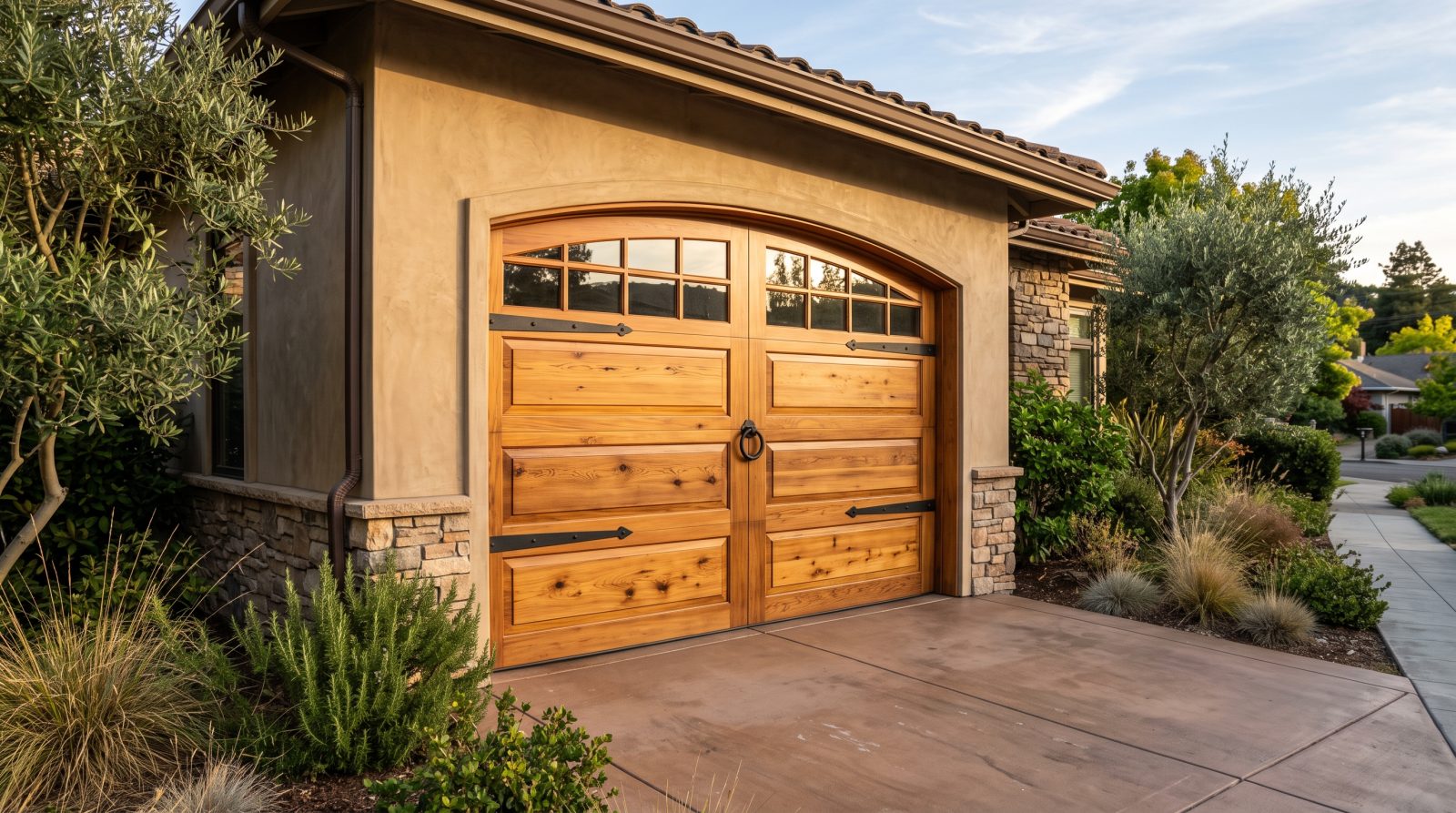
Why Homeowners Still Choose Real Wood
Wood remains the benchmark other garage door materials are measured against, and for good reason. Steel doors with a wood-grain print and composite-overlay doors have closed the gap on appearance, but stand a few feet from a genuine wood door and the difference is obvious. Real grain has variation a printed texture cannot fake, and a stained finish reveals the actual character of the species underneath. On a Craftsman bungalow, a Tudor, a Spanish Colonial, a mountain timber-frame home, or any architecture where natural materials are part of the language, a wood door reads as authentic in a way no substitute does.
There is also a customization advantage. Because wood is milled, it can be built to almost any size, panel layout, or design. Carriage-house styling, custom arches, specialty stain colors matched to your front door or trim, decorative hardware, and glass configurations are all far easier to execute in wood than in stamped steel. For homeowners who want a one-of-a-kind entrance — and who see the garage door as a major facade element rather than an afterthought — wood offers a level of design freedom that mass-produced doors do not.
The honest trade-off is upkeep and cost. Wood is a natural material that moves with humidity and degrades under sun and water unless it is protected. It is the most expensive common door material and the most maintenance-intensive. The right buyer values the look enough to commit to the care, or chooses a construction style and finish that reduces it. The wrong buyer is seduced by the showroom door and underestimates what keeps it looking that way three winters later.
Wood Species, Construction & What Drives the Look
Not all wood doors are the same animal, and the construction type matters as much as the species. The two broad categories are solid wood doors, milled from boards of the chosen species, and wood-overlay (sometimes called composite-core or hardboard-core) doors, which bond a real wood skin or veneer over an engineered, more dimensionally stable core. Solid wood delivers the most authentic depth and can be refinished many times; overlay construction resists warping and seasonal movement better and usually costs less, while still showing real wood on the surface.
Species selection drives both appearance and durability. Common choices include cedar, redwood, hemlock, fir, mahogany, and accoya (a modified wood prized for stability). Cedar and redwood are popular because they naturally resist rot and insects and take stain beautifully; mahogany offers a rich, dense grain for a high-end look; accoya and similar engineered options trade some of the romance for far better dimensional stability and finish life. The grain pattern, hardness, and how readily a species accepts stain versus paint should all factor into your choice.
- Solid wood: deepest authentic look, refinishable for decades, highest cost, most movement with humidity
- Wood overlay / composite core: real wood face over a stable engineered core, more warp-resistant, generally lower cost
- Cedar and redwood: natural rot and insect resistance, take stain well, classic for carriage and Craftsman looks
- Mahogany: dense, rich grain for premium custom doors
- Accoya and modified woods: best dimensional stability and finish longevity, a smart pick in harsh climates
- Stain vs. paint: stain showcases grain but needs more frequent refresh; paint hides grain but protects longer between coats
Styles, Insulation & Matching the Door to Your Home
A wood door should be chosen to fit the architecture, not fought into it. Carriage-house styles — with the look of side-hinged swing doors but the convenience of a modern sectional that rolls overhead — are the most popular wood format because they suit traditional, farmhouse, and transitional homes. Recessed or raised flat-panel designs read cleaner and work on more contemporary facades. Glass can be added in the top section or distributed across panels to bring light into the garage and lighten the door visually. Decorative iron hardware, custom arches, and specialty stains let you tune the door to your trim, front door, and roofline.
Insulation is a decision many buyers overlook with wood. Solid wood has some natural insulating value, but a single-layer solid door is not as thermally efficient as a well-built insulated steel sandwich door. If your garage is attached, finished, used as a workshop, or sits below living space, ask about insulated wood construction or an insulated core with a wood face. This matters more in climates with cold winters or hot summers, where an uninsulated garage door becomes a thermal hole in the side of the house. In milder regions, insulation may be more about noise and comfort than energy.
Region and climate should shape the whole decision. In hot, high-UV areas like the desert Southwest, sun is the enemy of finishes and you will refinish more often, so favor stable species and durable finishes and consider how much direct sun the door faces. In wet or coastal climates, moisture and salt air accelerate rot, making naturally resistant or modified species and diligent sealing essential. In dry, stable inland climates wood tends to behave best. There is no single right answer nationwide — the smart choice is the species, construction, and finish that match the conditions your specific door will live in.
- Carriage-house: most popular wood style; traditional, farmhouse, and transitional homes
- Flat or recessed panel: cleaner lines for contemporary facades
- Glass options: top-section or full-view lites add light and visual lightness
- Consider insulated construction for attached, finished, or below-living-space garages
- Hot/high-UV regions: expect more frequent refinishing; choose stable species and durable finishes
- Wet/coastal regions: prioritize rot-resistant or modified species and rigorous sealing
What Wood Garage Doors Cost (Typical Ranges)
Wood is generally the most expensive common garage door material, and prices vary widely with species, construction, size, design complexity, glass, hardware, and your region — so treat any number as a typical industry range and an estimate, not a quote. As a rough national guide, wood-overlay and entry-level real-wood doors often land in the lower-to-middle thousands installed, while solid custom wood doors in premium species with custom design, glass, and hardware can run several times higher. A double-wide custom solid-wood carriage door with decorative glass and ironwork sits at the top of the range; a simpler single overlay door sits well below it.
Installed pricing typically includes the door itself, new tracks and hardware as needed, and professional installation and disposal of the old door. A new opener, spring upgrades, smart accessories, structural modifications to the opening, or custom millwork are usually separate line items. Because wood is heavy, proper spring sizing and a correctly rated opener matter for safety and longevity, and a quality installation protects the investment you just made.
When you budget for wood, budget for its whole life, not just the purchase. Plan on periodic refinishing — typically every few years depending on climate, sun exposure, and finish — plus occasional hardware adjustment and the eventual possibility of repairing or replacing a damaged panel. A buyer who compares only the sticker price of wood against steel is comparing the wrong numbers. The fair comparison weighs the higher upfront cost and ongoing care of wood against its unmatched look, customizability, and the curb-appeal and home-value lift a beautiful real-wood door can add to the right house.
- Wood is typically the highest-cost common door material; all figures are estimates that vary by door, material, region, and scope
- Overlay and entry real-wood doors generally cost less than solid custom wood
- Premium species, custom design, glass, and ironwork push doors toward the top of the range
- Installed price usually covers the door, hardware, install, and old-door disposal; openers, springs, and structural work are typically separate
- Budget for the full lifecycle: periodic refinishing plus occasional repairs, not just purchase price
Maintaining a Wood Door So It Stays Beautiful
A wood garage door rewards maintenance and punishes neglect, and the single most important factor in how it ages is the finish. The protective stain or paint is what stands between the wood and the sun and water that degrade it. The first sign of a tired finish — fading, chalking, a dull or graying surface, or water that no longer beads — is your cue to refinish before the wood itself is damaged. Catching it at the finish stage is routine maintenance; letting it go until the wood cracks, swells, or rots turns a refresh into a repair.
A practical care routine is straightforward. Wash the door a couple of times a year with mild soap and water to remove dirt, pollen, and salt, and inspect all sides — including the bottom edge and the back, which are easy to forget and where moisture often does its worst. Keep sprinklers from spraying the door, trim back plants that trap moisture against it, and address any chips or scratches promptly so water cannot get behind the finish. Refinish on a schedule appropriate to your climate and exposure rather than waiting for obvious failure; south- and west-facing doors in strong sun will need attention sooner than shaded ones.
Beyond the finish, the door is still a moving mechanical system. Keep the rollers, hinges, and springs in good order, listen for new noises, and have the balance and hardware checked periodically — wood doors are heavy, so correct spring tension and a properly rated opener matter for both safety and the door's lifespan. Spring work in particular is high-tension and best left to a professional. Treat the finish as scheduled upkeep and the hardware as periodic service, and a quality wood door can stay genuinely beautiful for a very long time.
- The finish is everything: refinish at the first signs of fading, chalking, graying, or water no longer beading
- Wash a couple of times a year and inspect all sides, especially the bottom edge and the back
- Keep sprinklers off the door and trim back moisture-trapping plants
- Repair chips and scratches promptly before water gets behind the finish
- Refinish on a climate- and exposure-based schedule; sun-facing doors need it sooner
- Service the moving parts; leave high-tension spring work to a professional