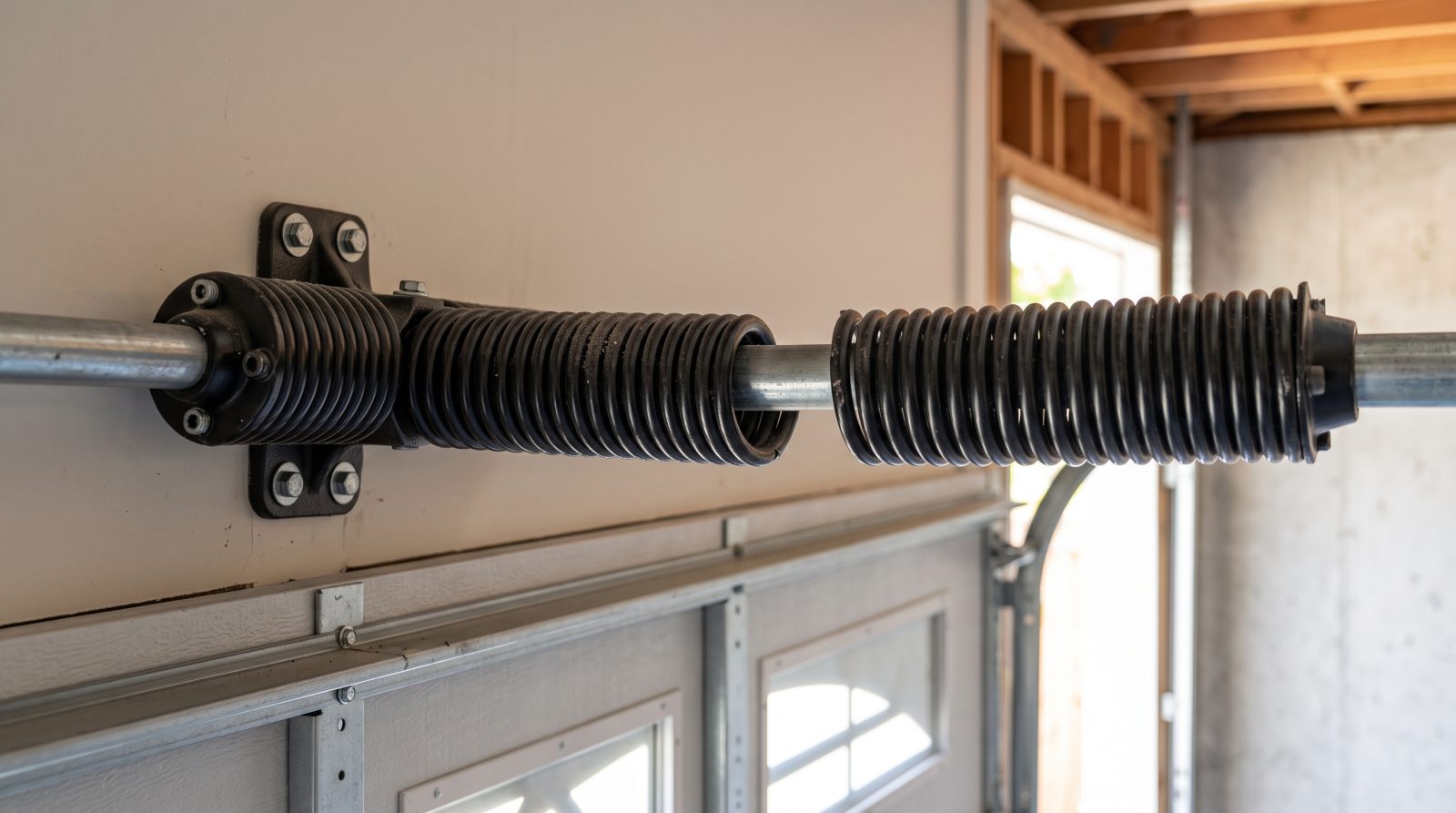
The unmistakable signs your spring has broken
Most garage doors use one of two spring systems. Torsion springs mount horizontally on a metal shaft above the door opening and are the more common, more durable setup on modern doors. Extension springs run along the horizontal tracks on each side and are typical on older or lighter doors. Whichever you have, a break produces a recognizable set of symptoms because the door has suddenly lost the counterweight that made it feel light.
The single clearest sign is a door that will not open, or that opens only a few inches and stops. With a torsion spring, you may also find an obvious gap of one to two inches in the coil where the metal separated, almost as if someone made a clean cut. With extension springs, you'll often see one spring hanging loose or visibly stretched out of shape compared to its partner.
Many people first notice the moment it happens: a loud bang from the garage, sometimes mistaken for a gunshot or something falling off a shelf. That noise is the spring releasing its stored tension all at once. After that, the door simply refuses to cooperate.
- A loud bang or pop from the garage, often when no one was using the door
- The door won't open, or rises a few inches and stops as the opener strains
- A visible gap or separation in the torsion spring above the door
- The door slams down hard or feels extremely heavy when lifted by hand
- The opener motor runs and hums but the door barely moves
- The door looks crooked or hangs lopsided in the opening
- Bent or loose cables, or cables that have come off the drums
How to confirm it safely (and what not to touch)
You can confirm a broken spring without any tools and without putting your hands near the dangerous parts. First, never try to force the door open with the opener. If a spring is broken, the opener is now trying to lift the door's full dead weight, which it was never designed to do. Repeated attempts can burn out the motor, snap the lift cables, or strip the opener's gears, turning a one-part repair into several.
The safest at-home test is the balance check, done with the door closed and the opener disconnected. Pull the red emergency release cord so the door is in manual mode, then try to lift the door by hand using the panel handles. A door with healthy springs will feel light, rise smoothly, and stay roughly in place when you let go around waist or chest height. A door with a broken or failing spring will feel like dead weight, will be very hard or impossible to lift, and will crash down the instant you release it. That weight is your answer.
Here is the hard line: do not attempt to remove, adjust, or replace torsion or extension springs yourself. They hold an enormous amount of stored energy even when the door is sitting still, and a slip can cause severe injury. Confirming the problem is fine; the repair itself belongs to a trained garage-door technician with the right winding bars and clamps.
- Stop using the opener immediately to avoid damaging the motor and cables
- Disconnect the opener with the red release cord before testing by hand
- Lift the closed door manually only a foot or so to feel the weight, then lower it gently
- Keep kids, pets, and cars clear of a door you suspect has a broken spring
- Leave all spring removal and winding to a professional
Why springs break, and why region and usage matter
Garage door springs are rated in cycles, where one cycle is a full open and close. A standard spring is often rated for roughly 10,000 cycles, which sounds like a lot until you do the math. A family that uses the garage as its main entrance can easily run four to six cycles a day, which works out to somewhere around four to seven years of life. Heavier-use households reach the limit sooner. In other words, most springs don't fail because something went wrong; they fail because they simply wore out on schedule.
Climate plays a real role in timing and is worth understanding honestly. In cold northern regions, springs are most likely to snap on the coldest mornings, because metal becomes more brittle as temperatures drop and the first lift of the day puts maximum stress on an already fatigued spring. In humid coastal and southern areas, rust is the bigger enemy, since corrosion eats at the steel and creates weak points that fail early. Dry, temperate climates tend to be easiest on springs, though sheer usage still rules.
A few other factors shorten spring life: skipping lubrication, which lets the coils grind and wear; an unbalanced door that forces the springs to work harder than designed; and builder-grade springs installed on a new house to save a few dollars. Many homeowners are surprised to learn their original springs were the cheapest option available, which is part of why an upgrade conversation often makes sense at replacement time.
- Normal wear: most springs are rated near 10,000 cycles and simply age out
- Cold climates: brittle metal makes failures spike on the coldest mornings
- Humid or coastal climates: rust and corrosion cause early, hidden weak points
- Poor maintenance: dry, unlubricated coils wear faster
- An unbalanced door that overworks the springs
- Low-cost builder springs that were never meant to last
Replacing the spring: what to expect and typical costs
A professional spring replacement is often a same-day job that takes a technician roughly one to two hours. A good technician will replace springs in matched pairs even if only one broke, because the second is almost always close behind and a mismatched pair throws off the door's balance. They will also check the cables, drums, rollers, and the door's overall balance while they're there, since these parts share the load and wear together.
As a general industry guide, replacing garage door springs commonly falls somewhere in the range of about 200 to 500 dollars installed for a typical residential door, with the price varying by spring type, door size and weight, how many springs are involved, and your region. Heavier doors, high-cycle upgrade springs, and harder-to-reach setups push toward the upper end. These are typical estimates to help you plan, not a quote, and the only accurate number comes from an inspection of your specific door.
One smart upgrade to ask about is high-cycle springs. For a modest amount more, you can often move from a 10,000-cycle spring to one rated for 20,000 cycles or higher, which can roughly double the lifespan and is well worth it for a busy household. If you do replace, ask the technician to note your door's weight and the spring specs, so you have a record for next time.
- Plan on a one to two hour repair, often completed the same day
- Always replace springs in pairs for balance and to avoid a quick second failure
- Typical installed cost ranges roughly 200 to 500 dollars (estimate, varies by door and region)
- Ask about high-cycle springs to extend lifespan for busy garages
- Have the cables, rollers, and door balance inspected at the same time
Repair the spring, or replace the whole door?
A broken spring is the classic fork in the road, and it's worth pausing to do the math rather than reflexively reaching for the cheapest fix. If your door is relatively new, structurally sound, and you're happy with how it looks and insulates, replacing the springs is the obvious, economical choice. There's no reason to scrap a good door over a single worn part.
The calculation changes when the door itself is aging. If the door is fifteen or more years old, if panels are dented, rusted, or sagging, if it's a thin uninsulated single layer that bakes the garage in summer and leaks heat in winter, or if you've already paid for several repairs in recent years, then putting more money into it can be throwing good money after bad. A new spring won't make an old, drafty, dated door any quieter, safer, or better looking. There's also a practical risk worth naming: forcing an old door open after a spring break, or a hard slam-down, can crack panels or bend the track, which sometimes pushes a repairable door into replacement territory anyway.
Replacement is also where the upside lives. A modern insulated steel or composite door dramatically cuts noise and energy loss, comes with quieter rollers and stronger hardware, and is one of the highest-return improvements you can make to a home's curb appeal and resale value. New doors arrive with fresh, often higher-cycle springs and updated safety features built in. If your spring just broke on a tired door, treat it as the natural moment to compare the cost of a repair against the cost of a door you'll be glad you bought. When you're ready, you can request a free quote and get honest numbers for both paths before you decide.
- Repair makes sense: newer door, good condition, well insulated, you like the look
- Lean toward replacement: door is 15+ years old, dented, rusted, uninsulated, or repaired repeatedly
- A new insulated door cuts noise and energy loss and boosts curb appeal and resale value
- New doors include fresh, often higher-cycle springs and modern safety hardware
- Get quotes for both the spring repair and a new door so you can compare honestly