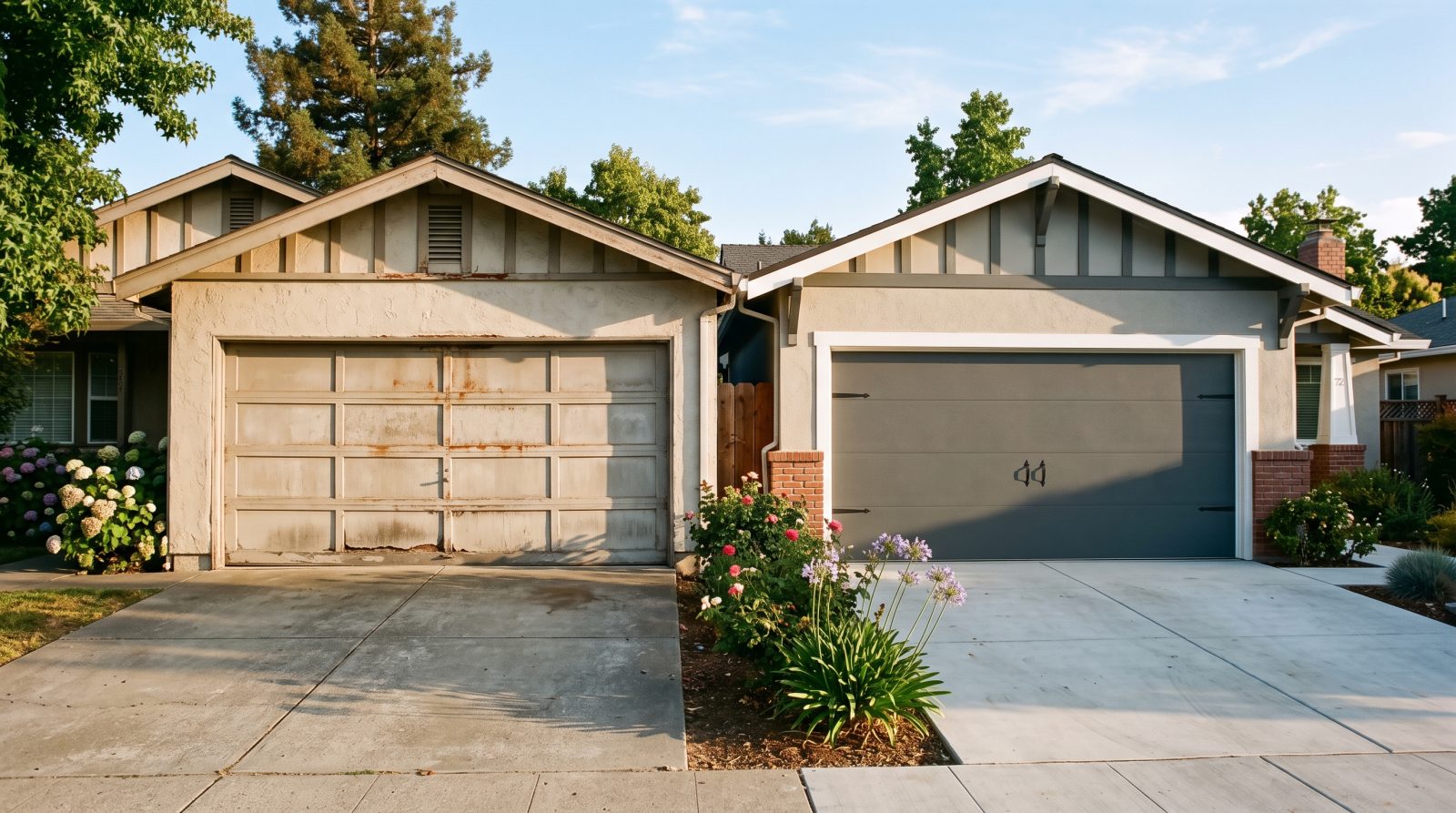
How Long a Garage Door Itself Typically Lasts
The door slab, the panels you actually see from the street, is usually the longest-lived part of the whole system. A well-built door that is reasonably maintained commonly lasts somewhere in the range of 15 to 30 years, and many doors stay structurally sound well beyond that. The wide range exists because material, build quality, and environment matter more than age alone. The opener and springs attached to that door will almost always need to be replaced one or more times during the door's life, which is why people often confuse a worn-out opener or a snapped spring with a worn-out door.
Material is the single biggest driver of how a door ages. Steel doors, especially insulated steel with a baked-on finish, tend to be the most durable for the money and resist warping, though dents and rust at the bottom edge become the limiting factor in wet or coastal regions. Aluminum and glass doors are light and rust-resistant but dent more easily. Wood doors can be stunning and extremely long-lasting when maintained, but they demand periodic refinishing and are vulnerable to moisture, swelling, and rot if neglected. Composite, faux-wood, and fiberglass doors aim to give the wood look without the upkeep, and they generally hold up well except in extreme cold, where some fiberglass can become brittle over many years.
Climate quietly sets the ceiling on a door's life. In humid coastal areas, salt air accelerates corrosion of steel components and hardware. In the Sun Belt, intense UV fades and chalks finishes and can stress lighter materials with heat cycling. In northern and mountain regions, freeze-thaw cycles, road salt, and constant cold are hard on seals, finishes, and the bottom of the door. None of this means a door fails overnight, but it does mean two identical doors in Phoenix and in coastal Maine will not age the same way, and your replacement timeline should reflect where you live.
- Steel and insulated steel: strong value and durability; watch for dents and bottom-edge rust in wet or coastal climates
- Wood: beautiful and long-lasting with upkeep; needs refinishing and is sensitive to moisture and rot
- Aluminum/glass: light and rust-resistant but dents more easily; popular for modern curb appeal
- Composite/fiberglass: low-maintenance wood look; generally durable, with some cold-climate brittleness over time
- Insulation matters in attached garages and harsh climates for comfort, energy, and quieter operation
Openers and Springs: The Parts That Wear Out First
If the door slab is the marathon runner of the system, the opener and the springs are the parts that punch a clock. A garage door opener typically lasts in the range of 10 to 15 years. Older chain-drive units are durable but noisy; belt-drive and newer smart openers run quieter and add features like battery backup, smartphone control, and rolling-code security. An opener that still works but lacks modern safety sensors or secure encryption is worth replacing on its own merits, regardless of the door's condition, because it is both a convenience and a security upgrade.
Springs are the most safety-critical wear part and the most commonly misunderstood. Springs are rated in cycles, where one cycle is a single open-and-close. A standard torsion spring is often rated around 10,000 cycles, which can translate to roughly 7 to 12 years for an average household, though a busy family that opens the door many times a day can burn through that in a few years. Higher-cycle springs exist and are well worth asking about if your door gets heavy daily use. When a spring breaks, the door becomes dangerously heavy and the opener can be damaged trying to lift it, so a broken or worn spring is a genuine repair priority, not a wait-and-see item.
Springs are also where the repair-versus-replace conversation gets practical. Spring work involves stored tension that can cause serious injury, so it is one of the clearest cases for bringing in a professional rather than attempting it yourself. If your springs are at the end of their cycle life and the opener is also aging and the door has cosmetic or structural issues, you are looking at a stack of repairs whose combined cost starts approaching the value of a fresh, fully warrantied system. Replacing springs in pairs is also standard practice, because if one has reached the end of its life the other is usually close behind.
- Opener lifespan: roughly 10 to 15 years; upgrade for quieter operation, battery backup, smart control, and modern security
- Springs are cycle-rated: a common 10,000-cycle spring often means about 7 to 12 years of typical use, less with heavy daily use
- A broken spring makes the door dangerously heavy and can damage the opener, so treat it as urgent
- Spring tension is hazardous; this is a job for a professional, not a DIY fix
- Replace springs in pairs and ask about high-cycle springs if your door runs many times a day
What Shortens (or Extends) Your Garage Door's Life
The difference between a door that limps to 12 years and one that sails past 25 often comes down to a handful of factors you can actually influence. Usage volume is the biggest. A single-car household that opens the door twice a day puts a fraction of the wear on springs, rollers, and the opener compared to a busy household using the garage as the main entrance with kids, vehicles, and deliveries coming and going all day. If your garage is your front door, expect to be on the faster end of every lifespan range above.
Maintenance is the cheapest insurance you will ever buy for a door. Lubricating rollers, hinges, and springs, keeping the tracks clean and aligned, checking that the door is properly balanced, and replacing worn weatherstripping all reduce strain on the opener and prevent small problems from cascading into big ones. Testing the auto-reverse safety feature and the photo-eye sensors a few times a year is a quick habit that protects both the equipment and the people who walk under the door. Doors that are balanced and lubricated put far less load on the motor, which directly extends opener life.
Environment and installation quality set the outer limits. A door installed level and square, with the right spring rating for its weight, simply lasts longer than one that was rushed or mismatched. Moisture intrusion, poor insulation in extreme climates, and a finish that is never cleaned or resealed all chip away at lifespan. None of this requires obsessive effort, but a door that is ignored for a decade will tell you about it, usually at the least convenient moment.
- Heavy daily use accelerates wear on springs, rollers, cables, and the opener
- Twice-a-year maintenance, lubrication, and balance checks meaningfully extend the whole system's life
- Worn weatherstripping and misaligned tracks quietly overload the opener if left unaddressed
- Regularly test auto-reverse and photo-eye sensors for safety and to catch problems early
- Correct installation, proper spring rating, and climate-appropriate materials set the ceiling on lifespan
When to Repair vs. When to Replace
A good rule of thumb is to think about the system, not the symptom. A single failed part on an otherwise sound, modern door is almost always a repair: a snapped spring, a frayed cable, a bad roller, or an aging opener can each be addressed without touching the rest. Replacement enters the picture when the failures start clustering, when the door itself is structurally compromised, or when the door is old enough that you would be pouring money into a platform that is near the end of its road anyway.
There are a few honest signals that tip the scale toward replacement. If the door is sagging, warped, rotted, or rusted through at the bottom, those are slab problems that repairs cannot truly solve. If you are facing multiple significant repairs at once, springs, opener, and panels all aging together, the combined cost can rival a new door that comes with a fresh warranty and far lower odds of another failure soon. Safety is another trigger: a door without working auto-reverse or modern sensors, or one that is so heavy and unbalanced it is straining everything, is worth retiring. And sometimes the driver is simply the home itself. A new garage door is consistently one of the higher-return exterior upgrades for curb appeal and resale, so if you are preparing to sell or refresh the front of your home, replacement does double duty as both a fix and an investment.
A practical way to decide is the part-cost test combined with age. If a repair costs a small fraction of a new door and the door has years of life left, repair. If repairs are stacking up, the door is past the midpoint of its expected life, and you are not confident it will make it much further without more visits, replacement is usually the better long-term value. Costs for both repairs and new doors vary widely by material, door size, spring rating, opener features, and regional labor, so treat any number you see online as a typical range and an estimate, not a quote. The only way to know your actual figure is to have your specific door and opening assessed.
- Repair a single failed part on a sound, modern door: spring, cable, roller, or an aging opener
- Replace when the slab is warped, sagging, rotted, or rusted through, those are not fixable defects
- Replace when multiple major parts are failing together and combined repair cost rivals a new system
- Replace for safety if the door lacks auto-reverse/sensors or is chronically heavy and unbalanced
- Treat all costs as typical ranges and estimates that vary by material, size, features, and region, never a fixed quote
Planning a Replacement on Your Timeline
The best garage door replacement is the one you choose deliberately, not the one forced on you by a breakdown. Because the door slab usually outlives its springs and opener, you often get warning signs, rising noise, slower operation, repeated small repairs, before a true failure. Treat those as your cue to start planning rather than to ignore. Getting ahead of it lets you compare materials, insulation levels, styles, and opener features instead of accepting whatever is fastest to install in an emergency.
When you do plan a new door, think beyond the panel design. Insulation level affects comfort and energy use, especially for attached garages and harsh climates. Spring rating should match how heavily you actually use the door. Opener features like battery backup, quiet belt drive, and secure smart control are worth the modest premium for most households. And the look of the door is not a small thing: it can occupy a third or more of your home's street-facing facade, which is exactly why a new door pays back so visibly in curb appeal. Choosing all of this on a calm timeline, with real information, is how you get a door that fits your home, your climate, and your daily life rather than just whatever ended the crisis fastest.
If you are weighing whether your current door has years left or is nearing the end, the smartest next step is a straightforward assessment of your specific door, springs, and opener so you can see your real options and a realistic cost range side by side. From there you can decide with confidence whether this is a season for one targeted repair or the right moment for a new door. Request a free quote to get a clear, no-pressure read on where your door stands and what a replacement would involve.
- Use early warning signs (noise, slowness, repeated small repairs) as a cue to plan, not to ignore
- Match insulation level to your climate and how the garage is used
- Choose spring rating for your real usage volume to avoid premature wear
- Weigh opener upgrades like battery backup, quiet belt drive, and secure smart control
- Factor in curb appeal and resale value, a new door is one of the most visible exterior upgrades