What the Noise Is Telling You
Garage doors don't make random noise. Each sound is a fairly specific clue, and learning to read it saves you from replacing the wrong part. Before you touch anything, stand inside the garage and run the door through a full cycle while you listen and watch. Note where the noise happens (opening, closing, or both), where it comes from (the rollers, the springs overhead, the opener motor, or the panels themselves), and whether it's new or has been slowly getting worse.
Steady squeaking or chirping almost always means friction: dry rollers, hinges, and bearings that need lubrication. A harsh metallic grinding usually points to worn rollers, a worn opener gear, or metal-on-metal contact where a part has gone dry or loose. A sharp bang or pop, especially a single loud crack from overhead, can signal a torsion spring under stress or one that has broken. Rattling and vibration typically trace back to loose hardware shaken free over thousands of cycles. A slapping or clicking that repeats with each foot of travel often means a flat spot or crack in a roller, or a chain that's gone slack on a chain-drive opener.
Climate plays a role too. In cold-winter regions, hardened or wrong-weight grease gets stiff and doors groan in the morning until they warm up; in humid or coastal areas, hinges and springs corrode faster and start squealing sooner. None of this is a reason to panic, but it is the reason to diagnose before you grab a tool.
- Squeak or chirp = friction, usually dry rollers, hinges, or bearings
- Grinding = worn rollers, a worn opener gear, or dry metal-on-metal contact
- Bang or loud pop overhead = spring stress or a broken spring (do not DIY)
- Rattle or vibration = loose nuts, bolts, brackets, or track hardware
- Repeated slap or click = a cracked/flat-spotted roller or a slack drive chain
The Quiet Fixes a Homeowner Can Safely Do
A large share of garage door noise disappears with two cheap, low-risk maintenance steps: tightening hardware and lubricating the moving parts. These are the right place to start, and doing them well often buys an older door years of quieter life.
Start with the hardware. With the door closed, use a socket wrench to snug up the nuts and bolts on the hinges, brackets, and track supports. The goal is firm, not gorilla-tight; over-torquing can strip or distort the soft brackets. Thousands of open-close cycles loosen these fasteners, and a single loose bracket can make the whole door sound like it's coming apart.
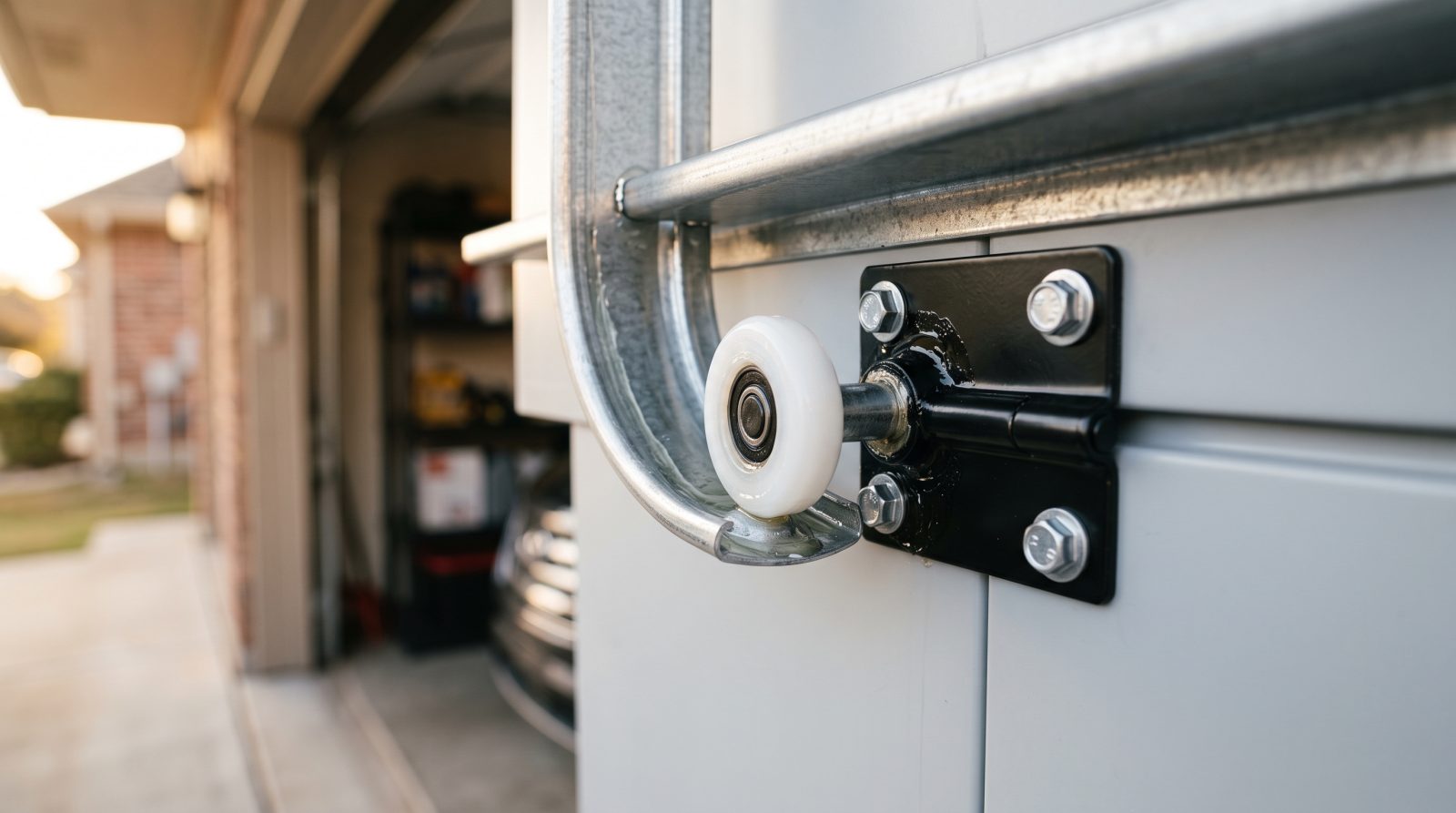
Then lubricate. Use a product made for garage doors (a silicone or lithium-based garage door lubricant), not WD-40, which is a cleaner and degreaser that actually strips lubrication and attracts grit. Apply a light coat to the hinges, the roller stems and bearings, the springs, and the bearing plates the springs turn in. Wipe the tracks clean but do not grease the inside face the rollers run on; the rollers should roll, not slide through gunk. Run the door a few times to work the lubricant in. A consistent twice-a-year lube schedule, and more often in dusty or coastal climates, prevents most squeaks from ever returning.
Two more honest fixes: if your opener is a noisy old chain drive bolted straight to the framing, an anti-vibration isolation kit or rubber mounting pads can cut the buzz that travels into the house. And nylon rollers, where they're a direct replacement for builder-grade steel rollers, run dramatically quieter; many homeowners are comfortable swapping the simple bolt-on rollers, though any roller attached to a cable or near a spring should be left to a technician.
- Tighten hinges, brackets, and track bolts (firm, not over-tightened)
- Lubricate hinges, rollers, springs, and bearing plates with garage door lube
- Never use WD-40 as a lubricant and never grease the roller track surface
- Add isolation pads to a noisy chain-drive opener to stop house vibration
- Consider quieter nylon rollers in place of builder-grade steel ones
Noises That Mean Stop and Call a Pro
Some sounds are not maintenance items; they are warnings that a high-tension component is failing, and these are where DIY enthusiasm turns into emergency-room visits. The clearest example is the springs. Most doors use torsion springs mounted on a bar above the opening, and they store an enormous amount of energy to counterbalance a door that can weigh well over a hundred pounds. A loud bang from the garage when nothing else happened, a door that suddenly feels twice as heavy, a visible gap in a spring coil, or a frayed lift cable all point to spring or cable failure. Adjusting, winding, or replacing these is a specialist job with the right tools, full stop.
Grinding from inside the opener motor is another stop signal. On older units the plastic drive gear wears down and the motor can run while the door barely moves or sounds like it's chewing on itself. Repeated harsh clunking at the same point in the door's travel can mean a bent track, a roller jumping its track, or a panel hinge tearing loose, any of which can let the door bind or come down hard.
A simple safety habit tells you a lot: once a month, with the door open, pull the manual release cord and lift the door by hand. A well-balanced door rises smoothly and stays roughly chest-high on its own. If it slams down, shoots up, or feels brutally heavy, the counterbalance is off and the door is not safe to keep running on the opener. When the symptoms point to springs, cables, the opener's internals, or the door's balance, bring in a qualified garage door technician rather than guessing.
- A single loud bang overhead or a visible gap in a spring coil
- A door that suddenly feels far heavier or won't stay up when lifted by hand
- Frayed, kinked, or loose lift cables near the bottom brackets
- Grinding from inside the opener with little or no door movement
- Repeated clunking, binding, or a roller jumping out of the track
When Quieting It Isn't Worth It: Repair vs. Replace
There's a point where chasing noise on an old door stops making sense, and recognizing it is part of being a smart homeowner. Noise on a door that's a decade or two old often isn't one bad part; it's general wear across the rollers, hinges, springs, and sometimes the panels all aging at once. You can fix one squeak only to have the next show up a month later. A useful rule of thumb: if the cost of the needed repairs starts approaching a meaningful fraction of a new door, or if you're calling for service repeatedly, replacement usually wins on both cost and peace of mind.
Older single-skin steel and lightweight doors are also simply louder by design. They have less mass to dampen vibration, thinner panels that drum and rattle, and basic steel rollers. Modern replacement doors are built to run quietly: insulated, multi-layer (steel-foam-steel) construction deadens sound and resists denting, sealed nylon rollers glide instead of clatter, and today's openers, especially belt-drive and direct-drive units, are far quieter than the chain drives many noisy doors still use. If the racket from the garage wakes a bedroom above it, the quietest fix is often the combination of an insulated door and a modern opener, not another round of lubricant.
Replacement is also the moment to gain things a repair never gives you. A new insulated door improves comfort in a garage that doubles as a workshop, gym, or play space, holds temperature better in both hot-summer and cold-winter regions, and refreshes curb appeal. A quality garage door is consistently cited among the home improvements that return a strong share of their cost at resale, so the same project that ends the noise can also be one of the better dollar-for-dollar upgrades you make to the front of the house. As with any project, expect typical costs to vary widely by material, insulation level, size, opener choice, and region, so treat any number you read online as a rough industry range and get an itemized quote for your door.
- Repeated repairs or repair costs nearing a large share of a new door
- An aging door wearing out on multiple fronts at once
- Thin, uninsulated panels that drum and rattle by design
- A bedroom or living space above the garage that hears every cycle
- Wanting the comfort, efficiency, curb appeal, and resale upside of a new door
Keeping a New Door Quiet for the Long Run
Whether you quiet your current door or install a new one, a little routine care keeps it that way and protects the investment. Quiet is the natural state of a healthy, well-balanced door; noise is what creeps in when maintenance slips. Twice a year, walk through the same checks: tighten the hardware, lubricate the moving parts, wipe the tracks, and look over the rollers, cables, and weatherseal for wear. Listen during a normal cycle and treat any new sound as information, not just an annoyance.
Pay attention to climate-driven wear, which varies a lot across the country. In humid and coastal areas, inspect springs, hinges, and fasteners more often for rust and refresh lubrication on a tighter schedule. In cold-winter regions, use a lubricant that stays workable in low temperatures and keep the bottom seal in good shape so the door doesn't freeze to the slab and strain the opener. In hot, dusty, or high-cycle households, expect rollers and lube to need attention sooner because grit is the enemy of quiet rollers.
If you've done the basic care and the door is still loud, or if any of the warning signs in this guide show up, that's your cue to have it looked at rather than living with it. A door that runs quietly and stays balanced is also a door that's running safely. When you're weighing a noisy, worn-out door against a quieter, more efficient replacement, you can request a free quote and compare what a new insulated door and modern opener would cost against another year of repairs.
- Run a twice-a-year tighten, lubricate, and inspect routine
- Check rollers, cables, and the bottom weatherseal for wear each time
- Adjust your schedule for your climate: rust in humid areas, cold-rated lube in winter
- Treat any new noise as an early warning, not background sound
- Compare the cost of ongoing repairs against a quieter, insulated replacement