Start Here: Is It the Opener, the Door, or the Power?
Before you assume the worst, narrow down which part of the system is actually failing. A garage door is really two systems working together: the door itself (the panels, springs, cables, rollers, and track) and the opener (the motorized unit that pulls the door up and down). When a door won't open, the cause almost always lives in one of those two systems, or in the power feeding the opener. Identifying the right one in the first few minutes saves you from chasing the wrong fix.
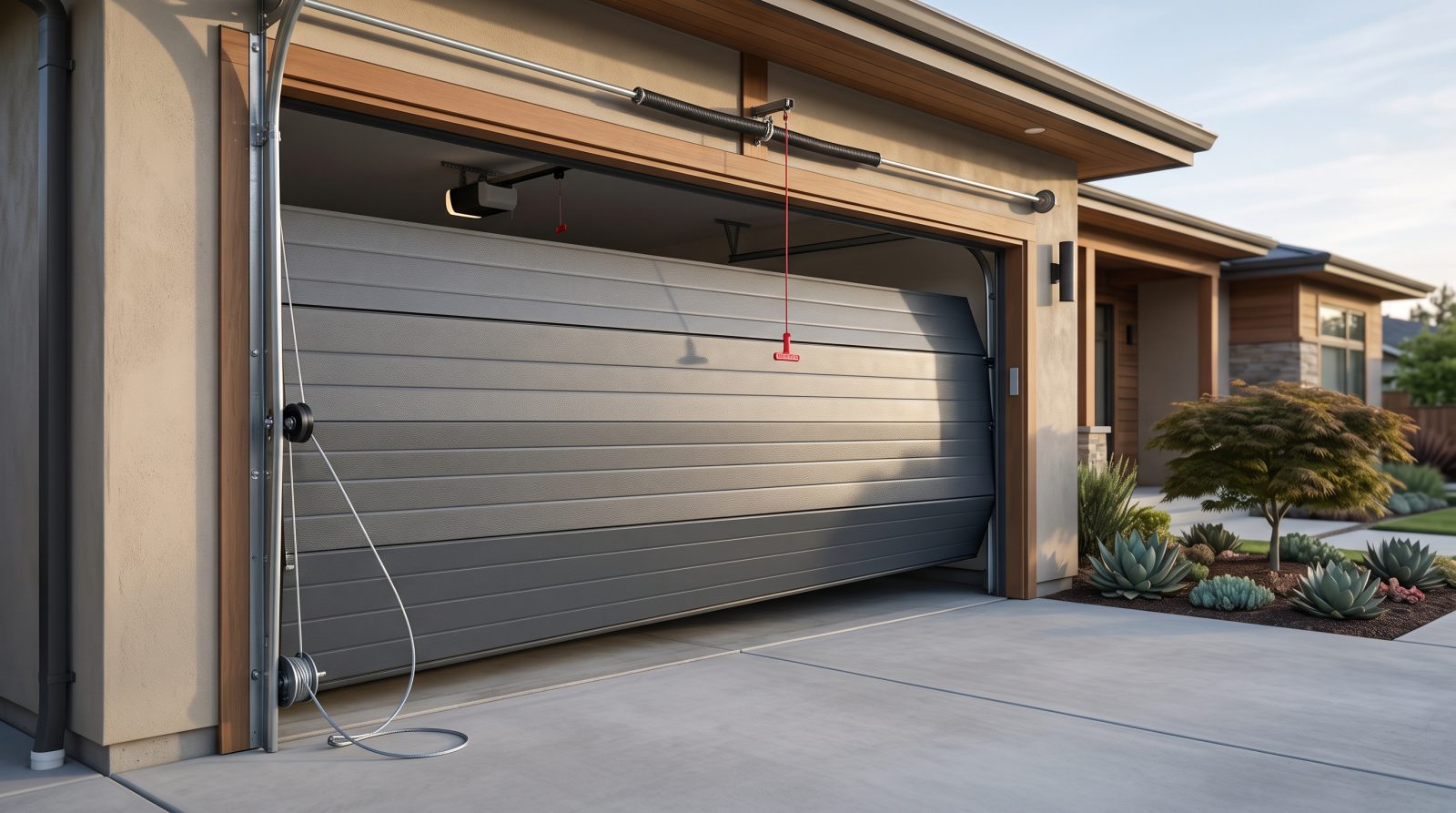
A fast way to isolate the problem is to pull the emergency release cord, the red handle hanging from the opener trolley, and try to lift the door by hand (only do this with the door fully closed, never partially open). If the door glides up smoothly by hand, your mechanical system is fine and the issue is with the opener or its power. If the door is extremely heavy, stuck, or won't budge, the problem is mechanical, often a spring or cable, and that's the category that calls for caution.
Run through the obvious electrical checks first, because they're free and surprisingly common. Confirm the opener is plugged in, check whether the outlet has power by testing another device, and look at your breaker panel for a tripped breaker. Power surges, especially during storm season in many parts of the country, regularly knock out garage opener circuits without anyone noticing.
- Door lifts easily by hand after pulling the release: suspect the opener, remote, or power
- Door is heavy or won't move by hand: suspect a broken spring, cable, or off-track door
- Opener motor hums or runs but the door doesn't move: suspect a stripped gear or disengaged trolley
- Nothing happens at all, no lights, no sound: start with power, outlet, and breaker
The Most Common Reasons a Garage Door Won't Open
Broken torsion or extension springs are the single most frequent reason a heavy door refuses to open. Springs do almost all the lifting work, counterbalancing the door's weight so the opener (or your arm) only has to provide a nudge. When a spring snaps, you'll often hear a loud bang like a firecracker, and afterward the door feels like it weighs a ton because nothing is offsetting its weight anymore. Springs are wear items rated for a finite number of cycles, and they tend to fail after years of daily use. This is the one repair you should never attempt yourself, more on that below.
Safety sensor problems are the most common reason a door won't fully open or close on an electric opener. The two small photo-eye sensors near the bottom of the track must see each other to operate. If one is bumped out of alignment, blocked by a leaf or cobweb, or has a dirty lens, the opener may refuse to run and will often blink its lights as a warning. Realigning or wiping the sensors clean resolves a large share of these calls.
Other frequent culprits include a snapped or frayed lift cable, a door that has jumped off its track (often after being hit by a vehicle or after a roller fails), a stripped main drive gear inside an older opener, dead remote batteries, a tripped or disengaged trolley, and remotes or keypads that have lost their programming. Cold weather adds its own twist: in colder regions, grease can stiffen, metal contracts, and a door can freeze to the concrete at the bottom, all of which can make a door seem stuck when the underlying hardware is fine.
- Broken spring: loud bang, door suddenly very heavy, visible gap in the coiled spring
- Misaligned or dirty safety sensors: opener clicks or lights blink, door won't run
- Broken lift cable: door hangs crooked or one side drops, frayed cable visible
- Off-track door: rollers out of the rail, door binding or jammed at an angle
- Stripped opener gear: motor runs and hums but the door doesn't move
- Dead batteries or lost programming: wall button works but remote/keypad doesn't
What You Can Safely Check Yourself (And What You Must Not)
There's a clear line between DIY-safe checks and jobs that require a trained technician with the right tools. On the safe side: replacing remote batteries, reprogramming a remote or keypad, cleaning and realigning the photo-eye sensors, clearing debris from the tracks, checking the breaker and outlet, and lubricating rollers and hinges with a garage-door-specific lubricant. These are low-risk maintenance tasks that resolve a meaningful percentage of "won't open" complaints and cost little more than your time.
On the do-not-touch side are the components under high tension: torsion and extension springs, and the lift cables connected to them. A torsion spring stores an enormous amount of energy, and releasing it without the proper winding bars and technique can cause severe injury. The same caution applies to a door that has come off its track while the springs are still loaded. These are not jobs to learn on the fly with a wrench from the garage, they are the leading source of serious garage-door injuries, and the parts are inexpensive relative to a trip to the emergency room.
If your hand-lift test showed a heavy, stuck door, or if you can see a broken spring or a dangling cable, stop and don't operate the opener. Forcing a motorized opener to pull against a broken spring or jammed door can damage the opener, bend the track, or worsen the problem. At that point, the safe move is to leave the door closed and call a professional to inspect and quote the repair.
- Safe to DIY: remote batteries, reprogramming, sensor cleaning/alignment, track debris, lubrication, breaker check
- Leave to a pro: torsion/extension springs, lift cables, off-track doors, opener gear replacement, bent track
- Never run the opener against a door you suspect has a broken spring or jammed track
- When in doubt, keep the door closed and get it inspected rather than risk injury or further damage
Repair It or Replace It? How to Make the Smart Call
Once you know what's wrong, the real question becomes whether to repair the existing door or replace it. A single broken spring or sensor on an otherwise sound, modern door is almost always a straightforward repair. But repeated failures are a signal worth listening to. If you're calling for service every year or two, if multiple components are wearing out around the same time, or if replacement parts for an aging opener or door model are getting hard to source, those repair bills start adding up to a meaningful fraction of a new door, often without solving the underlying problem of an aging system.
Age and condition matter as much as any single breakdown. Garage doors that are decades old were frequently built as thin, uninsulated single-layer steel or as wood that has since warped, cracked, or rotted, common in humid and coastal climates. A door at the end of its service life will keep generating problems no matter how many individual parts you swap. A new door, by contrast, comes with fresh springs, cables, rollers, and modern hardware all at the start of their lifespan, plus the option of better insulation, quieter nylon rollers, and a current-generation opener with smartphone control and battery backup.
Don't overlook what a replacement adds beyond reliability. A new garage door is one of the most visible upgrades you can make to a home's exterior, and it consistently ranks among the home-improvement projects with the strongest return on resale value. Insulated doors also help moderate the temperature of attached garages and adjacent rooms, which matters in both hot southern summers and cold northern winters. As a rough planning guide, professional repairs for items like springs or sensors typically fall in the lower hundreds of dollars, while a full replacement door installed commonly ranges from roughly the high hundreds into several thousand dollars depending on size, material, insulation, and style. These are typical industry estimates only, your actual figures vary by door, material, region, and scope.
- Lean toward repair: an isolated failure on a relatively modern, structurally sound door
- Lean toward replacement: repeated breakdowns, multiple worn components, hard-to-find parts
- Lean toward replacement: a door that's decades old, dented, rotted, warped, or uninsulated
- A new door resets every wear part at once and adds insulation, quieter operation, and curb appeal
- Treat all dollar figures as typical ranges that vary by region and scope, not fixed quotes
Choosing a Replacement Door That Won't Leave You Stranded Again
If you decide to replace, the choice you make now determines how reliable and trouble-free the door will be for the next couple of decades. Material is the foundation. Steel is the most popular choice nationwide for its durability and value, and insulated multi-layer steel resists dents and dampens noise better than thin single-layer versions. Aluminum and full-view glass doors deliver a sleek, modern look and resist rust, making them popular in coastal areas, though they can dent more easily. Wood and wood-composite offer warmth and high-end curb appeal but ask for more upkeep, especially in wet or sun-intense climates. Fiberglass and composite options resist moisture and warping, a practical pick for humid regions.
Insulation, measured by R-value, is worth real thought even if your garage isn't heated. Higher R-value doors with polyurethane or polystyrene cores hold temperature better, run quieter, and feel more solid, which matters most for attached garages, rooms above the garage, and homes in climates with hot summers or hard winters. If you spend any time in the garage or have living space adjacent to it, the upgrade to an insulated door usually pays off in comfort and energy.
Finally, match the door to the way you live and to your home's style. Modern doors pair with smart openers offering smartphone control, battery backup so the door still works in a power outage, and quieter belt-drive operation that's ideal when there's a bedroom near the garage. Style and color should complement your home's architecture, since the garage door often occupies a large share of your front elevation and shapes the home's whole first impression. A reputable installer will measure your opening, walk you through material and insulation trade-offs for your climate, and handle disposal of the old door. When you're ready to compare options for your home, you can request a free quote to get tailored guidance and pricing for your specific door and region.
- Steel: durable, popular, best value; choose insulated multi-layer for dent resistance and quiet
- Aluminum/glass: modern, rust-resistant, great for coastal looks; can dent more easily
- Wood/composite: premium curb appeal; wood needs upkeep, composite resists moisture and warping
- Insulation (R-value): meaningful for attached garages, rooms above, and hot or cold climates
- Smart openers: app control, battery backup for outages, quiet belt-drive near bedrooms
- Style and color: a large part of your curb appeal, so match it to your home's architecture