Why Rollers and Tracks Are the Heart of Smooth, Quiet Operation
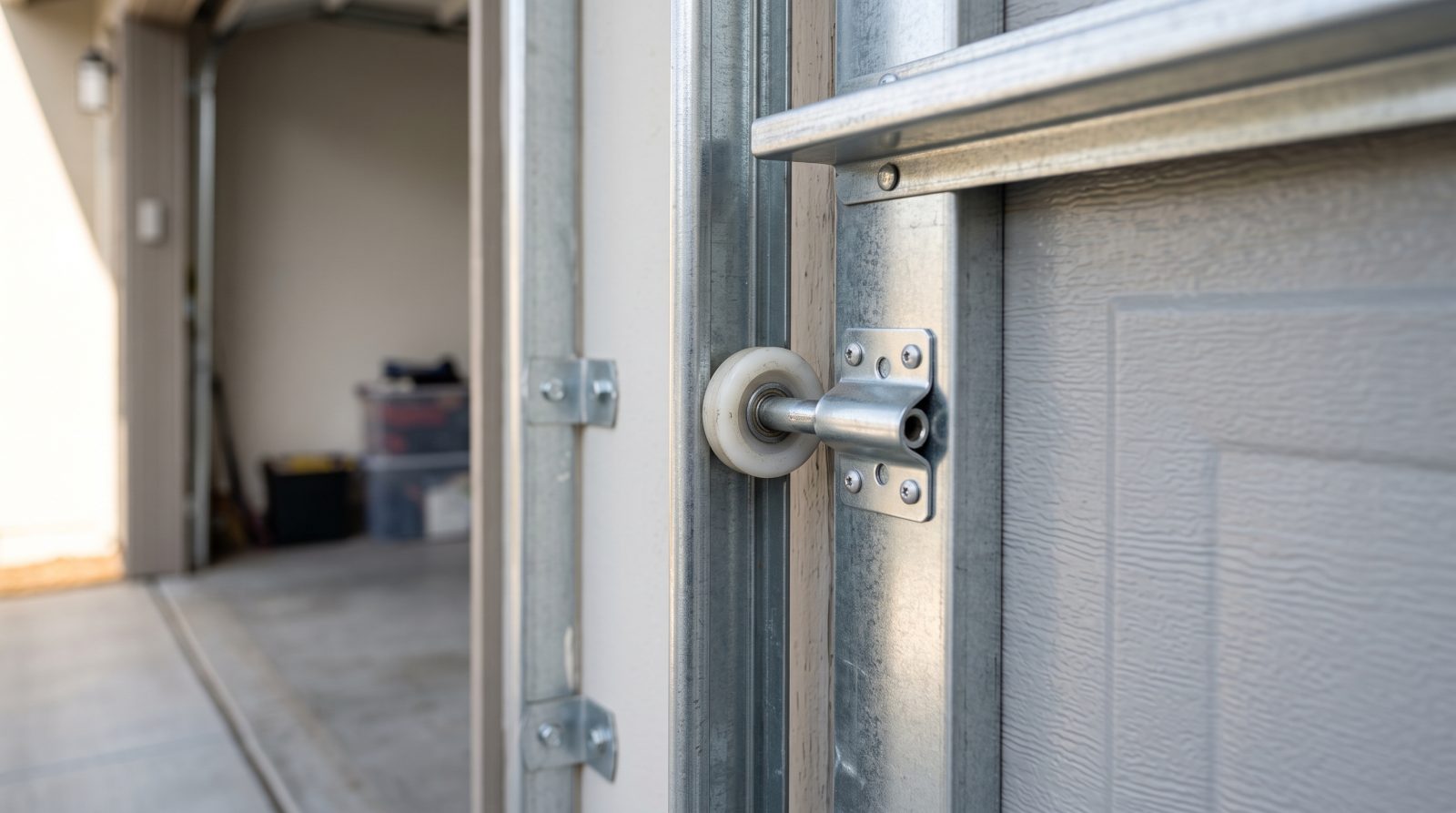
Your garage door doesn't lift straight up the way it appears to. The door panels travel along a pair of vertical and curved horizontal tracks, riding on small wheels called rollers that are pinned into hinges along each panel edge. The opener and springs supply the lifting force, but the rollers and tracks control the path, the alignment, and how much friction the system fights on every cycle. When this guidance system is clean, aligned, and rolling on good bearings, even a heavy insulated door moves with a soft, almost hushed sound.
Most of the harsh noise homeowners describe, grinding, squealing, popping, or a metallic rattle, traces back to friction or misalignment in this roller-and-track relationship. A roller with a dry or failing bearing scrapes instead of rolls. A track that's bent, dented, or pulled slightly out of plumb forces the rollers to bind at certain points in the travel. Because the door cycles so often, these small problems compound quickly, accelerating wear on the opener, the springs, and the hinges until a minor tune-up becomes a larger repair.
Understanding this is also the foundation of any smart replacement decision. If you're weighing a new door, knowing how the roller and track system behaves helps you evaluate quality, because a premium door is largely defined by how quietly and reliably it runs over the long haul, not just how it looks from the curb.
- Rollers: small wheels (steel, plastic, or nylon) on a stem that ride inside the tracks
- Hinges: connect panels and hold the roller stems, allowing the door to flex around the curve
- Vertical and horizontal tracks: steel channels that guide and contain the rollers
- Track brackets and lag bolts: anchor the tracks to the wall and ceiling framing
Worn Rollers: The Most Common Source of a Noisy Door
Rollers are wear parts, plain and simple. Builder-grade doors are very often fitted with inexpensive plastic or unsealed steel rollers that have few or no ball bearings, and these are typically the first thing to go loud. As the bearing wears or the plastic wheel flattens and cracks, the roller begins to skid and grind inside the track instead of spinning freely. You'll usually hear it as a rhythmic squeal or scraping that gets worse in cold weather, when old grease stiffens and dry bearings seize up.
Visually, a worn roller often shows a wobbling stem, a wheel that no longer spins by hand, chipped or cracked plastic, or flat spots on the tread. Worn rollers also let the door drift slightly side to side, which then bangs the panels against the track and chews up the track edges, an example of one cheap part causing damage well beyond itself. Replacing all the rollers at once, rather than one at a time, restores balanced, quiet travel and is one of the highest-value small repairs on the entire door.
The most popular upgrade is a switch to sealed nylon rollers with multiple precision ball bearings. Nylon runs dramatically quieter than steel, doesn't require regular lubrication of the wheel-to-track contact, and won't rust, which matters a great deal in humid coastal regions or northern climates where salt and moisture are constant. For most homeowners, upgrading to quality nylon rollers is the single most effective way to transform a loud door into a quiet one without touching the opener or springs.
- Listen for: rhythmic squealing, grinding, or scraping that worsens in cold weather
- Look for: wheels that won't spin by hand, cracked plastic, flat spots, or a wobbling stem
- Upgrade path: sealed nylon rollers with 10+ ball bearings for quiet, low-maintenance, rust-free travel
- Replace as a full set so the door tracks evenly and wear stays balanced
Bent, Misaligned, and Damaged Tracks: Diagnosis and Repair
Tracks fail differently from rollers. Because they're made of relatively thin steel, they're vulnerable to physical impact, a bumper tap, a ladder, a stored item leaning against them, or the slow strain of loose mounting brackets. The classic symptoms are a door that catches or jerks at the same spot every time, a visible gap between the roller and the track, a door that looks crooked when closed, or a grinding sound concentrated in one area of the travel rather than throughout.
Minor track issues are frequently repairable. A slightly bent section can sometimes be carefully straightened, loose lag bolts and brackets can be re-secured, and a track that has drifted out of alignment can be re-shimmed and re-plumbed so the gap between roller and rail is correct and consistent along the whole run. Cleaning packed debris and old hardened grease out of the channel also removes a surprising amount of noise and resistance. These are precise adjustments, however, fractions of an inch matter, and a track set incorrectly will wear rollers and hinges prematurely.
Some track damage genuinely calls for replacement rather than repair. A deeply kinked, crimped, or rusted-through track will never guide rollers smoothly again, and forcing a door to run on it risks a derailment, where the door jumps the track entirely. A derailed or off-track door is also a serious safety situation that should not be operated, because the door's weight is no longer being controlled the way it was designed to be. In those cases, a section or full track replacement matched to the door is the correct fix.
One important safety note that shapes every track repair: never loosen or adjust components while a torsion or extension spring is under tension. The springs store enormous energy, and track and roller work is best handled with the door supported and tension respected. This is the part of the system where the gap between a confident homeowner job and a professional repair is widest.
- Repairable: minor bends, loose brackets, mild misalignment, packed debris, incorrect gap
- Replace instead: deep kinks, crimped or rusted-through sections, repeated derailments
- Stop using the door immediately if it has jumped off the track or hangs at an angle
- Track alignment is a precision job, fractions of an inch determine smoothness and lifespan
Repair, Upgrade, or Replace: Making the Smart Call
For a door that's otherwise sound, fixing rollers and tracks is almost always the right move, and it's a modest investment relative to a new door. The decision gets more nuanced when the roller and track noise is a symptom of an aging door that's also showing other wear: rusting or cracking panels, failing hinges, worn springs, an outdated uninsulated build, or repeated breakdowns across several components. At that point, you're spending money to keep an old system limping along rather than improving your home.
A useful rule of thumb: if a roller and track repair restores quiet, reliable operation on a door you're otherwise happy with, repair it and enjoy years more service. But if the door is old, poorly insulated, dented, or you find yourself fixing one thing after another, the same money is often better directed toward a new door, where you gain quiet nylon-roller operation, modern insulation, better security, and a meaningful boost to curb appeal and resale value all at once. A new garage door consistently ranks among the home-improvement projects with the strongest return on cost, which is why selection and replacement, not just repair, deserve real consideration.
Regional climate should weigh into the call. In humid and coastal areas, steel rollers and tracks corrode faster, making rust-resistant nylon rollers and galvanized hardware especially worthwhile. In cold northern climates, an uninsulated door with marginal rollers runs loudest and stiffest in winter, so a repair that also upgrades to nylon, or a replacement with an insulated door, pays off in both comfort and quiet. Honest typical pricing helps frame the choice, with the figures below presented as industry estimate ranges that vary by door, materials, hardware, and local labor.
- Full set of upgraded nylon roller replacement: roughly $100-$200 as a typical estimate, varies by door size and roller quality
- Track realignment or minor bend repair: commonly $125-$300 as a typical estimate, depending on extent
- Section or full track replacement: often $200-$600+ as a typical estimate, varies by door and hardware
- These are general industry ranges, not a quote; off-track or spring-related work changes scope and cost significantly
Maintenance That Keeps Rollers and Tracks Quiet for Years
Most roller and track problems are slow to develop, which means simple, occasional maintenance heads off the majority of them. A few minutes a couple of times a year, ideally heading into the temperature extremes of summer and winter, keeps the system rolling quietly and dramatically extends the life of the rollers, hinges, and opener that all depend on smooth travel.
The single most common mistake homeowners make is spraying the inside of the track with lubricant. Tracks should be kept clean and dry, lubricant in the channel only attracts grit that grinds the rollers down faster. Lubrication belongs on the moving metal parts: the roller bearings (on steel rollers), the hinges, and the springs, using a proper garage-door lubricant rather than a general-purpose degreasing spray. Keeping the track itself wiped clean of dirt and debris is what actually matters there.
If you've done the basic maintenance and the door is still noisy, catching, or running roughly, that's the signal that a worn part or an alignment problem needs hands-on attention rather than another round of lubricant. A professional inspection can quickly pinpoint whether you're looking at a quick roller swap, a track adjustment, or a larger decision about the door itself, and it's the safe path whenever spring tension is involved.
- Wipe tracks clean and dry, never lubricate the inside of the track itself
- Lubricate hinges, steel roller bearings, and springs with a dedicated garage-door lubricant
- Visually inspect rollers, hinges, and track brackets a couple of times a year
- Tighten loose track brackets and lag bolts before they let the door drift and grind
- Address new noises early, small fixes now prevent expensive damage later