How a Garage Door Opener Actually Works
Understanding the repair starts with understanding the machine. A garage door opener does not lift the full weight of the door, which can run 130 to over 350 pounds depending on material and insulation. The torsion or extension springs counterbalance almost all of that weight; the opener simply provides the final push or pull to move a balanced door and hold it in place. That is why a tired opener and a failing spring produce similar symptoms, and why diagnosing the wrong part is the single most common DIY mistake.
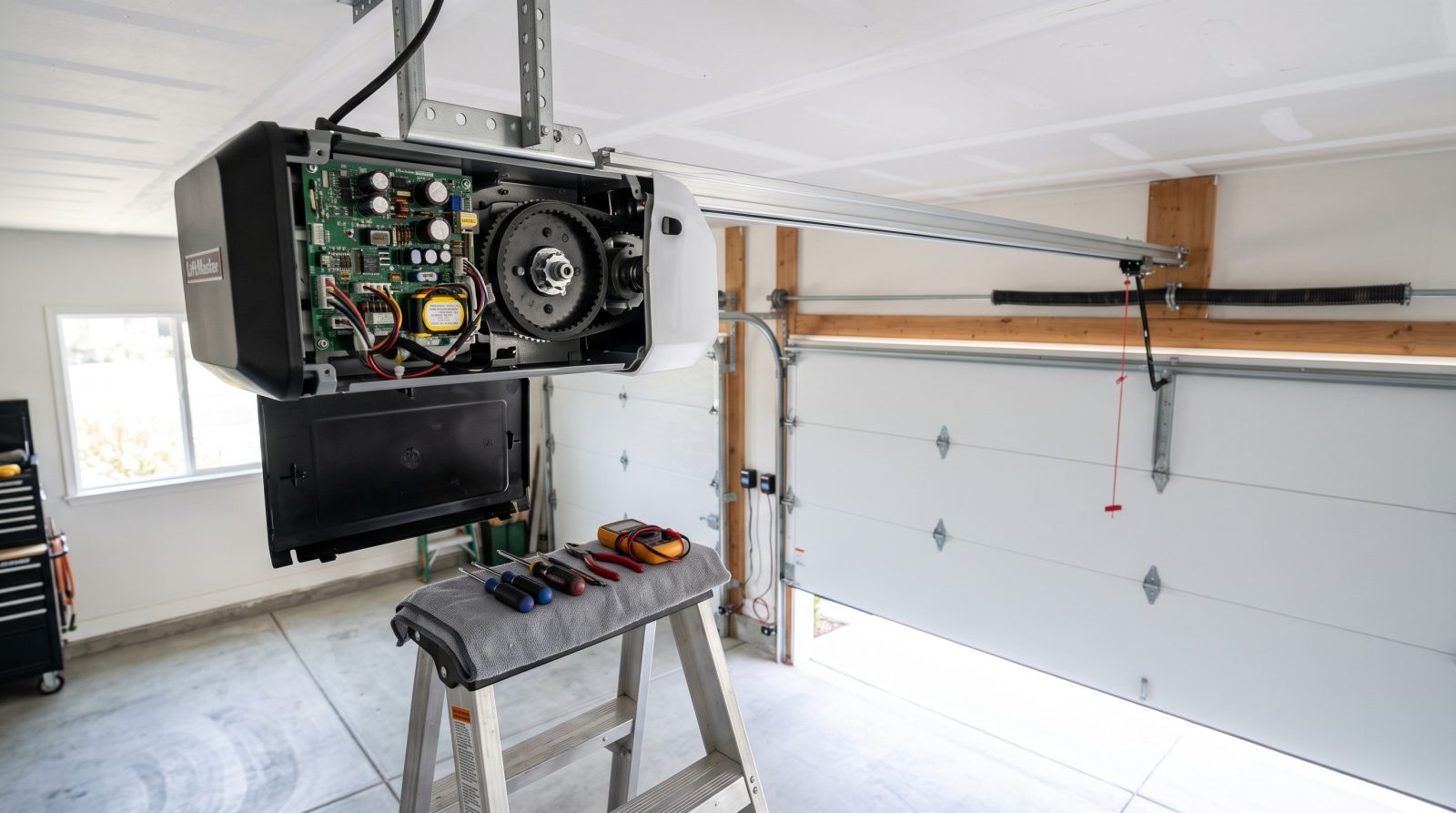
Inside the powerhead you will find a motor, a drive system, a logic board, a limit and force-sensing mechanism, and a receiver for your remotes. The drive is usually a chain, a steel-reinforced belt, a screw drive, or on newer wall-mount (jackshaft) units, a direct connection to the torsion bar. Outside the powerhead, two photo-eye safety sensors near the floor stop and reverse the door if anything crosses the beam. When an opener misbehaves, the fault almost always lives in one of these subsystems, and good troubleshooting is really a process of isolating which one.
- Motor: provides the driving force; an electric motor that can wear, overheat, or burn out over many thousands of cycles
- Drive system: chain, belt, screw, or direct-drive that transfers motor power to the door
- Logic board: the circuit board that controls timing, force limits, lighting, and remote programming
- Limit and force settings: tell the opener how far to travel and how much resistance means an obstruction
- Photo-eye sensors: the floor-level safety beam required on all openers manufactured since 1993 in the U.S.
Diagnosing the Most Common Opener Symptoms
Most service calls trace back to a short list of symptoms, and each points to a different subsystem. The fastest way to narrow things down is to pull the manual-release cord (with the door fully closed) and lift the door by hand. If a disconnected door is heavy, sticks, or slams, the problem is your springs or balance, not the opener, and no opener repair will fix it. If the door glides smoothly by hand but the opener still struggles, you have isolated the fault to the powerhead, electronics, or settings.
Pay close attention to what the opener does and the sounds it makes. A motor that hums or buzzes without moving the door often signals a stripped drive gear or a seized motor. A door that starts down and immediately reverses is almost always the safety photo-eyes, misaligned, dirty, or obstructed. Intermittent remote response usually means a weak battery, radio interference, or an aging receiver. Clicking with no motor activity points toward the logic board or a failed capacitor. Working through symptoms methodically saves you from replacing a part that was never broken.
- Motor hums, door doesn't move: stripped main drive gear, seized motor, or broken drive chain/belt
- Door reverses before or after touching the floor: misaligned photo-eyes or incorrect force/limit settings
- Remote works intermittently or not at all: dead remote battery, interference, or a failing receiver/logic board
- No response at all, no lights: tripped breaker, unplugged unit, or a dead logic board
- Loud grinding or rattling: worn chain/belt, loose hardware, or a failing gear assembly
- Door opens but won't close (or vice versa): blocked or unaligned safety sensors, indicated by a blinking sensor LED
Motor, Gear, and Logic-Board Failures Explained
Three internal failures account for a large share of opener repairs, and knowing which one you have shapes the repair-versus-replace decision. The most common by far on chain and belt-drive units is a stripped plastic drive gear (often called the worm gear or helical gear). Manufacturers frequently use a nylon gear as a deliberate sacrificial part, it is cheaper to shear a gear than to burn out a motor. When it strips, the motor runs loudly but the carriage doesn't move. A gear kit is one of the most economical repairs available and is often well worth doing on an otherwise healthy, recent opener.
Motor failure itself is less common but more serious. Motors can overheat from running against an out-of-balance door, suffer a failed start capacitor, or simply wear out after many years of cycling. A burned-out motor on an older unit is usually the point where replacement makes more sense than repair. Logic-board (circuit board) failures are the third category, often triggered by power surges, lightning, or moisture. Symptoms include erratic behavior, lights that won't shut off, lost remote programming, or a unit that is completely unresponsive despite having power. Boards are repairable in the sense that they can be swapped, but on older models the part can be costly or discontinued, which again tilts the math toward a new opener.
- Stripped drive gear: frequent, inexpensive, and a strong candidate for repair on newer units
- Failed start capacitor: a small, low-cost part that can mimic a dead motor
- Burned-out motor: serious; on aging units, usually a replacement decision
- Logic-board failure: often surge- or moisture-related; cost and parts availability drive the repair-or-replace call
- Worn carriage/trolley or sprocket: mechanical wear that may be repaired or bundled into a new install
Safe DIY Checks vs. When to Call a Pro
Several opener checks are genuinely safe to do yourself and resolve a surprising number of problems before any tools come out. Confirm the unit has power and the breaker hasn't tripped. Replace remote and keypad batteries. Clean the photo-eye lenses with a soft cloth and make sure both are aimed at each other, the indicator LEDs should be steady, not blinking. Inspect the drive chain or belt for obvious slack or damage. Many homeowners discover their entire problem was a spider web across a sensor or a sun-faded photo-eye that needed a quick realignment.
Other repairs sit firmly in professional territory, primarily because of stored mechanical energy. Garage door springs are under extreme tension and cause serious injuries every year; spring, cable, and drum work should always be left to a trained technician. The same caution applies to anything involving the high-force limit settings, motor disassembly, or electrical components inside the powerhead. If your door is out of balance, if you smell burning, if the unit is sparking, or if you have done the basic checks and the opener still won't run correctly, it is time to bring in a pro. A technician can also tell you honestly whether your specific model is worth repairing or whether you have reached the point of diminishing returns.
- Safe to DIY: power/breaker checks, fresh batteries, cleaning and realigning photo-eyes, tightening visible loose hardware
- Leave to a pro: spring, cable, and drum work; motor internals; force/limit calibration; logic-board replacement
- Stop and call immediately if: you smell burning, see sparks, or the door is dangerously out of balance
- A balance test (lifting the disconnected door by hand) tells you whether the issue is the opener or the springs
Repair the Opener or Replace It? Making the Smart Call
Because this is a decision about long-term value, not just today's breakdown, it pays to weigh the repair against an upgrade. As a general rule of thumb, repairing makes sense when the opener is relatively recent, the failure is a single inexpensive part like a gear or capacitor, and the safety features are current. Replacement tends to win when the unit is more than 12 to 15 years old, when the motor or board has failed, when parts are discontinued, or when repeated repairs are stacking up. Older units also predate modern safety and security standards, an opener without working photo-eyes or with vulnerable fixed-code remotes is a genuine reason to upgrade regardless of whether it still runs.
There is also a meaningful comfort-and-value case for a new opener, which matters most when you are already considering a new door. Modern belt-drive and direct-drive wall-mount openers are dramatically quieter, a real benefit when bedrooms sit above or beside the garage. Current models add rolling-code security, battery backup so you are not stranded during an outage, smartphone control, and tighter integration with insulated, heavier doors. If your opener is failing and your door is also aging or poorly insulated, pairing a new door with a properly matched opener is usually the better long-term investment than nursing old equipment through another season. A professional can size the opener to your door's weight and material so the system runs smoothly and lasts.
- Lean toward repair: newer unit, single low-cost part, safety features intact, smooth-balancing door
- Lean toward replace: 12-15+ years old, failed motor or logic board, discontinued parts, recurring repairs
- Upgrade payoffs: quieter operation, battery backup, rolling-code security, smartphone control, better match to heavy insulated doors
- Match the opener to the door: heavier, insulated, or oversized doors need an opener rated for the load
- Regional note: in cold climates, battery backup and weather-tolerant components are worth prioritizing