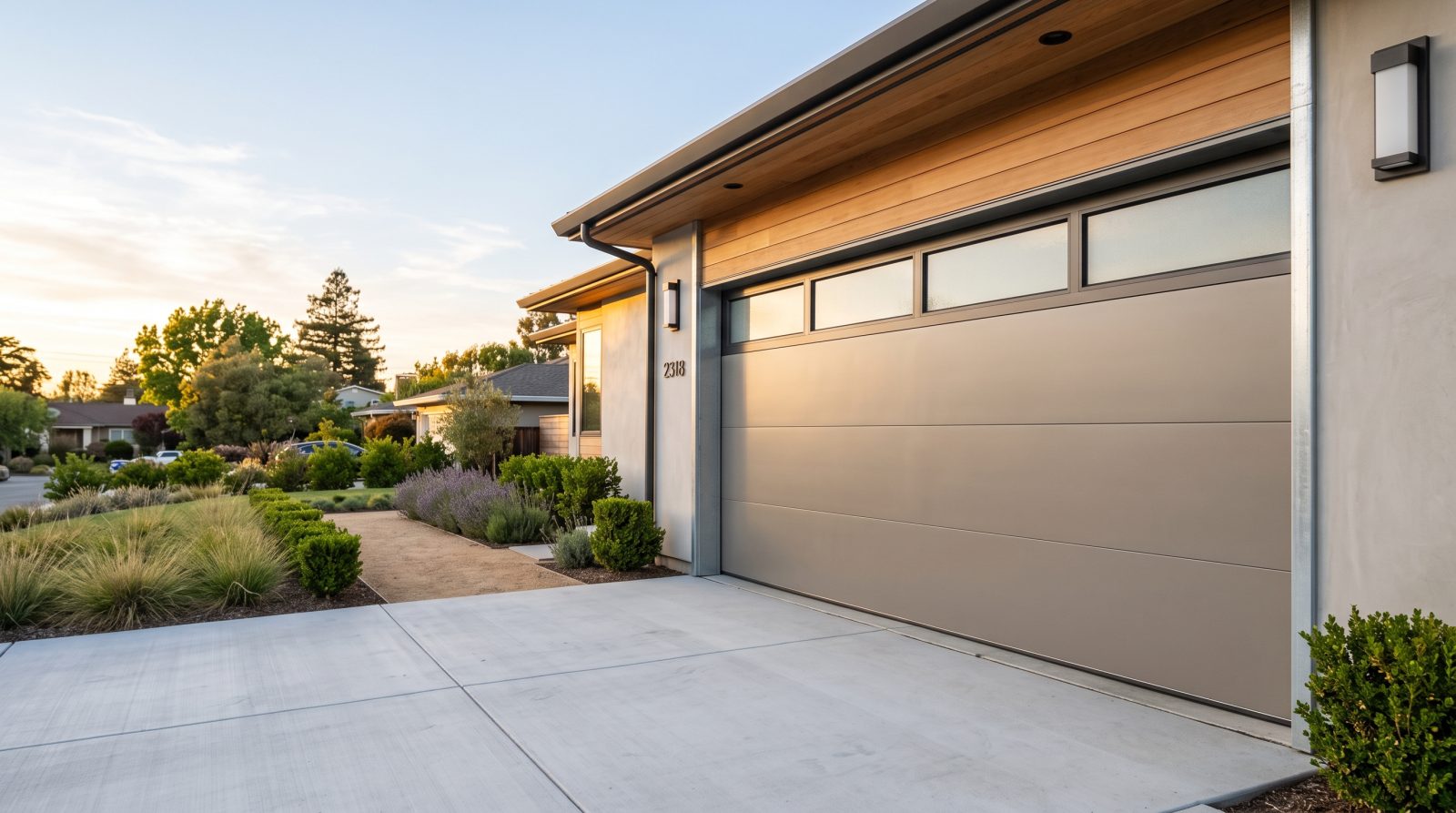
Typical garage door replacement cost ranges (installed)
For a standard single-car door (roughly 8 to 9 feet wide), a fully installed replacement typically falls somewhere between about $800 and $2,500 depending on material and insulation. A standard double-car door (15 to 16 feet wide) usually runs from around $1,200 to $4,500 installed, with well-insulated steel and premium materials at the upper end. These ranges generally include the door, hardware, tracks, springs and professional installation, but not always a new opener.
It helps to think in tiers rather than one average. A builder-grade, non-insulated steel door is the entry point most quotes are anchored to. A mid-range insulated steel door with a window row and an upgraded finish is where many homeowners actually land, because it balances curb appeal, energy performance and durability. Custom carriage-house, solid wood, and full-view aluminum-and-glass doors sit in a premium tier that can run several thousand dollars and, for true custom wood, well beyond that.
Because these are installed figures, the labor portion matters. Professional installation for a straightforward swap is commonly in the $200 to $600 range when bundled into a door package, more if the opening needs modification, the old door is oversized, or two doors are being done in one visit. Treat every number here as a planning range to compare against your own written quotes, not a guarantee.
- Single-car door, installed: roughly $800–$2,500 typical
- Double-car door, installed: roughly $1,200–$4,500 typical
- Builder-grade non-insulated steel: lowest tier, anchors most base quotes
- Mid-range insulated steel with windows: where many replacements land
- Custom wood, carriage-house, or full-view glass: premium tier, often $4,000+
- All figures are estimates that vary by material, size, region and scope
What you're actually paying for: material and door type
Material is the single biggest driver of garage door replacement cost, and it also determines how the door looks, how long it lasts, and how it handles your climate. Steel is the most popular choice nationwide because it spans a wide price range, resists dents reasonably well in thicker gauges, and accepts insulation easily. Single-layer steel is cheapest; double- and triple-layer (steel-insulation-steel) construction costs more but is quieter, more rigid, and far better at holding temperature.
Aluminum and full-view glass doors deliver a modern, architectural look and are lightweight, but the large glass packages drive cost up quickly and offer less insulation than layered steel. Solid wood and wood-composite carriage doors are the premium curb-appeal play; real wood is beautiful and customizable but is the most expensive and asks for periodic refinishing, especially in sun-heavy or humid regions. Fiberglass and composite overlays can mimic wood grain at a lower price point and resist warping and rot, which makes them popular in coastal and high-humidity areas.
Door style interacts with material. Traditional raised-panel doors are the value default. Carriage-house styling (whether real swing-out or modern overlay on a roll-up door) and contemporary flush or full-view designs carry a premium for the look. Windows, decorative hardware, custom colors and woodgrain finishes are all add-ons that stack onto the base material price.
- Steel (single-layer): most affordable, least insulating, can dent
- Insulated steel (double/triple-layer): quieter, sturdier, better R-value — mid to upper tier
- Aluminum + full-view glass: modern look, lightweight, glass pushes cost up
- Solid wood / carriage: top tier, highest curb appeal, needs upkeep
- Fiberglass / composite: wood look without the rot or warp — strong in humid/coastal climates
- Style, windows, custom color and hardware all add to the base material cost
Insulation, R-value and why climate changes the math
Insulation is where the new-door decision gets genuinely regional. A garage door's insulation is rated by R-value, and higher R-value means more resistance to heat transfer. If your garage is attached to the house, shares a wall with a living space, sits under a bedroom, or doubles as a gym, workshop or home office, insulation is often worth the upgrade regardless of where you live. If it's a fully detached, unconditioned shed-style garage, the case is weaker and you can reasonably save money with a lighter door.
Climate sharpens the trade-off. In cold northern regions, an insulated door helps keep the garage (and adjacent rooms) from becoming a heat sink in winter and reduces strain on heating. In hot southern and southwestern regions, insulation fights the oven effect that bakes an attached garage in summer and can radiate into the house. In milder coastal climates the energy argument is smaller, so insulation may be more about noise reduction and door rigidity than utility bills. There's no single nationwide right answer — match the R-value to how the garage is used and your climate.
Practically, stepping up from a non-insulated door to a quality insulated one typically adds a few hundred dollars to a single door and more on a double, but it also buys quieter operation, a more solid feel, and better resistance to dents. For many homeowners that upgrade is the highest-value line item in the whole quote.
- R-value measures insulation; higher = more resistance to heat transfer
- Attached garages and rooms above/beside the garage make insulation worth it almost anywhere
- Cold climates: insulation cuts heat loss and protects adjacent rooms
- Hot climates: insulation fights summer heat buildup in attached garages
- Mild/coastal climates: insulation is often more about quiet and rigidity than energy
- Upgrading to insulated typically adds a few hundred dollars but is often the best-value choice
The hidden line items: opener, springs, hardware and disposal
A replacement quote covers more than the visible door panels, and knowing the supporting parts helps you compare bids fairly. The opener is the big one: if yours is old, loud, or lacks modern safety sensors and smartphone control, replacing it during the door swap is efficient. A new opener installed typically adds a few hundred dollars depending on drive type — chain drives are cheapest, belt drives are quieter, and direct-drive or smart wall-mount (jackshaft) units sit higher. If your existing opener is recent and healthy, a good installer can often reuse it.
Springs and hardware are not optional extras to skimp on. New doors should come with correctly sized torsion or extension springs, balanced for the door's weight; mismatched or worn springs are a leading cause of premature failure and are genuinely dangerous to adjust yourself. Tracks, rollers, hinges and cables are usually included in a full replacement, but upgraded nylon rollers and heavier-duty hardware can be worth requesting for quieter, longer-lasting operation.
Finally, account for removal and disposal of the old door, and for any structural prep. Most professional quotes include hauling away the old unit, but confirm it. If your opening is non-standard, the framing is rotted, or the header needs reinforcement, those are legitimate add-ons. A transparent quote itemizes door, insulation, opener, springs/hardware, labor, and disposal so you can see exactly what each dollar buys.
- New opener installed: typically a few hundred dollars; chain (cheapest) → belt → direct/smart wall-mount
- A healthy recent opener can often be reused to save money
- Correctly sized, professionally installed springs are a safety item — never DIY torsion springs
- Upgraded nylon rollers and heavy-duty hardware buy quieter, longer-lasting operation
- Confirm old-door removal and disposal is included
- Non-standard openings or framing repair are legitimate add-on costs
Value, ROI and how to read your quote
A garage door replacement is consistently one of the top-performing home improvement projects for cost recovered at resale, because it's a large, highly visible facade element that buyers notice immediately. National remodeling cost-versus-value studies routinely place garage door replacement near the top of the list for percentage of cost recouped. Beyond resale, a new door improves daily curb appeal, security, quiet, and — with insulation — comfort in the adjacent spaces.
To read a quote well, compare like with like. Two bids can differ by a thousand dollars simply because one is single-layer steel and the other is triple-layer insulated with windows. Ask each installer to specify material and construction (single/double/triple layer), R-value, spring type and warranty, opener (new or reused), and whether removal, disposal and tax are included. A lower number that excludes the opener, uses thinner steel, or omits disposal isn't actually cheaper.
The smart move is to decide on your tier first based on how the garage is used and your climate, then collect itemized written quotes against that spec. When the scope is identical, price differences become meaningful and you can choose confidently. When you're ready, you can request a free quote and get a clear, itemized estimate for your specific door, opening and climate.
- Garage door replacement is regularly a top project for resale cost recovery
- Match material and construction layer-for-layer when comparing bids
- Always confirm: R-value, spring type, warranty, opener (new vs reused), disposal and tax
- A 'cheaper' quote that drops the opener or thins the steel isn't truly cheaper
- Pick your tier from garage use + climate first, then get itemized written quotes
- Ready to plan? Request a free quote for an itemized estimate on your exact door