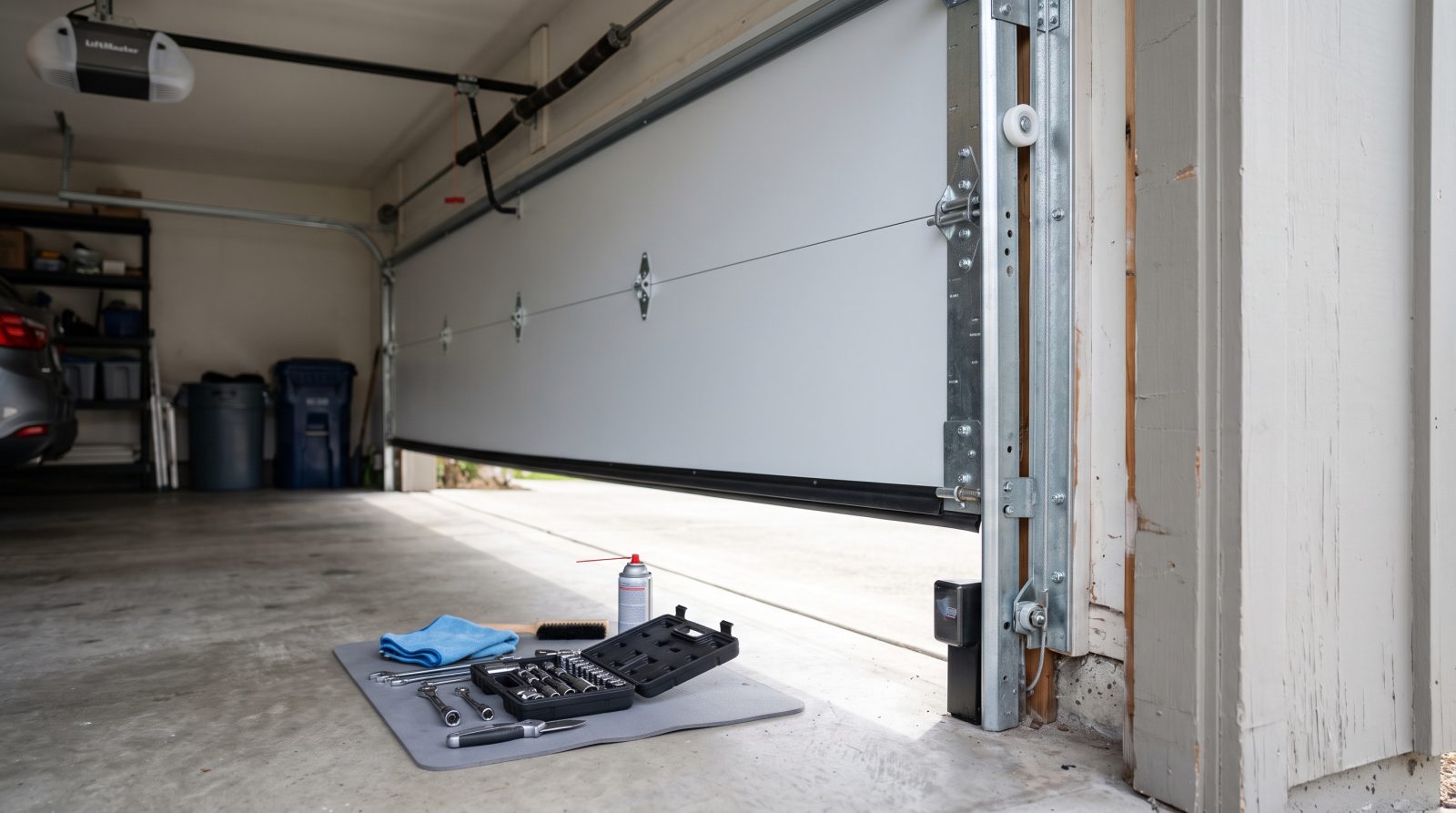
Why Garage Door Maintenance Matters More Than People Think
A garage door cycles thousands of times a year. Every open and close puts load on rollers, hinges, cables, springs, and the opener that drives them. Small problems compound: a dry roller drags, which strains the opener; a loose bolt lets a panel flex, which wears a hinge; a frayed cable lets a door hang unevenly, which throws extra stress onto the springs. Catch these early with five minutes of looking and listening and you avoid the cascade that turns an inexpensive part into a door-down emergency.
Maintenance is also a safety issue. A residential door weighs anywhere from roughly 130 pounds for a light single steel door to well over 350 pounds for a large insulated double or a solid-wood door. That weight is held in balance by springs under enormous tension. When the safety systems that govern that weight, the auto-reverse, the photo-eye sensors, the cables, are neglected, a failure stops being an inconvenience and becomes a hazard to people, pets, and vehicles.
Finally, maintenance protects the part of your home that does the most visual work. The garage door can occupy a third or more of a home's street-facing facade. Rust streaks, peeling paint, sagging sections, and dents read as deferred maintenance to anyone pulling up, including a future buyer. Keeping the door clean, aligned, and operating smoothly is one of the highest-leverage things you can do for curb appeal between now and the day you decide to replace it.
- Protects your largest moving appliance from avoidable wear and premature failure
- Keeps the door's safety systems, auto-reverse, sensors, and cables, working as designed
- Preserves curb appeal and resale value on the most visible facade of the home
- Turns surprise breakdowns into planned, low-cost upkeep you control
The Core Checklist: What to Do Every Season
Most homeowners are well served by a quick visual-and-listening check monthly and a deeper hands-on service two to four times a year, ideally at the seasonal transitions. Power down or stand clear of the door's path before you start, and never put fingers between sections. Here is the routine that covers the parts you can safely maintain yourself.
Start with eyes and ears. Run the door through one full cycle and watch it. It should move smoothly, stay level side to side, and not jerk, grind, or pop. Grinding usually means a dry or worn roller or bearing; popping can mean a binding hinge or a section out of alignment. A door that hesitates, slams the last few inches, or strains to lift is telling you something is out of balance, which is a spring or cable issue that points to professional service.
Then clean and lubricate. Wipe debris out of the tracks with a damp cloth, but do not grease the tracks themselves; rollers should roll, not slide on lubricant that just collects grit. Apply a garage-door-rated lubricant, a silicone or lithium-based product, to the rollers' bearings, the hinges, the spring coils, and the opener's drive screw or chain per the manufacturer's guidance. Skip household oils like WD-40 as a lubricant; it's a cleaner and solvent, not the long-lasting film these parts need.
Finally, tighten and test. Vibration loosens the hardware over time. With a socket or wrench, snug the bolts and brackets that hold the track and hinges, without overtightening. Then test the two safety systems every door should have: the photo-eye sensors near the floor and the mechanical auto-reverse.
- Watch a full cycle: the door should move level, quiet, and smooth, with no jerking or grinding
- Clean tracks with a damp cloth; do not lubricate the track surface itself
- Lubricate rollers, hinges, springs, and the opener drive with a garage-door-rated silicone or lithium product, not WD-40
- Tighten track brackets, hinges, and roller brackets; check the bottom bracket only visually, it is under spring tension
- Test the photo-eye reversal: wave an object through the beam as the door closes and confirm it reverses
- Test the mechanical auto-reverse: lay a 2x4 flat on the floor in the door's path; the door should reverse on contact
- Check the balance: with the opener disconnected, lift the door halfway by hand; a balanced door holds its position
Season by Season: A Climate-Aware Routine
Garage doors face different stresses across the country, so the same calendar checklist should flex with your climate. Use these seasonal passes as the anchor points for the core routine above, and weight your attention toward the failures that your region actually produces.
Spring is for recovery from winter. Metal contracts and expands with cold, fasteners loosen, and grit and road salt accumulate. This is the season to re-tighten everything, re-lubricate after winter's lubricant has thickened or washed away, and inspect the bottom weather seal that took the brunt of ice and freeze-thaw. In humid and coastal regions, spring is also when you look hardest for early rust and corrosion on hardware and steel panels.
Summer heat and humidity are the enemies of openers and finishes. Heat can make an opener's electronics and motor work harder, and direct sun bakes finishes and can warp lighter or solid-wood doors. In hot, sunny states this is the season to check that the door isn't sticking or binding as panels expand, to confirm the opener isn't laboring, and to inspect the finish for fading and chalking. In storm-prone and hurricane-belt regions, summer is the time to verify that a wind-rated door's bracing and hardware are intact before storm season peaks.
Fall is the most important tune-up of the year, because it prepares the door for the season that breaks the most doors. Lubricate thoroughly so cold weather doesn't seize dry parts, replace a worn or cracked bottom seal before it lets in drafts and snow, and confirm the door is balanced so springs aren't fighting the cold. Winter then becomes a watch-and-listen season: in cold climates, a door that gets sluggish, noisy, or refuses to seal often points to a contracted, stiff spring, a frozen seal, or a sensor knocked out of alignment, and it's the season when a door at the end of its life finally fails.
- Spring: re-tighten hardware, re-lubricate, inspect the bottom seal and look for rust, especially in humid and coastal areas
- Summer: watch for heat-related opener strain and panel binding; check finish for sun fade; verify wind bracing in storm regions
- Fall: the key annual service, deep lubrication, fresh weather seal, and a balance check before the cold
- Winter: monitor for cold-stiffened springs, frozen seals, and sluggish operation; address problems promptly to avoid a door-down emergency
Know Your Limits: What to Leave to a Professional
The single most important rule of garage door maintenance is knowing which parts you should never touch. The torsion springs (the tightly wound springs mounted on a bar above the door) and the lift cables store an enormous amount of energy. Adjusting, loosening, or attempting to replace them without the right tools and training is how serious injuries happen. If your door is unbalanced, won't stay open halfway, has a visibly broken or gapped spring, or has a frayed or slack cable, stop and call a professional.
Likewise, the bottom roller bracket is under direct spring tension and should never be unbolted by a homeowner. Track that is bent, crimped, or pulling away from the wall, panels that are cracked through, and openers that reverse erratically or fail their safety tests after you've cleaned the sensors are all signs to bring in a trained technician rather than improvising a fix.
Maintenance you can do safely is limited to cleaning, lubricating, gentle tightening of non-tensioned hardware, replacing the bottom weather seal, keeping sensors aligned and clean, and running the safety tests. Everything that involves the springs, cables, the bottom bracket, or structural realignment belongs with a pro. There is no shame in this division of labor, it's simply the line between a chore and a hazard.
- Never adjust, loosen, or replace torsion springs or lift cables yourself
- Never unbolt the bottom roller bracket, it's under spring tension
- Call a pro for a door that won't hold halfway, a broken spring, or a frayed cable
- Call a pro for bent track, cracked panels, or an opener that fails its safety tests after cleaning
- DIY-safe tasks: cleaning, lubricating, tightening non-tensioned hardware, replacing the bottom seal, sensor alignment, and safety testing
When Maintenance Tells You It's Time to Replace
The quiet benefit of a maintenance routine is that it becomes your early-warning system. When you're looking at the door closely a few times a year, you notice the trajectory, and a well-maintained door that still keeps demanding attention is often a door telling you it's reached the end of its useful life. The decision to repair or replace is rarely about a single part; it's about the pattern.
A practical way to think about it: when the cost of the next repair approaches a meaningful share of the price of a new door, or when you're paying for repairs repeatedly within a year or two, replacement usually wins on both economics and peace of mind. Older doors also tend to be single-skin, uninsulated steel; replacing them with a modern insulated door can quiet the door, steady the garage's temperature, and on attached garages reduce energy loss into the adjacent rooms. Age compounds the case, many doors are designed for somewhere in the range of 15 to 30 years of service depending on material, climate, and use, after which parts get scarce and metal fatigue sets in.
There's also the upgrade everyone underestimates: appearance. The garage door is one of the highest-visibility, highest-return exterior projects a homeowner can take on, and a tired door drags down the whole facade. If maintenance has you repeatedly patching rust, repainting peeling panels, or living with dents and sagging sections, you're spending money to preserve a look you don't love. A replacement is the moment to choose a material, an insulation level, a style, and a finish that match your home and your climate, and to fix the curb appeal and the function in one project.
If your seasonal check keeps surfacing the same warning signs, it's worth pricing a replacement alongside the next repair so you can compare honestly. Costs vary widely by door size, material, insulation, window and hardware options, and regional labor, so treat any figure as a typical industry estimate rather than a quote, and get the actual numbers for your door before you decide.
- Repeated repairs within a year or two, or a repair approaching a large share of a new door's cost
- An uninsulated, single-skin door in a climate where insulation would noticeably help comfort and energy use
- Age beyond the typical service life for the material, with parts getting harder to source
- Persistent rust, peeling, dents, or sagging panels that maintenance only temporarily hides
- A safety system that keeps failing tests even after cleaning and basic service
- When the door's look no longer matches the home, replacement upgrades curb appeal and function together