What a Roll-Up Garage Door Actually Is (and the Two Types People Confuse)
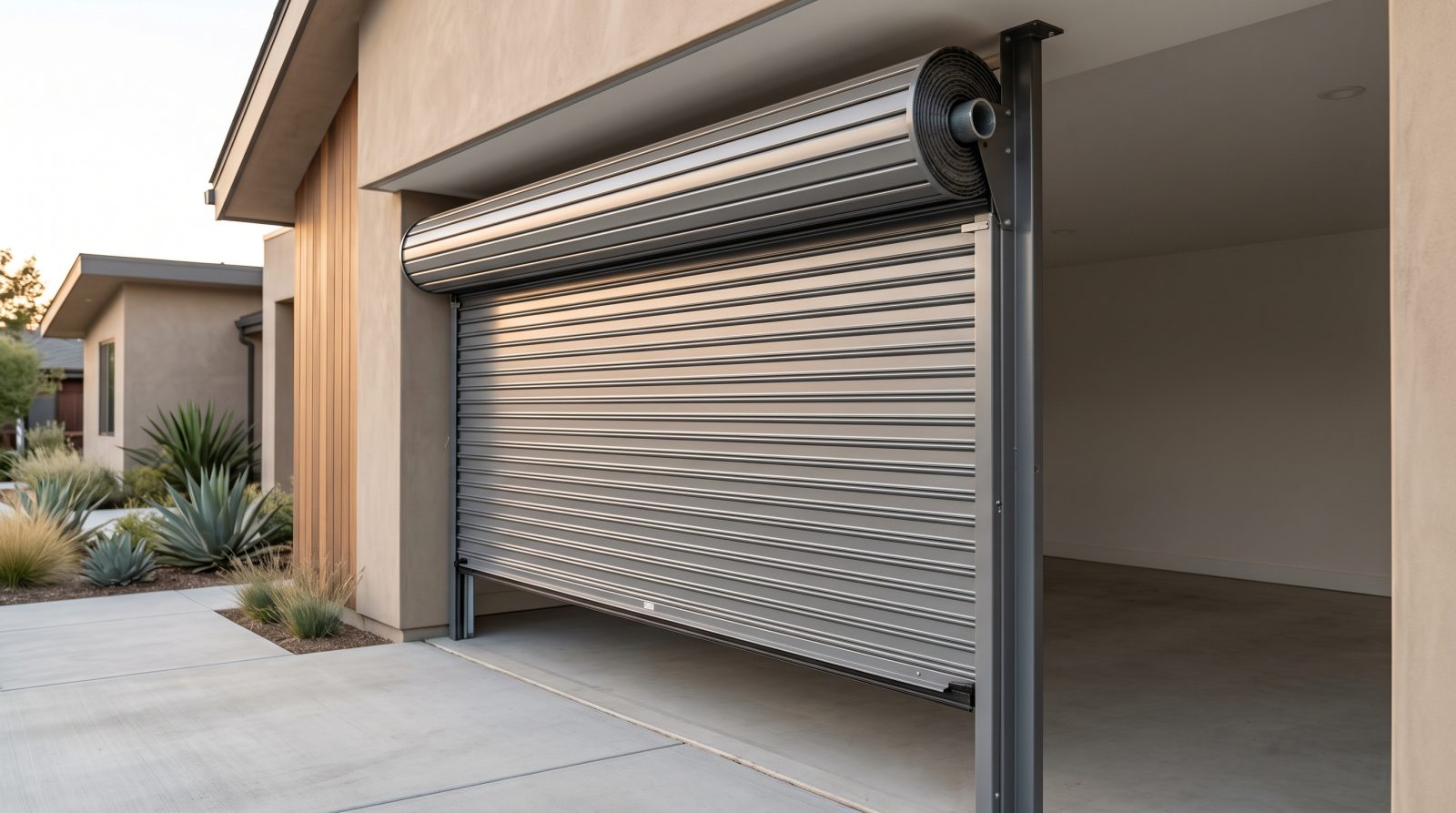
The term "roll-up" gets used loosely, and that ambiguity leads to a lot of mismatched quotes. In the strictest sense, a true roll-up door is a coiling door: a continuous curtain of interlocking metal slats that rolls up around a barrel mounted directly above the opening. There are no horizontal tracks running back across your ceiling. This is the door you see on warehouses, loading docks, self-storage units, fire stations, and retail roll-down storefronts. Because the entire door coils into a tight drum, it needs almost no back-room (the depth behind the opening) and very little headroom, which is its single biggest advantage.
The second product people call "roll-up" is a residential sectional door, which is built from several horizontal panels (sections) hinged together. It rolls up in the sense that the panels follow a curved track and end up parallel to the ceiling. This is the most common home garage door in North America. It looks like a series of stacked panels, often with windows along the top row. When a homeowner says they want a "roll-up door," they usually mean a sectional; when a property manager or contractor says it, they often mean a true coiling door. Confirming which one you need is the first and most important step, because the framing, hardware, motor, and price are all different.
For this guide we'll address both, because the replacement decision often comes down to your building: commercial spaces, compact urban garages, and low-headroom structures lean toward true coiling doors, while most attached residential garages are best served by an insulated sectional. The good news is that whichever path fits your opening, the same buying principles apply: match the door to the climate, the use pattern, and the look you want to live with.
Where Roll-Up (Coiling) Doors Win: Commercial Spaces and Compact Homes
True coiling roll-up doors earn their keep wherever space, durability, and security are at a premium. In commercial settings such as warehouses, auto shops, storage facilities, and storefronts, they cycle thousands of times, resist forced entry, and recover from minor impacts better than panel doors. Their slat construction means a dent or scrape usually affects one slat rather than an entire section, and damaged slats can often be replaced individually rather than swapping a whole door.
For homeowners, the compelling case is space. If your garage has very low headroom, an obstruction above the opening, a finished ceiling you don't want to lose, or storage you want to keep overhead, a coiling door's tight drum can be the only thing that fits. They're also a natural choice for detached garages, workshops, carriage houses converted to garages, and alley-loaded urban lots where every inch counts. In hot or coastal regions, aluminum coiling doors resist corrosion well, while in colder climates an insulated coiling door (or an insulated sectional) becomes important for comfort and energy use.
The trade-offs are real and worth weighing before you buy. Standard commercial-style coiling doors are typically less insulated and have a more industrial, ribbed appearance than the deep-panel sectionals most neighborhoods expect, so they can affect curb appeal on a street of traditional homes. They can also run louder than a well-built insulated sectional. For a home, the right move is usually to choose a coiling door only when headroom or space genuinely demands it, and then to prioritize an insulated model and a finish that complements the house.
- Best for: warehouses, storage units, auto shops, storefronts, detached garages, workshops, and any opening with limited headroom or back-room
- Strengths: minimal ceiling clearance needed, strong forced-entry resistance, individual slats replaceable, durable under heavy cycling
- Watch-outs: more industrial appearance, often less insulation than premium sectionals, can be noisier; verify wind-load needs in hurricane-prone regions
- Climate note: aluminum resists coastal corrosion; insulated versions matter most in very hot or very cold areas
Materials, Gauges, and Insulation: What Actually Drives Quality and Price
With roll-up doors, the material and the steel gauge do more to determine longevity and price than almost anything else. Galvanized steel is the workhorse for both coiling and sectional doors, offering strength and good value; lower gauge numbers mean thicker, more rigid steel, so a heavier-gauge curtain or panel resists denting and warping better over time. Aluminum is lighter and naturally corrosion-resistant, making it popular for coastal properties and high-cycle commercial openings, though it dents more easily than steel. Stainless steel and specialty finishes exist for demanding commercial or coastal environments at a premium. On the residential side, you'll also see steel sectional doors with composite overlays, faux-wood finishes, and full glass-and-aluminum modern designs.
Insulation is where many buyers under-spec and later regret it, especially for attached garages or any space used as a gym, shop, or living area. Insulation is rated by R-value, with higher numbers meaning better thermal performance. Single-layer doors have no insulation; double-layer doors add a polystyrene or polyurethane board; and premium triple-layer doors sandwich polyurethane foam between two steel skins for the best R-value, the most rigidity, and meaningfully quieter operation. Polyurethane outperforms polystyrene at the same thickness. In hot southern and southwestern climates, insulation curbs solar heat gain and keeps adjacent rooms livable; in northern and mountain climates, it protects against freezing pipes and reduces heating loss. Even in mild regions, an insulated door noticeably cuts road and operating noise.
A few other specs quietly shape the result. Weatherseals along the bottom, sides, and top keep out drafts, dust, water, and pests, and they degrade over time, so a replacement is a good moment to upgrade them. Hardware grade matters: heavier doors need correctly rated springs (torsion springs generally last longer and operate more smoothly than extension springs) and quality rollers and tracks. Finish quality, baked-on paint versus a basic coat, affects how the door ages against UV and weather. When you compare quotes, you're really comparing material, gauge, insulation layers and R-value, weatherseal, and hardware, not just the headline price.
- Steel gauge: lower number = thicker, stronger, more dent-resistant; ask for the gauge in writing
- Aluminum: lighter and corrosion-resistant (good coastal/commercial), but dents more readily than steel
- Insulation tiers: single-layer (none) to double-layer (polystyrene/polyurethane board) to triple-layer (foam-in-place polyurethane, best R-value and quietest)
- Polyurethane beats polystyrene at equal thickness; higher R-value means better comfort and lower noise
- Don't overlook: weatherseals, spring type (torsion vs. extension), roller and track quality, and baked-on finish
Sizing, Headroom, and the Installation Process
Getting the measurements right is what separates a smooth replacement from a frustrating one. The opening width and height are only the starting point. Installers also need the headroom (clear space between the top of the opening and the ceiling or any obstruction), the back-room (how far the door travels into the garage), and the side-room (clearance on the left and right for tracks and the motor). True coiling doors shine precisely because they need very little headroom and back-room, while sectional doors require more of both, plus extra headroom if you add a higher-lift track or a side-mount opener. If your space is tight, measuring these clearances first tells you which door types are even feasible.
Single-car openings, double-car openings, and oversized RV or commercial bays each call for different door weights, hardware, and often motor strength, so the size of your opening influences the whole package, not just the door. Existing framing condition matters too: rotted jambs, an out-of-square opening, or undersized headers may need attention before a new door goes in, and a good installer will flag this rather than force a door onto a compromised opening.
The installation itself follows a predictable sequence. The crew removes the old door and hardware, inspects and prepares the opening and framing, mounts the new tracks or barrel and the door curtain or panels, installs and tensions the springs, fits the weatherseals, and finally sets up and tests the opener and safety reversing sensors. A typical residential replacement is often completed in a few hours, though commercial coiling doors, structural repairs, custom sizes, or complex openers can extend the timeline. Spring tensioning in particular is genuinely dangerous and is the part of the job you should leave to a trained installer rather than attempt yourself.
- Measure five things, not two: width, height, headroom, back-room, and side-room
- Coiling doors need minimal headroom and back-room; sectionals need more, especially with high-lift or side-mount openers
- Match hardware and motor strength to the opening size (single, double, or oversized/commercial bay)
- Address framing first: rot, out-of-square openings, or weak headers should be fixed before install
- Leave spring tensioning to a professional; it is the most hazardous step in the job
Cost Ranges, Curb Appeal, and Home Value
Pricing varies widely, so treat any number as a typical industry estimate that shifts with door type, material, gauge, insulation, size, finish, opener, and your region, not a fixed quote. As a broad guide, a basic single-car steel roll-up or sectional door installed often falls in the low-to-mid four figures, while insulated, double-car, custom-size, premium-finish, or commercial coiling doors can run several thousand dollars or more once you factor in hardware, an opener, and labor. Commercial coiling doors, wind-rated doors for hurricane regions, and oversized openings sit at the higher end. Add-ons like a new high-torque opener, smart controls, decorative windows, or upgraded weatherseals raise the total. Labor rates and permit requirements also differ from market to market, which is why a precise figure requires an on-site look at your specific opening.
For homes, the curb-appeal stakes are high because the garage door is frequently the largest single design element on the front of a house. On a traditional street, a deep-panel insulated sectional with tasteful windows or a carriage-house look usually reads better than an industrial coiling door, so reserve coiling doors for situations where space truly requires them or for modern and detached structures where the clean, ribbed look fits. Color and finish should complement the home's trim and front door; a coordinated palette makes the whole facade look considered. Hardware accents and window placement can elevate an otherwise plain door without a large cost increase.
On value, a new garage door is consistently one of the better-returning exterior upgrades because it combines visual impact with practical function, security, insulation, and quieter, more reliable operation. Buyers notice a fresh, well-fitting door and read it as a sign the home is cared for. The smart approach is to balance budget against the features that pay you back daily: insulation suited to your climate, a quiet and dependable opener, and a finish you'll be happy to look at for years. When you're ready, request a free quote so a professional can measure your opening, confirm the right door type, and give you an accurate, itemized estimate.
- Costs are typical estimates only and vary by type, material, gauge, insulation, size, finish, opener, and region
- Higher-end drivers: insulation, double-car or oversized openings, custom sizes, premium finishes, wind-rated and commercial coiling doors
- Curb appeal: favor insulated sectionals on traditional streets; reserve industrial coiling looks for modern or detached structures
- A new garage door is one of the stronger-returning exterior improvements for resale and daily livability
- Get an on-site, itemized quote for an accurate price, then prioritize climate-right insulation, a quiet opener, and a finish you'll love