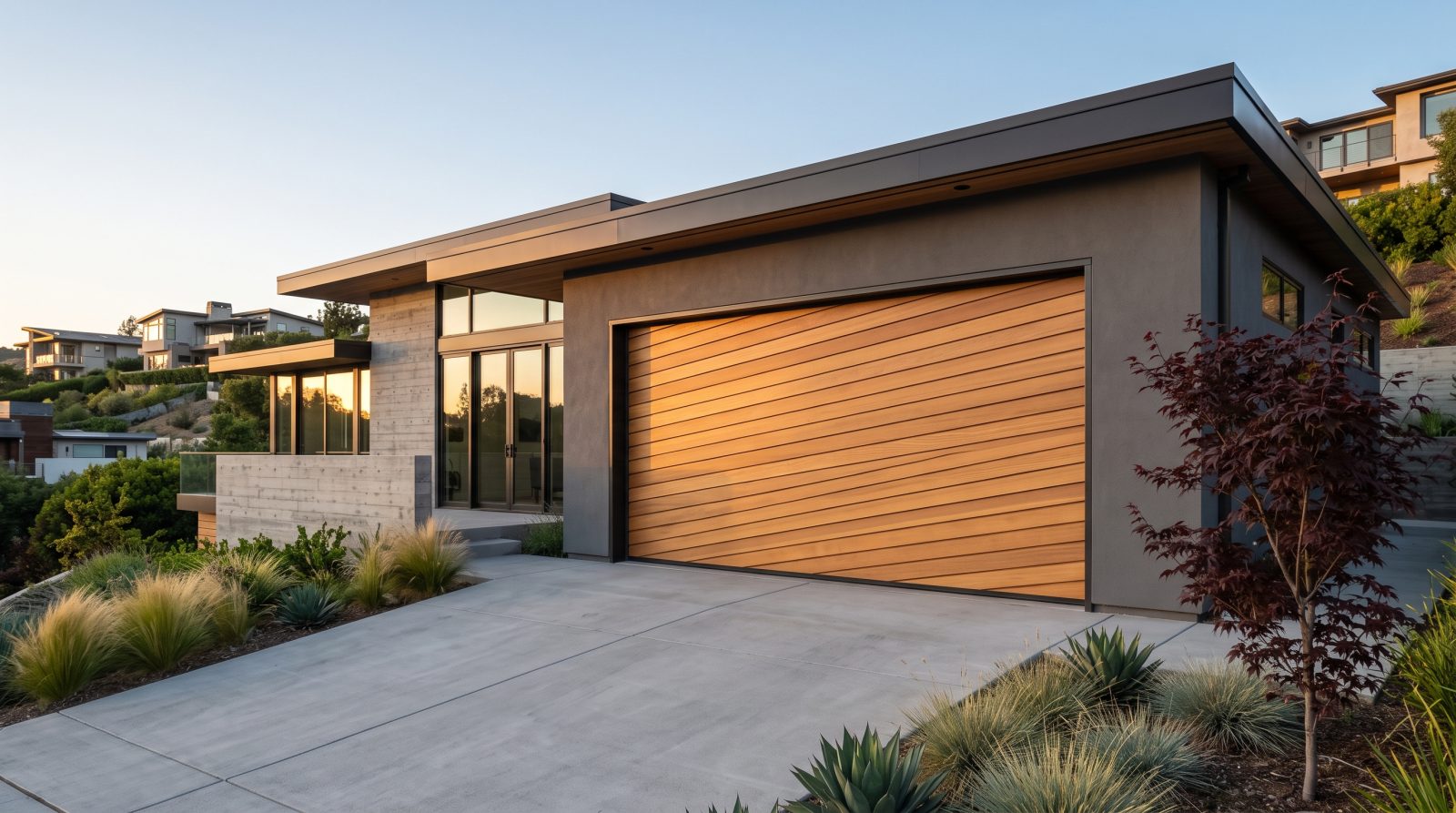
What Makes a Garage Door 'Modern'
The modern garage door aesthetic is defined less by a single product and more by a set of design principles borrowed from contemporary architecture: clean geometry, restrained ornamentation, and an honest use of materials. Where a traditional door leans on raised panels, decorative hardware, and arched window inserts to signal warmth, a modern door leans on flush surfaces, repeating horizontal lines, large uninterrupted planes of glass or metal, and a tightly controlled color palette. The goal is for the door to feel like a deliberate part of the building's design rather than a functional afterthought bolted onto the front.
There is a meaningful difference between 'modern' and 'contemporary' even though the terms are used interchangeably in most showrooms. Strictly speaking, modern references the mid-century design movement with its emphasis on simplicity and function, while contemporary describes whatever is current and stylish right now. In practice, the doors marketed under both labels share the same visual DNA, so you don't need to agonize over the distinction. What matters is choosing lines, finishes, and proportions that complement your home's architecture rather than fighting it.
A door that suits a flat-roofed, glass-forward modern home will often look out of place on a traditional Colonial or Craftsman, and vice versa. The most successful modern garage doors echo something already present in the house, the window mullion pattern, the siding orientation, the entry door material, so the eye reads the facade as a coherent whole.
- Clean horizontal lines and flush or lightly grooved panels instead of raised, decorative panels
- Large planes of frosted, tinted, or clear glass framed in slim aluminum
- A restrained palette: matte black, charcoal, bronze, warm white, or realistic woodgrain
- Minimal or hidden hardware rather than ornamental hinges and handles
- Proportions and materials chosen to echo the home's windows, siding, or entry door
Contemporary Styles and Finishes That Define the Look
Within the modern category there are a handful of distinct looks, and understanding them makes shopping far easier. Full-view aluminum-and-glass doors are the most dramatic: a slim aluminum grid frames panels of glass that can be clear, frosted, tinted, or textured, flooding the garage with daylight and giving the facade a showroom-clean appearance. These are popular for contemporary new builds, but they are the least insulating choice and typically the most expensive, so they make the most sense in mild climates or for garages used as studios, gyms, or living space.
Flush and modern grooved steel or aluminum doors deliver the contemporary look at a more accessible price. A flush door presents a smooth, almost monolithic surface, while grooved or 'modern raised' designs add subtle horizontal reveals for shadow lines and depth without the ornamentation of a traditional panel. Both pair beautifully with matte finishes and a few rows of frosted glass at eye level. Faux-woodgrain finishes deserve special mention: modern composite and coated-steel doors now reproduce species like walnut, oak, and dark-stained cedar convincingly, giving you the warmth of wood with far less maintenance than real timber, which can crack, fade, and warp outdoors.
Finish is where a modern door earns or loses its premium feel. The strongest factory finishes are baked-on powder coats and multi-layer painted systems that resist chalking and fading, and anodized aluminum for full-view frames. Matte and satin sheens currently dominate the modern look because they hide minor imperfections and read as more architectural than high gloss. Whatever finish you choose, ask whether it is a true factory finish with a finish-specific warranty, because field-painted doors rarely hold up the same way over years of sun exposure.
- Full-view glass and aluminum: maximum daylight and wow factor, lowest insulation, highest cost
- Flush steel or aluminum: smooth, monolithic, contemporary, and budget-friendly
- Modern grooved or 'modern raised': subtle horizontal reveals for depth without ornamentation
- Faux-woodgrain composite and coated steel: the warmth of wood with far less upkeep
- Glass options: clear for openness, frosted or tinted for privacy and glare control
- Finish matters: prioritize baked-on powder coat, multi-layer paint, or anodized aluminum
Materials, Insulation, and Climate Considerations
Material choice drives nearly everything about a modern door: its look, its weight, its insulation, its maintenance, and a large share of its cost. Steel is the workhorse of the category, offering strength, dent resistance in heavier gauges, low maintenance, and the widest range of modern finishes and woodgrain looks at the best value. Aluminum is lighter and naturally rust-resistant, which is why it dominates full-view glass designs and is favored in coastal regions where salt air attacks steel, though thinner aluminum can dent more easily. Real wood delivers unmatched authenticity and is the choice for high-end modern homes that want genuine timber, but it demands ongoing refinishing and responds to humidity swings. Glass with composite or aluminum framing rounds out the premium end.
Insulation is the single most overlooked decision when people shop on looks alone. Modern doors are commonly available as single-layer (no insulation), double-layer (a polystyrene core), or triple-layer (polyurethane sandwiched between steel skins). Insulation is rated by R-value, and a higher number means better resistance to heat transfer. For an attached garage, a garage you heat or cool, or any space connected to living areas, a higher R-value door pays off in comfort and energy efficiency and also runs noticeably quieter. A triple-layer polyurethane door is also stiffer and more dent-resistant than a hollow single-layer door of the same style.
Climate should weigh heavily on the final call, and this is where a national perspective matters because the right door in a hot, sunny region is not the right door in a cold-winter one. In hot, sunny regions, lighter colors and reflective or low-e glass help keep the garage cooler and reduce finish fade, and full-view glass is more comfortable than in cold zones. In cold-winter climates, a well-insulated triple-layer door with good weather sealing is worth the upgrade for both comfort and energy savings, and you'll want to confirm the glass is insulated. Along the coasts, prioritize aluminum, stainless or marine-grade hardware, and finishes rated for salt exposure. In hurricane-prone and high-wind areas, look for doors that are engineered and rated to wind-load standards, since the garage door is often the largest opening on the house and a common failure point in a storm.
- Steel: best value, strong, low maintenance, widest range of modern finishes and woodgrains
- Aluminum: lightweight and rust-resistant, ideal for full-view glass and coastal homes
- Real wood: authentic and premium, but requires ongoing refinishing and reacts to humidity
- Insulation tiers: single-layer (none), double-layer (polystyrene), triple-layer (polyurethane)
- Higher R-value means better energy efficiency, quieter operation, and a stiffer, tougher door
- Hot climates: lighter colors and low-e glass; cold climates: triple-layer insulation and sealing
- Coastal: aluminum and corrosion-resistant hardware; high-wind: wind-load-rated doors
The Replacement Process and What to Expect
Replacing a garage door with a modern model is a well-defined process, and knowing the steps helps you ask the right questions and avoid surprises. It typically begins with a measurement and assessment: a technician confirms the rough opening width and height, headroom and side-room clearance, and the condition of the existing framing and opener. Modern full-view and heavier insulated doors sometimes require checking that the springs and opener are matched to the new door's weight, since a heavier door needs the correct spring system to operate safely and smoothly.
Once you've selected the style, material, insulation level, glass, and finish, the door is ordered to your opening's specifications. Lead times vary widely depending on whether the door is a stock size and finish or a custom configuration, with custom full-view and specialty finishes generally taking longer to arrive. On installation day, the crew removes the old door and tracks, inspects and prepares the opening, installs the new tracks, sections, springs, and hardware, mounts or reconnects the opener, and adjusts the spring tension and travel limits so the door balances and seals correctly. Spring systems store significant energy and are a genuine safety hazard, which is why this is work for a trained professional rather than a DIY project.
A quality installation finishes with a safety and function check: the auto-reverse safety feature is tested, the photo-eye sensors are aligned, the door is checked for level operation and a proper weather seal, and you're walked through the opener and any smart features. A correctly installed and balanced modern door should glide quietly, sit flush and sealed when closed, and reverse if it meets an obstruction.
- Step 1: Measure the opening and assess headroom, side room, framing, springs, and opener
- Step 2: Confirm the springs and opener are matched to the new door's weight
- Step 3: Order the door to spec; expect longer lead times for custom finishes and full-view glass
- Step 4: Professional removal, installation, spring tensioning, and opener setup
- Step 5: Safety check of auto-reverse, photo-eye sensors, balance, and weather seal
- Spring work is high-energy and hazardous; leave installation to trained professionals
Cost, Curb Appeal, and Home Value
Modern garage doors span a wide price range, and being clear about the variables helps you budget realistically. The figures below are typical industry ranges and estimates only; your actual price varies with the door size, material, insulation level, glass and finish choices, your region, and the complexity of the installation, so treat any number you see online as a starting point rather than a quote. As a rough guide, a basic single-car modern steel door installed commonly falls in the lower thousands, a well-insulated double-car steel or composite door with some glass typically lands in the mid-thousands, and premium full-view aluminum-and-glass or genuine wood doors, especially in custom sizes, can run substantially higher. Add-ons like a new opener, smart controls, additional insulation, custom color matching, and decorative or oversized glass all move the figure up.
It helps to think in terms of value rather than price alone. The garage door is one of the most visible elements of a home's exterior, and replacing a tired door with a clean modern design is consistently cited as one of the home-improvement projects with the strongest return on curb appeal relative to its cost. For homeowners planning to sell, an updated door makes the listing photos and the in-person first impression noticeably stronger; for those staying put, the daily upgrade in how the home looks and how comfortable an insulated garage feels is real and immediate.
When you compare quotes, look past the sticker number to what's actually included: the door's construction and gauge, the insulation R-value, the quality and warranty of the finish, the spring system and hardware, whether a new opener or smart features are part of the package, and the warranty on both the product and the labor. The cheapest bid is rarely the best value if it pairs a thin single-layer door with a short warranty, and a slightly higher bid that includes better insulation, a stronger finish, and a longer labor warranty often costs less over the life of the door. When you're ready to compare options for your home and opening, request a free quote and have the specifics priced for your exact configuration.
- All prices are typical industry estimates that vary by size, material, insulation, glass, and region
- Basic single-car modern steel doors generally sit at the lower end of the range
- Insulated double-car steel or composite doors with glass typically land mid-range
- Premium full-view aluminum-glass and genuine wood doors, especially custom, run highest
- A new modern door is frequently ranked among the best projects for curb-appeal return
- Compare what's included, construction, R-value, finish, hardware, opener, and warranties, not just the price