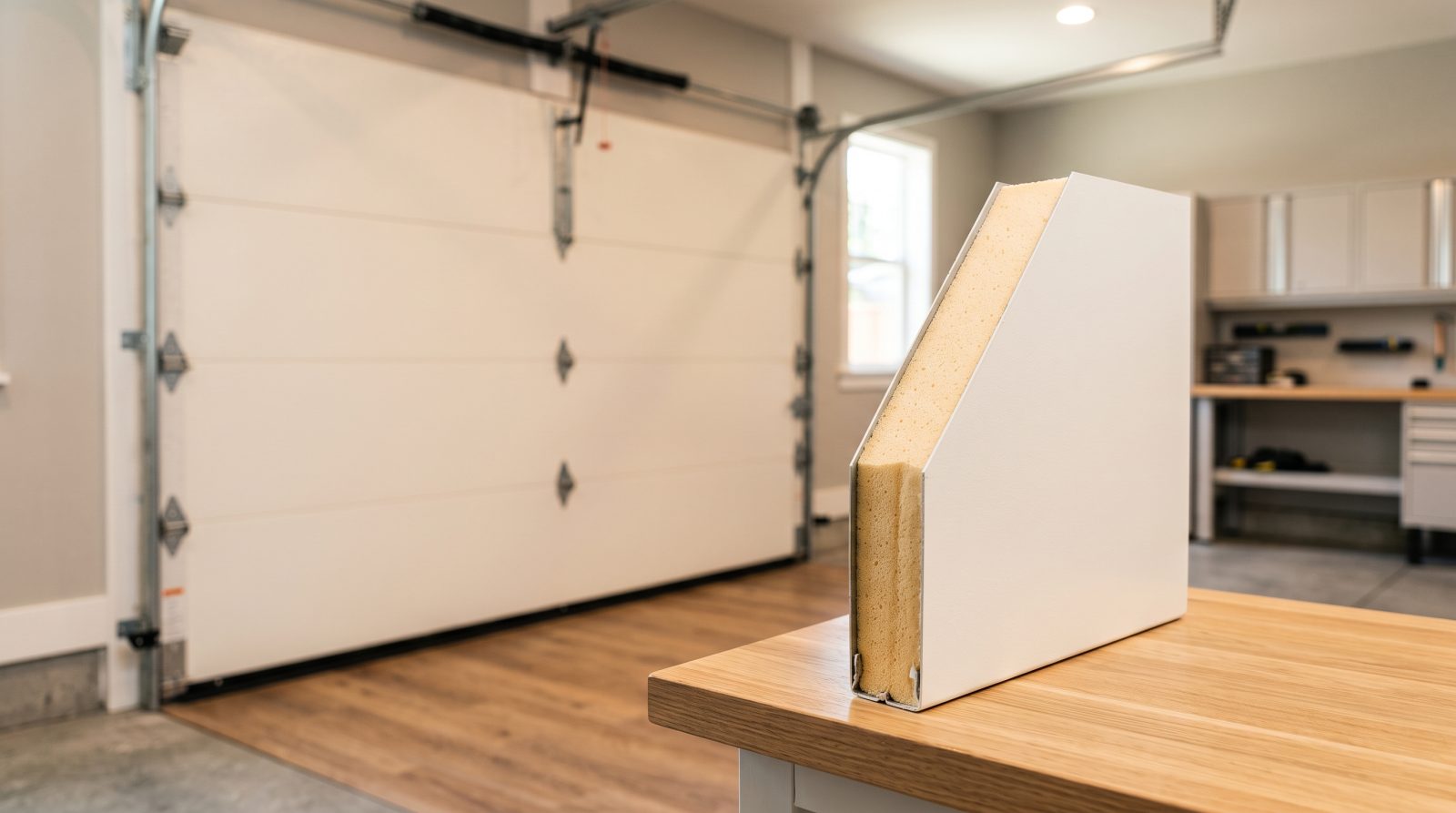
What R-Value Really Means on a Garage Door
R-value measures resistance to heat flow: the higher the number, the more slowly heat passes through the material. On garage doors you'll see ratings that commonly range from roughly R-6 on a basic insulated steel door up to the high R-teens and into the low R-20s on premium polyurethane doors. More is generally better for temperature control, but the number alone can mislead you, so it pays to read it critically rather than chase the biggest figure on the sticker.
The most important caveat is the difference between center-of-panel R-value and whole-door R-value. Many manufacturers quote the insulation value at the thickest middle of a section, ignoring the thinner rails, the joints between panels, and the perimeter where most air actually leaks. A door advertised at R-18 in the center may perform closer to the low double digits as an installed assembly. When comparing doors, ask whether the rating is center-of-section or calculated for the full door, and pay just as much attention to weatherseals and how tightly the door fits its opening.
Finally, R-value only describes conduction. Real-world garage comfort also depends on air sealing (bottom astragal, jamb seals, and a top seal), thermal bridging through the steel skins, and whether the garage itself is finished and the ceiling insulated. A well-sealed R-12 door in a tight, drywalled garage can easily outperform a poorly sealed R-18 door in a bare one.
- R-6 to R-10: entry-level insulated steel; meaningful upgrade over a non-insulated door for detached or lightly used garages
- R-12 to R-16: solid mid-range, a sensible target for most attached garages in mixed climates
- R-17 and up: premium polyurethane construction for attached garages, living space above, workshops, or extreme climates
- Always confirm whether a quoted R-value is center-of-panel or whole-door before comparing models
How Insulated Doors Are Built: Layers and Core Material
Garage door construction is the single biggest driver of real insulation performance, durability, and noise control, and it is where the price differences come from. Doors are typically described as single-layer, double-layer, or triple-layer, and the insulating core is either expanded polystyrene (EPS) board or injected polyurethane foam. Understanding these two variables tells you most of what you need to know about how a door will actually perform.
Single-layer doors are a single skin of steel (or aluminum, wood, or composite) with no insulation; they are the least expensive and the least comfortable, and they dent and transmit sound easily. Double-layer doors add a layer of EPS insulation backed by a vinyl or thin liner, raising the R-value and stiffening the panel. Triple-layer doors sandwich the core between two steel skins for the best rigidity, the quietest operation, and a finished interior face, which matters if your garage doubles as a gym, office, or workshop.
The core matters as much as the layer count. EPS is a rigid foam board cut to fit inside the panel, so it leaves small gaps and a lower density. Polyurethane is injected as a liquid that expands to fill every cavity and bonds to both steel skins, which produces a higher R-value per inch, a much stronger and quieter door, and better resistance to dents and wind. For an attached garage or living space above, a steel-on-steel triple-layer door with a polyurethane core is the configuration most professionals point to as the long-term value choice.
- Single-layer: no insulation; lowest cost; dents and transmits noise readily; best only for detached, low-use garages
- Double-layer (EPS): insulation plus a back liner; good mid-range comfort and stiffness at a moderate price
- Triple-layer (steel/polyurethane/steel): highest R-value, quietest, strongest, with a finished interior face
- Polyurethane cores outperform EPS board for the same thickness and bond the panel into a more rigid, dent-resistant unit
When Insulation Is Worth It (and When It Isn't)
The honest answer is that insulation is not equally valuable for every home, and matching the door to how you actually use the garage prevents both overspending and underbuilding. The two questions that matter most are whether the garage is attached to or under living space, and how you use the room.
If your garage is attached, shares a wall with a finished room, or sits beneath a bedroom or bonus room, an insulated door is one of the most cost-effective comfort upgrades available because it directly affects the temperature of the adjoining living space and reduces the load on your heating and cooling. The same is true if you spend real time in the garage as a workshop, home gym, laundry area, or hobby space. In those cases stepping up to a higher R-value and a triple-layer construction is usually money well spent.
If your garage is fully detached, uninhabited, and you only use it to park, the case is weaker and a basic insulated or even non-insulated door may be perfectly reasonable, though insulation still adds panel rigidity and quieter operation. Climate sharpens the decision in both directions: in cold northern winters and hot southern or southwestern summers, insulation delivers tangible comfort and energy benefits year-round, while in mild coastal regions the comfort gain is smaller and noise reduction or dent resistance may be the bigger reason to upgrade. Be realistic, too, that a single insulated door is only one part of the envelope; without an insulated, sealed garage you should expect a more modest temperature improvement rather than a fully conditioned room.
- Strong case: attached garages, rooms or bedrooms above the garage, and garages used as workshops, gyms, or offices
- Climate-driven: high value in cold-winter and hot-summer regions; comfort gains are smaller in mild coastal climates
- Weaker case: fully detached, park-only garages, where basic insulation or even a non-insulated door may suffice
- Remember the whole envelope: insulating the walls and ceiling and sealing the door multiplies the benefit of an insulated door
Beyond Energy: The Hidden Benefits of an Insulated Door
Buyers usually shop insulated doors for energy savings, but in practice the day-to-day benefits people notice most are comfort, quiet, and durability. Because an insulated door buffers the garage against outdoor swings, the space stays meaningfully cooler in summer and warmer in winter, which protects anything you store there and makes the room usable in shoulder seasons without running a heater or fan constantly.
Noise is the benefit homeowners are most often surprised by. The added mass and the bonded core of a double- or triple-layer door dampen both the rumble of the door cycling open and closed and the intrusion of street noise, which matters a great deal when there is a bedroom above the garage. A polyurethane-core door also operates more smoothly and quietly on the opener because the panel is stiffer and flexes less.
Durability is the long-game payoff. Multi-layer construction resists the dents, dings, and wind flex that plague single-skin doors, so the door looks better longer and is less likely to bind or rack. From a resale standpoint, an attractive, modern insulated door is a consistently strong return-on-investment upgrade for curb appeal because it occupies a large, highly visible share of most home facades, which is one more reason a door replacement is rarely just about the energy bill.
- Comfort: steadier garage temperatures that buffer adjoining rooms and protect stored items
- Quiet: noticeably less operating noise and street noise, important for living space above the garage
- Durability: better resistance to dents, wind flex, and racking over the door's lifespan
- Curb appeal and resale: a large, visible upgrade that reliably improves how the home presents
Typical Cost Ranges and What Drives the Price
Pricing for an insulated garage door varies widely, and the figures below are typical industry ranges meant for planning only, not a quote; your actual price depends on door size, material, construction, window and hardware options, and your region's labor rates and removal needs. As a general planning guide, an installed insulated steel double-layer door for a standard double-car opening commonly falls in the low-to-mid four figures, while premium triple-layer polyurethane doors, carriage-house styles, full-view aluminum-and-glass, or solid wood can run substantially higher. Single-car doors cost less than double-car doors, and custom sizes, decorative windows, and upgraded finishes all add to the total.
Several factors move the number. Construction and R-value are the biggest: each step up from single to double to triple layer, and from EPS to polyurethane, adds cost and performance. Material matters too: steel offers the best value, composite and faux-wood split the difference on looks and maintenance, and real wood and full-view glass sit at the top of the range. Don't forget the parts you can't see, removal and disposal of the old door, new tracks and rollers, weatherseals, and a properly matched spring system all factor into a complete installation, and a correctly sized spring is essential when a heavier insulated door replaces a light single-layer one.
When you weigh cost, look at total value rather than sticker price alone. A better-built insulated door reduces energy use in the adjoining space, lasts longer, operates more quietly, and supports curb appeal and resale, so the gap between a budget door and a quality one often narrows considerably over the years you'll own it. The smartest approach is to get an itemized, written estimate that lists the door's construction, whole-door performance, included seals and hardware, and the spring system, so you're comparing complete installations rather than headline prices. To get accurate numbers for your home and opening, you can request a free quote and have the options scoped to your exact garage.
- Costs shown are typical industry estimates that vary by size, material, construction, options, region, and scope, not a fixed quote
- Biggest price drivers: layer count, core material (EPS vs. polyurethane), and overall R-value
- Material ladder: steel offers best value; composite and faux-wood mid-range; real wood and full-view glass at the top
- A complete install includes old-door removal, tracks, rollers, weatherseals, and a correctly matched spring for the heavier door