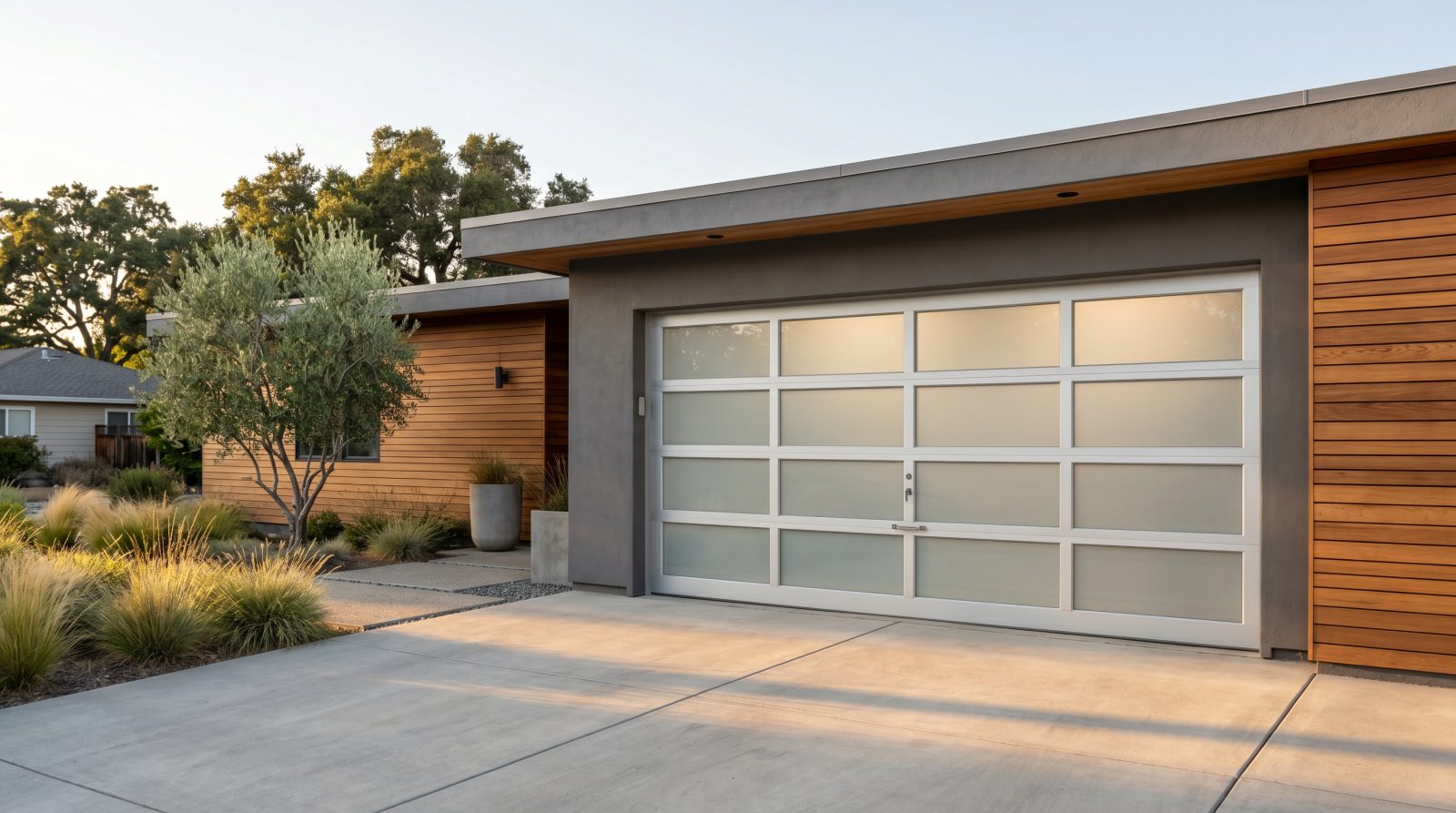
Why aluminum and glass for a modern home
Aluminum-and-glass doors (often sold as "full-view" or "contemporary" doors) are built around a slim aluminum frame that holds large panes instead of solid panels. That construction is what gives them their signature look: lots of daylight, a low-profile frame, and clean horizontal lines that suit mid-century, modern farmhouse, and minimalist architecture. For a home where the garage faces the street, the door is often the single largest design element on the facade, so the style payoff is significant.
Aluminum is also corrosion-resistant and light, which matters mechanically. Compared with a heavy insulated steel sectional door, an aluminum frame puts less strain on springs and openers over time. The flip side is that aluminum is a soft, dent-prone metal and a poor insulator on its own, so the frame design and the glass you choose do a lot of the heavy lifting on durability and energy performance.
If your goal is a door that looks intentional and architectural rather than utilitarian, aluminum and glass is the category that most directly delivers that. The decisions that follow are mostly about tuning it for your climate, your privacy needs, and your budget.
Choosing your glass: light, privacy, and performance
The glass is where most of the design and performance decisions actually happen, and it is worth slowing down here. Clear glass maximizes daylight and shows off a clean garage interior, but it offers no privacy and the most heat gain. Frosted and obscure glass diffuse light while hiding the inside of the garage, which is the most popular middle ground for street-facing doors. Tinted (gray or bronze) glass cuts glare and heat and reads as sleeker and more modern. Mirrored or reflective glass gives daytime privacy and a striking facade but can look dark from inside.
Beyond appearance, glass type drives safety and energy. For a door this size, ask specifically about tempered or laminated safety glass rather than standard annealed glass, because large panes near an operating door are an impact and breakage concern. If comfort or an attached/heated garage matters, dual-pane (insulated) glass dramatically outperforms single-pane and is worth the upcharge in both hot and cold climates.
Acrylic and polycarbonate panels are lighter, far more shatter-resistant, and less expensive than real glass, which is why they are common on entry-level full-view doors. The trade-off is that plastics can scratch, haze, or yellow with years of UV exposure, so they are a reasonable choice for a budget or a low-sun elevation but less ideal for a south-facing door in a high-UV region.
- Clear: maximum light, zero privacy, highest heat gain
- Frosted/obscure: diffused light with privacy — the popular default
- Tinted (bronze/gray): cuts glare and heat, modern look
- Reflective/mirrored: daytime privacy and bold facade
- Insulated dual-pane: best comfort for attached or conditioned garages
- Tempered or laminated: ask for safety glass on large panes
The insulation reality (and how to spec around it)
This is the honest weak point of the category, and addressing it directly is part of buying well. An aluminum frame conducts heat readily and a single sheet of glass insulates poorly, so a basic full-view door has a low effective R-value compared with a foam-filled steel door. If your garage is detached, unconditioned, and you simply want light and curb appeal, that may not matter at all. If your garage is attached to living space, doubles as a gym or workshop, or sits in a region with hard winters or brutal summers, insulation should shape your spec.
You have several levers. Insulated (dual-pane) glass is the biggest one and noticeably reduces heat transfer. Thermally broken aluminum frames — where a non-conductive barrier separates the inside and outside of the frame — cut the metal's heat conduction and reduce condensation, which is especially valuable in cold and humid climates. Tinted or low-E coatings reduce solar heat gain in hot, sunny regions. You can also weatherstrip thoroughly along the bottom, sides, and between sections to limit drafts.
Set expectations realistically: even a well-specced aluminum and glass door will generally not match the raw insulating value of a premium insulated steel door. The right move is to match the spec to the job — go basic for a detached garage, and invest in insulated glass plus a thermally broken frame when the space is conditioned or the climate is extreme.
Durability, maintenance, and climate fit
Aluminum will not rust, which makes these doors a strong fit for coastal and high-humidity regions where steel can corrode at cut edges and fasteners — though salt air can still pit lower-grade finishes, so a quality anodized or powder-coated finish matters near the ocean. The vulnerability to watch is denting and bending; the soft frame and large glass area mean a stray basketball or a backed-into bumper does more visible damage than it would to a heavier door, so households with active kids or tight driveways should weigh that.
Maintenance is mostly about the glass and the finish. Large panes show water spots, dust, and fingerprints more than solid panels, so plan on routine cleaning to keep the door looking sharp. Anodized and powder-coated frames hold color well and resist fading, but in very high-UV regions you'll want to confirm a UV-stable finish. The moving hardware — rollers, hinges, springs, and the opener — needs the same periodic lubrication and inspection as any sectional door.
Climate should steer your finish and glass choices truthfully. In hot, sunny areas, lean toward tinted or low-E glass and lighter frame colors to manage heat and glare. In cold or coastal areas, prioritize a thermally broken, well-finished frame and insulated glass. In wildfire-prone or high-wind regions, ask about impact and wind-load ratings, since a large glass door has different code and safety considerations than a solid one.
Cost ranges and the installation process
Aluminum and glass doors typically sit at the higher end of the residential door market, and the spread is wide because glass and frame choices move the number a lot. As a general industry estimate that varies by size, glass type, frame quality, finish, region, and labor, a basic single-car full-view door with acrylic or single-pane glass often falls in the lower thousands installed, while a large double-car door with insulated tempered glass, a thermally broken frame, and a custom finish can run several times that. Treat any figure here as a typical range, not a quote — your real price depends on your exact door and local labor rates, so it's worth getting an itemized estimate.
Replacement on an existing opening is usually a single-day job for a professional crew: the old door and tracks come down, the opening and floor level are checked, new tracks and the sectional door go in, springs are sized and tensioned to the door's weight, and the opener is reconnected and its force and safety reversal are tested. Because glass adds weight unevenly and spring tension is genuinely dangerous to set, this is a category where professional installation is strongly advised over DIY.
When you compare bids, look past the headline price. Confirm the glass type and safety rating, whether the glass is insulated, the frame finish and whether it's thermally broken, the warranty on both finish and hardware, and whether haul-away, new tracks, weatherstripping, and opener testing are included. A slightly higher bid that includes insulated safety glass and a quality finish is often the better long-term value than a stripped-down number.
- Cost drivers: glass type, frame quality/finish, size, insulation, region, labor
- Typical install: roughly a single day on an existing opening
- Spring tensioning and heavy glass make pro installation the safe choice
- Compare bids on glass safety rating, insulation, finish, and warranty — not just price
- Confirm haul-away, new tracks, weatherstripping, and opener testing are included
Curb appeal and home value
Because the garage door can occupy a large share of a home's street-facing surface, replacing a tired door is one of the more visible exterior upgrades you can make, and a modern aluminum-and-glass door reads as a deliberate design statement. For contemporary and transitional homes especially, it can pull the whole facade forward a couple of decades and is frequently the photo that makes a listing stand out.
Resale impact varies by market and buyer expectations, so it's fair to say a fresh, well-chosen door generally supports curb appeal and first impressions rather than to promise a fixed dollar return. The strongest results come from matching the door to the architecture: frame color that ties into windows or trim, glass opacity that suits how exposed the garage is to the street, and proportions that fit the opening.
If you're weighing this purely as an investment, remember that the same light and openness that buyers love also carries the insulation and privacy trade-offs covered above. The homes where aluminum and glass pays off best are modern-leaning, where the look is a genuine match — there, the door does double duty as both a functional replacement and a facade upgrade. Ready to compare options for your home? Request a free quote and get an itemized estimate for your exact opening, glass, and finish.