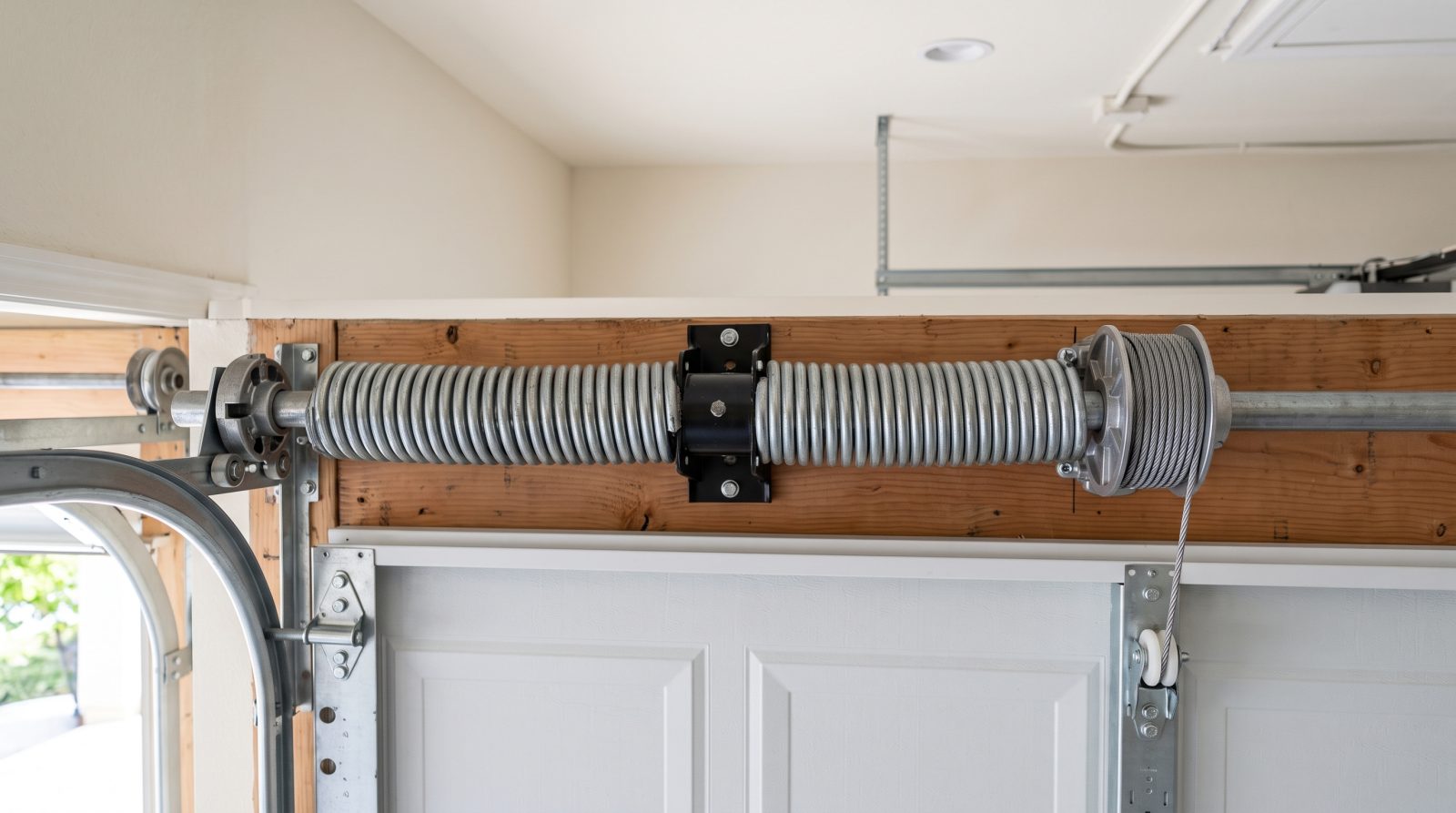
Torsion vs. Extension Springs: Know What You Have
Residential garage doors use one of two counterbalance systems, and the type you have changes everything about how the door is repaired, how dangerous it is to service, and what replacement parts cost. Identifying your system is the first step toward understanding any spring problem.
Torsion springs mount horizontally on a metal shaft above the door opening, usually centered or split into a pair on either side of a central bracket. When the door closes, the springs wind up and store energy; when it opens, they unwind to lift the door. Torsion systems are the modern standard on heavier and wider doors because they tend to offer smoother, more controlled, and more balanced operation, and they generally last longer.
Extension springs run horizontally along the upper tracks on each side of the door, stretching and contracting as the door moves. They are common on older homes and lighter single-car doors. Because they expand and snap back under load, a failing extension spring can become a projectile, which is why a safety cable threaded through the spring is essential and should never be missing.
Spring systems are not interchangeable in the way many homeowners assume. The correct spring must be matched to the door's exact weight, height, and the drum or pulley setup, which is why guesswork ordering from a big-box store so often leads to a door that is wildly out of balance.
- Torsion springs: mounted on a shaft above the door, wind and unwind, best for heavier and wider doors
- Extension springs: mounted along the side tracks, stretch and contract, common on lighter and older doors
- Safety cables are mandatory on extension springs to contain a broken spring
- The right spring is sized to your specific door weight and dimensions, not a one-size-fits-all part
Why Garage Door Springs Break
Spring failure is almost never random. It is the predictable end of a component engineered to a finite lifespan, accelerated by a handful of common factors. Understanding them helps you anticipate a break before it leaves you stranded with a door that will not move.
The biggest factor is simple cycle count. Springs are rated in cycles, where one cycle is a single open-and-close. A standard spring is commonly rated for around 10,000 cycles, which for a busy household using the garage as the main entrance can be as little as a handful of years. High-cycle springs rated for 20,000 or more cycles cost more upfront but can roughly double the service life, an upgrade well worth considering on a door you use many times a day.
Climate plays a real and underappreciated role. In colder regions, metal becomes more brittle, and many springs snap on the first frigid morning of the season when the steel is least forgiving and the door is heaviest with cold. Coastal and humid areas face a different enemy: rust. Corrosion pits the steel, creates stress points, and shortens lifespan, which is why a light coat of lubricant on the springs a couple of times a year genuinely helps. In dry, dusty climates, grit can accelerate wear on the moving hardware that springs depend on.
Other culprits include poor maintenance, improper original installation or an undersized spring chosen to cut costs, and the slow rust-and-fatigue cycle that affects every spring over time. When one spring in a two-spring system breaks, the surviving spring is usually close behind, having endured the same number of cycles, which is why replacing them in matched pairs is standard practice rather than upselling.
- Cycle fatigue: standard springs are commonly rated around 10,000 cycles, often a handful of years depending on use
- Cold weather: brittle steel makes winter mornings a common time for a break
- Rust and corrosion: humid and coastal climates pit the metal and shorten lifespan
- Wrong-sized or low-quality springs from a previous install can fail prematurely
- Lack of lubrication and maintenance speeds up wear across the whole system
Warning Signs of a Failing or Broken Spring
Springs sometimes give warning before they fail completely, and catching the signs early can mean scheduling a planned repair instead of facing a sudden lockout. Many homeowners discover a problem only when the door simply will not open one morning, but the clues are usually there sooner.
The most unmistakable sign is a loud bang from the garage, often described as sounding like a gunshot or a heavy collision. That is the sound of a spring snapping under tension, and it frequently happens when no one is in the room. After a break, you will commonly find a visible two-to-three-inch gap in the torsion spring coil, where what looked like one continuous spring is now clearly in two pieces.
Behavioral symptoms are just as telling. A door that feels suddenly and dramatically heavy, opens only a few inches and stops, hangs crooked, or that the opener strains and struggles to lift all point to a counterbalance problem. The opener is designed to guide the door, not to haul its full weight, so when springs fail, the motor is the next thing at risk if you keep forcing the door.
A simple, safe balance test tells you a lot. With the door closed and the opener disconnected via the manual release, lift the door by hand to about waist height and let go. A healthy door with good springs will hold its position. A door that crashes down or shoots up is out of balance and needs professional attention before it damages itself or hurts someone.
- A loud bang from the garage, even when no one was operating the door
- A visible gap in the coiled torsion spring where it has separated
- The door feels extremely heavy, opens only partway, or hangs crooked
- The opener strains, struggles, or reverses while trying to lift
- The door will not hold its position during a manual balance test
Why Spring Repair Is Not a Safe DIY Project
Of all the repairs a garage door can need, spring replacement is the one professionals most strongly urge homeowners not to attempt. This is not about protecting business; it is about physics. A wound torsion spring stores tremendous potential energy, and if it releases unexpectedly, the winding bars, the spring itself, or fragments of hardware can move with enough force to cause serious injury, broken bones, or worse.
Proper spring work requires specialized winding bars, the correct replacement spring sized precisely to your door, and trained technique to wind the exact tension. Using the wrong tools, a screwdriver instead of a true winding bar, or a mismatched spring is exactly the kind of shortcut behind many of the most severe garage-door injuries. The danger is compounded because a spring under tension gives no second chances if your grip slips.
There is also a quality dimension. A spring set even slightly wrong leaves the door out of balance, which silently overworks the opener, wears the rollers and tracks, and shortens the life of components you did not intend to replace. A professional not only installs the spring safely but balances the entire door, checks the cables, drums, and bearings, and confirms the opener's safety reversal still works.
The honest guidance is straightforward: minor maintenance like lubricating tracks and rollers or tightening loose hardware is reasonable for a careful homeowner, but anything involving the springs, cables, or the bottom-bracket hardware should be left to a trained technician with the right equipment.
- Wound springs store enough energy to cause serious injury if released suddenly
- Correct repair needs winding bars and a spring matched exactly to your door
- Wrong tools or a mismatched spring are behind many severe garage-door injuries
- A pro balances the whole door and verifies the opener's safety reversal, not just the spring
Repair, Replace the Pair, or Replace the Door?
Springs are one of the few garage door components where repairing in place usually makes more sense than replacing the whole door, so a broken spring is rarely a reason to start over. That said, a smart technician will look at the bigger picture rather than swapping a single part in isolation.
When one spring in a two-spring system breaks, replacing both at the same time is the standard, cost-effective recommendation. Both springs have endured the same cycle count, so the unbroken one is typically near the end of its life. Replacing the pair avoids a likely second service call soon after and keeps the door balanced evenly across both sides.
It is also worth considering an upgrade at the moment of repair. Moving from a standard 10,000-cycle spring to a high-cycle version costs more upfront but can roughly double the service life, which pays off on doors used many times a day. While the springs are being serviced, it is a sensible time to have the cables, rollers, drums, and bearings inspected, since these wear together and a fresh spring on tired hardware is a short-term fix.
Full door replacement enters the conversation only when the spring failure sits alongside other problems: an aging or damaged door, cracked or warped panels, an obsolete system where parts are hard to source, or a homeowner already planning to improve curb appeal, insulation, and energy efficiency. In those cases the cost of repeated repairs is better redirected toward a new, better-insulated door that raises both comfort and home value. If you are weighing that path, our material, style, and insulation guides walk through choosing the right replacement for your climate and budget.
- A broken spring alone is usually a repair, not a reason to replace the door
- Replace both springs together when one breaks to avoid a quick repeat failure
- Consider high-cycle springs to roughly double lifespan on heavily used doors
- Inspect cables, rollers, drums, and bearings during the same visit
- Full replacement makes sense only when the door is also aged, damaged, or due for an upgrade
What Professional Spring Repair Typically Costs
Cost is one of the first questions homeowners ask, and the honest answer is that it varies. The figures below are typical industry ranges offered as estimates only; your actual price depends on your door's weight and size, spring type and cycle rating, whether one or two springs are replaced, regional labor rates, and the condition of the surrounding hardware. Treat any number you see online as a ballpark, not a quote.
As a general guide, replacing a single garage door spring commonly falls somewhere in the range of roughly 150 to 350 dollars including parts and labor, while replacing a pair of springs together often lands somewhere around 250 to 550 dollars. These are estimates that move with the market and your specific door. Heavier doors, premium high-cycle springs, oversized or custom doors, and harder-to-source systems push toward and beyond the upper end. Extension spring jobs are sometimes slightly less than torsion jobs, but the added safety-cable work and condition of the tracks affect the total.
Beware of quotes that seem unusually cheap. A low headline price sometimes reflects an undersized or low-quality spring that may fail prematurely, or a single-spring swap on a system that really needs the pair. The better value is a correctly sized, quality spring set, installed and balanced properly, with the rest of the door checked at the same time.
Because every door is different, the only accurate way to know your cost is an on-site assessment where a technician weighs the door, identifies the exact spring specification, and inspects the full system. When you are ready, you can request a free quote and get a clear, itemized estimate before any work begins.
- Single spring replacement: typically around 150 to 350 dollars (estimate, varies by door and region)
- Pair replacement: typically around 250 to 550 dollars (estimate, varies by door and region)
- Heavier, oversized, custom, or high-cycle setups cost more
- Suspiciously cheap quotes often mean undersized or low-quality springs
- An on-site assessment is the only way to get an accurate, itemized price