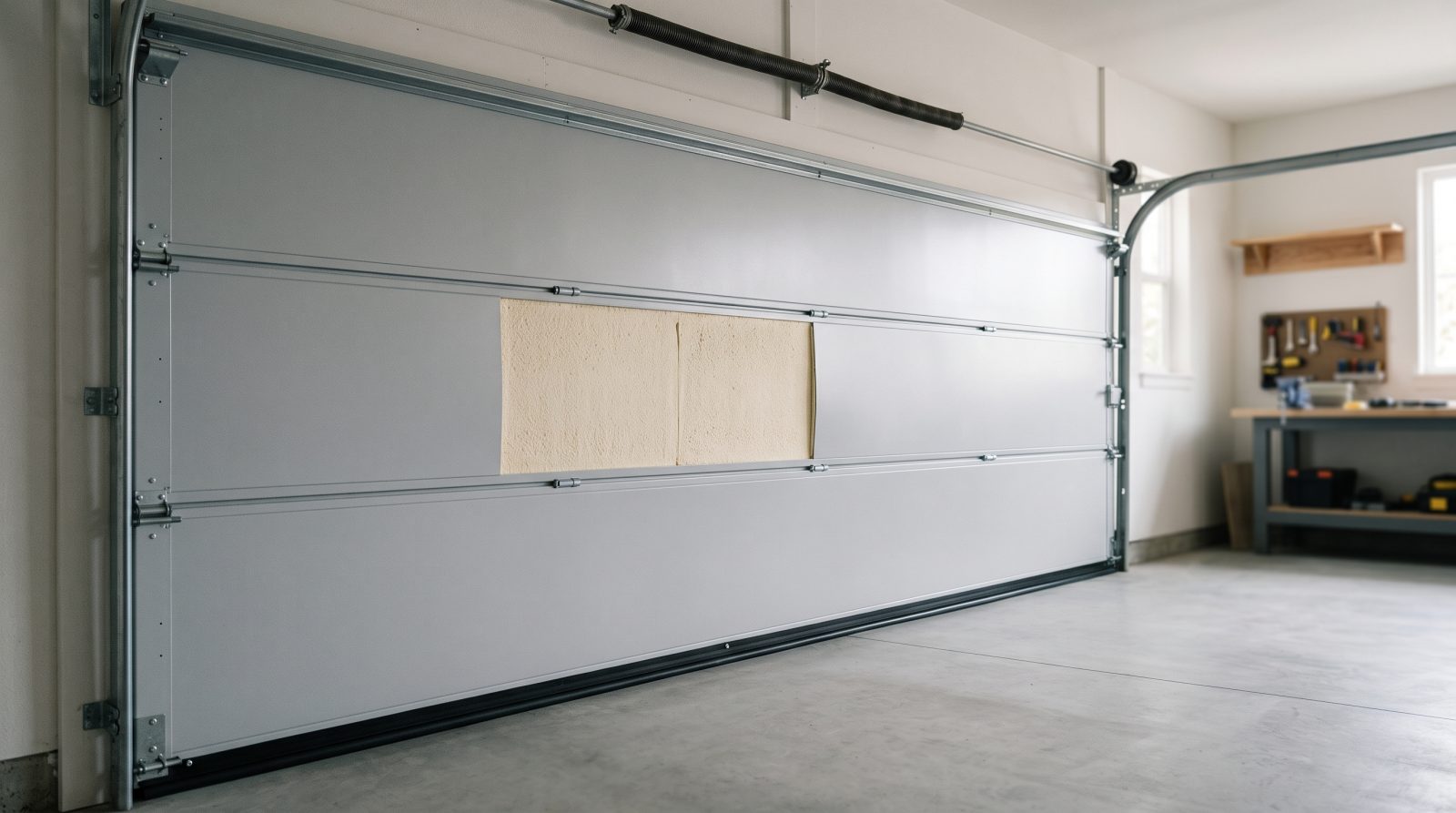
What Garage Door Insulation Actually Does (And What It Doesn't)
Insulation slows the movement of heat. In summer, heat wants to flow from the hot outdoors into your cooler garage; in winter, the flow reverses and your heated air escapes outward. A bare single-layer steel or aluminum door is essentially a metal sheet — it conducts that heat almost freely, which is why an uninsulated garage can swing far from comfortable in either direction depending on your region. Adding insulation puts a thermal barrier in the middle of that sandwich, dramatically reducing how fast the door gives up or gains heat.
It's important to be realistic about what this buys you. An insulated garage door does not turn an unconditioned garage into a climate-controlled room on its own. The door is one surface; the walls, ceiling, the gap under the door, the man-door, and any windows all matter too. What an insulated door reliably delivers is a more stable, moderate garage temperature, less strain on any heating or cooling that does reach the space, a quieter door, and — critically for the rooms attached to or above the garage — a meaningful reduction in the cold or heat that migrates into your living space.
There's also a structural and comfort benefit people overlook: insulated doors are typically built as multi-layer 'sandwich' construction (steel-insulation-steel), which makes them noticeably more rigid, more dent-resistant, and significantly quieter when they open and close. So even buyers who don't care about energy often choose insulation purely for durability and noise.
- Slows heat transfer in both directions — keeps summer heat out and winter warmth in
- Stabilizes garage temperature rather than perfectly conditioning it
- Reduces heat/cold bleeding into attached rooms and rooms above the garage
- Adds rigidity and dent resistance through multi-layer construction
- Cuts operating noise — a genuine selling point for attached garages and bedrooms nearby
Understanding R-Value: The Number Everyone Quotes and Few Explain
R-value measures resistance to heat flow — the higher the number, the better the material resists conduction. Garage doors are commonly marketed with R-values that range from very low single digits on thin or single-layer doors up to roughly the high teens or low twenties on premium multi-layer insulated doors. As a rule of thumb, more insulation thickness and a true sandwich construction push the R-value up.
Here's the nuance manufacturers rarely emphasize: there are two ways to state insulation performance. 'Calculated' or 'center-of-section' R-value measures only the insulated panel itself, which produces a flattering number. 'Whole-door' or 'installed' R-value accounts for the frame, the seams between sections, and the thermal bridging where the steel skins meet — and that real-world figure is always lower. When you compare doors, try to compare the same type of rating, and treat any single eye-popping number with healthy skepticism.
It's also worth knowing that beyond a certain point, climbing R-value gives diminishing returns for most homeowners. Going from an uninsulated door to a moderately insulated one captures the large majority of the benefit. Jumping from a good insulated door to the absolute highest-R model is worthwhile mainly if your garage is conditioned, a workshop, a gym, or directly below a bedroom in an extreme climate. The right target depends on how you use the space, not on chasing the biggest number on the brochure.
- R-value = resistance to heat flow; higher resists better
- Single-layer doors sit very low; premium multi-layer doors reach the high teens to low twenties
- 'Center-of-section' R-value looks better than the real 'whole-door' installed value
- Compare like-for-like ratings — and don't over-index on one number
- Returns diminish past 'moderately insulated' unless the garage is conditioned or heavily used
Insulation Types: Polystyrene vs. Polyurethane (and Why It Matters)
Two materials dominate factory-insulated garage doors, and the difference is significant. Expanded polystyrene (EPS) is rigid foam board cut to fit inside the door's pan. It's effective, affordable, and common in mid-range doors. Because it's a pre-cut panel set into the frame, there can be small gaps around the edges, and it doesn't bond the two steel skins together, so the door isn't quite as rigid as the alternative.
Polyurethane is foamed-in-place: liquid foam is injected into the door section, where it expands to completely fill the cavity and chemically bond to both steel skins. This produces a denser insulation with no gaps, a higher R-value for the same thickness, and a much stiffer, quieter, stronger door. For a given thickness, polyurethane generally outperforms polystyrene — which is why it's the standard in premium doors and the better choice if energy performance and durability are priorities.
Single-layer (non-insulated) and dual-layer vs. triple-layer construction is the other axis to understand. Single-layer is one steel skin with no insulation — lowest cost, lowest performance. Dual-layer (steel + insulation) adds real R-value. Triple-layer (steel-insulation-steel) sandwiches the foam between two skins, giving you the best combination of insulation, strength, dent resistance, and a finished interior face — which also looks far better from inside the garage.
- Polystyrene (EPS): rigid pre-cut foam, affordable, possible edge gaps, less rigid
- Polyurethane: foamed-in-place, no gaps, higher R per inch, stiffer and quieter
- Single-layer: no insulation, lowest cost and performance
- Dual-layer: steel + insulation — solid mid-range performance
- Triple-layer (steel-insulation-steel): best insulation, strength, and a finished interior
- Per inch of thickness, polyurethane is the stronger performer
Retrofitting Your Existing Door vs. Buying an Insulated Replacement
If your current door is a bare single-layer model, you have two paths. The first is a retrofit insulation kit: rigid foam panels or reflective batt material you cut and fit into each section yourself. Kits are inexpensive and can be a reasonable DIY weekend project on a door that's otherwise in good shape. They will raise the door's effective insulation and quiet it down somewhat.
But retrofit kits have real limits, and this is where honesty matters. Added panel weight can throw off the door's spring balance, which affects how it lifts and how hard the opener works — and an unbalanced door is a safety and longevity issue, so the springs may need adjusting by a professional afterward. Retrofits also don't seal the seams between sections, don't fix worn weatherstripping, and never match the integrated performance, rigidity, or finished look of a factory-insulated sandwich door. You're improving a thin door, not transforming it.
Replacement is the path that solves the problem at the root. A modern insulated door arrives engineered as a system: the insulation, the steel skins, the section joints, the bottom seal, and the spring sizing are all matched from the factory. You get the full R-value the door was designed for, tight weather seals all around, better security and curb appeal, and — because a new door is one of the most visible upgrades on a home's exterior — a strong return on resale appeal. If your door is old, damaged, noisy, or already underperforming, replacement usually delivers more value per dollar than repeatedly patching it, and it's the only path that also modernizes the look of the home's largest moving feature.
- Retrofit kits: low cost, DIY-friendly, modest improvement on an otherwise-good door
- Added kit weight can unbalance springs — budget for a professional balance check
- Kits don't seal section seams, fix old weatherstripping, or match factory rigidity
- Replacement gives full designed R-value, integrated seals, and matched spring sizing
- A new insulated door also upgrades curb appeal, security, and resale value
- Old/damaged/noisy doors: replacement usually beats repeated patching
Climate, Use, and How to Choose the Right Level for Your Home
The right amount of insulation is genuinely regional. In hot southern and southwestern climates, the priority is keeping radiant and conductive heat out, protecting an attached room's cooling load, and preventing the garage from becoming an oven that bakes everything stored inside. In cold northern climates, the priority is retaining warmth, protecting pipes or water heaters in the garage, and stopping the freeze from creeping into a room above. In mixed climates, you're hedging both. None of this requires the maximum-R door — it requires matching the door to your actual conditions.
Use case matters as much as climate. An attached garage shares a wall — and often a ceiling — with living space, so insulation there pays off in the comfort and energy bills of the rooms next to it, not just the garage. A detached, unheated storage garage benefits far less from a premium high-R door. If you've turned (or plan to turn) the garage into a workshop, home gym, office, or hangout, you'll want both a higher-performing door and attention to the rest of the envelope, since the door alone can't condition a space.
Finally, remember that a door's real-world performance depends on what surrounds it. Even the best insulated door leaks if the bottom seal is worn, the perimeter weatherstripping is cracked, or the threshold lets air and water track underneath. When you're choosing or upgrading a door, treat the seals as part of the package — they're inexpensive relative to the door and they protect the insulation investment you just made. When you're ready, you can request a free quote to compare insulated door options matched to your climate, garage type, and how you actually use the space.
- Hot climates: prioritize keeping heat out and protecting cooling load
- Cold climates: prioritize retaining warmth and protecting pipes/water heaters
- Attached garages benefit most — they share walls and ceilings with living space
- Detached storage garages rarely justify a maximum-R door
- Workshops, gyms, and offices need a higher-performing door plus a tighter overall envelope
- Bottom seals, weatherstripping, and the threshold make or break real performance