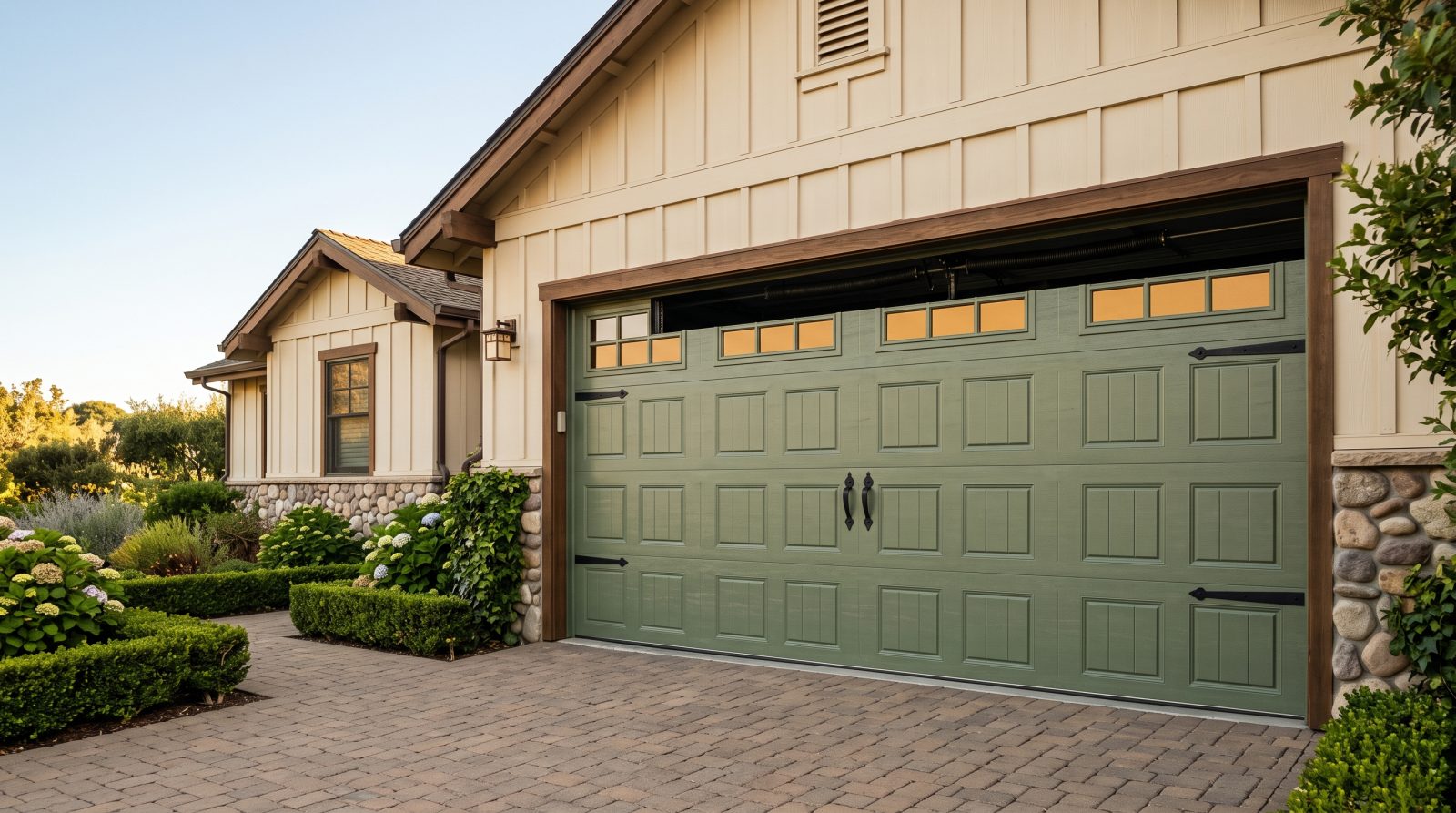
What "Carriage House" Actually Means (And Why It's a Style, Not a Mechanism)
The term "carriage house" describes a look, not a way of opening. The original carriage houses were outbuildings where horse-drawn carriages were stored, fronted by tall wooden doors that swung outward on hinges. That heritage gives the style its signature cues: vertical or symmetrical plank panels, a divided "barn door" appearance, decorative strap hinges, and handles or pull rings that suggest the door is meant to be swung open by hand.
Here's the key thing most buyers don't realize until they shop: you almost never have to choose between that classic look and modern convenience. The overwhelming majority of carriage house doors sold today are sectional overhead doors — they roll up on a track exactly like any standard garage door and work with any opener — but they're built and detailed to mimic the appearance of doors that swing. This is what's often called a "carriage-look" or "carriage-style" door, and it's the right choice for most homeowners replacing an existing overhead door.
A smaller share of the market is true swing-out (or swing-up) carriage doors, which genuinely open on hinges. They deliver the most authentic look and can work beautifully on detached garages, workshops and historic homes, but they come with real trade-offs: they need clear space in front to swing, they're harder to automate, they can be more affected by wind and snow drifts, and weather-sealing them well takes more care. For a replacement on an attached two-car garage, the carriage-look sectional is usually the smarter, more practical path — and from the curb, the difference is hard to spot.
Choosing Your Material: Steel, Wood, Composite and the Climate Question
Material is the single biggest decision in a carriage house door purchase, because it drives the look, the maintenance, the durability and a large part of the cost. Carriage styling is available in essentially every material, so the choice comes down to the appearance you want, the climate you live in and how much upkeep you're willing to do.
Climate matters more with this style than people expect, because so much of the carriage look depends on the surface staying crisp — flat panels, clean wood-grain texture and dark hardware that doesn't rust or fade. In humid, coastal and freeze-thaw regions, low-maintenance materials and corrosion-resistant hardware pay off. In hot, sun-intense climates, fade-resistant finishes and good insulation matter. In northern snow country, an insulated sectional with strong weather seals generally outperforms a true swing-out door that has to clear drifts. None of this means one material is universally "best" — it means the right answer is the one matched to where you live and how the garage is used.
- Steel (often with a wood-grain embossed finish): the most popular choice for carriage-look doors — durable, secure, low-maintenance and available insulated. Faux-wood overlays give the carriage appearance without wood's upkeep. Best all-around value for most replacements.
- Faux-wood / composite overlay doors: a steel or insulated core with a textured composite or polymer overlay that reads convincingly as painted or stained wood up close. Strong middle ground for buyers who want a richer look without real-wood maintenance.
- Real wood (cedar, hemlock, redwood, mahogany): the most authentic, premium appearance and unmatched character, but the highest maintenance — periodic refinishing, sensitivity to moisture and the highest cost. Rewards owners who want true craftsmanship and will maintain it.
- Aluminum and glass carriage variants: lighter and rust-resistant, useful in coastal areas, though less common in traditional carriage styling.
- Insulation in any material: look at how well it holds R-value and resists denting and fading in your specific climate, not just the headline material name.
Windows, Hardware and Color: Where the Carriage Look Is Won or Lost
Two carriage house doors made of the same material can look completely different depending on three details: the window pattern, the decorative hardware and the color. These are where the style is genuinely made, and they're also where buyers have the most room to personalize without changing the price tier dramatically.
Windows are the fastest way to set the character. A top row of square or arched lites instantly signals "carriage," floods the garage with daylight and breaks up a large door's mass. Grille patterns (the dividers within the glass) can lean traditional, craftsman or more contemporary. For privacy or street-facing garages, frosted, seeded or obscure glass keeps the look while hiding the interior. If the garage faces a busy road or strong afternoon sun, glass choice is worth thinking through carefully.
Decorative hardware — strap hinges, clavos (decorative nail heads), handles and pull rings — is the detail that tells the eye "this door swings," even on a sectional that rolls up. It's typically optional and inexpensive relative to the door, and it's one of the highest-impact upgrades you can make. Color ties it all together: many homeowners get the strongest curb appeal from a door color that contrasts the siding — warm wood tones, deep charcoal, black, or a color drawn from the trim or front door — rather than matching the wall and disappearing.
- Window placement: a single top row is most classic; full-height or no windows shift the mood and affect privacy and light.
- Glass type: clear for light, obscure/frosted/seeded for privacy, insulated glass where energy matters.
- Hardware finish: matte black is the most popular for the authentic forged look; oil-rubbed bronze and pewter are alternatives — choose rust-resistant in coastal/humid areas.
- Color strategy: coordinate with the front door and trim, and consider tasteful contrast against the siding for maximum curb appeal.
- Symmetry: align window and hardware layout with the home's architecture (Craftsman, Colonial, Tudor, farmhouse, Spanish) so the door reads intentional, not generic.
Insulation, Construction and the Installation Process
For an attached garage — or any garage below living space, a bedroom over the garage, or one used as a workshop or gym — insulation is worth serious attention. Carriage house doors are available in single-layer (non-insulated), two-layer (insulation bonded to the back) and three-layer (insulation sandwiched between two skins) construction. Three-layer doors give the highest R-value, the quietest, most solid feel, and the best resistance to dents and temperature swings; they're the upgrade most owners are glad they made when the garage is conditioned or attached.
Beyond R-value, construction quality shows up in everyday use: thicker steel resists dents, quality rollers and hinges run quieter, and good weather seals (bottom astragal, side and top stops) keep out drafts, dust, water and pests. These are the differences you feel for years, so they're worth comparing alongside the visible styling.
The replacement itself is typically a straightforward one-day job for a professional crew: the old door and hardware are removed, the new sections, tracks, springs and hardware are installed, the opener is reconnected and the spring tension and balance are set and safety-tested. A few realities are worth planning for. Garage door springs store enormous force and are genuinely dangerous to adjust without training — this is the part to leave to a pro. If you're keeping your opener, confirm it's compatible with a heavier insulated door; a richer, heavier carriage door sometimes pairs best with a new opener. And because carriage styling is so design-driven, confirming the exact size, panel design, window layout, hardware and color before ordering avoids the most common source of disappointment.
Cost Ranges, Curb Appeal and Resale Value
Carriage house doors span a wide price range because the same style is offered from budget steel up to premium custom wood. The figures below are typical industry estimates only — real pricing varies significantly by material, insulation level, size (single vs. double), window and hardware options, your region and the complexity of the installation. Always get a written quote for your specific door; treat any range as a planning starting point, not a guarantee.
Where carriage doors stand out is value relative to impact. The garage door is often the single largest visible feature on a home's front elevation, so replacing a dated or plain door with a well-chosen carriage style can transform curb appeal more affordably than most exterior projects. In real-estate terms, garage door replacement is consistently cited among the home improvements with the strongest cost recovery at resale, and a carriage-style door in particular photographs well and helps a listing stand out — meaningful whether you're selling soon or simply want the house to look its best.
Think about total cost of ownership, not just the sticker price. A slightly higher upfront spend on an insulated three-layer door, fade-resistant finish and corrosion-resistant hardware often pays back in lower maintenance, better energy performance and a look that still impresses years later. When you're ready, the next step is simple: confirm your opening size, pick the material and style that fits your home and climate, and request a free quote so you get accurate, itemized pricing for your project.
- Steel carriage-look doors: generally the most budget-friendly tier — strong value for most replacements (estimate, varies by size/insulation/options).
- Composite / faux-wood overlay doors: a mid-range tier offering a richer look without real-wood upkeep (estimate, varies).
- Real wood / custom carriage doors: the premium tier, reflecting craftsmanship, species and customization (estimate, varies widely).
- Cost drivers to expect on a quote: insulation level, single vs. double width, windows, decorative hardware, finish/color, and whether the opener or tracks are also being replaced.
- Value note: garage door replacement is widely regarded as one of the higher-return exterior upgrades for both curb appeal and resale — figures vary by market and source.