What "Off Track" Actually Means
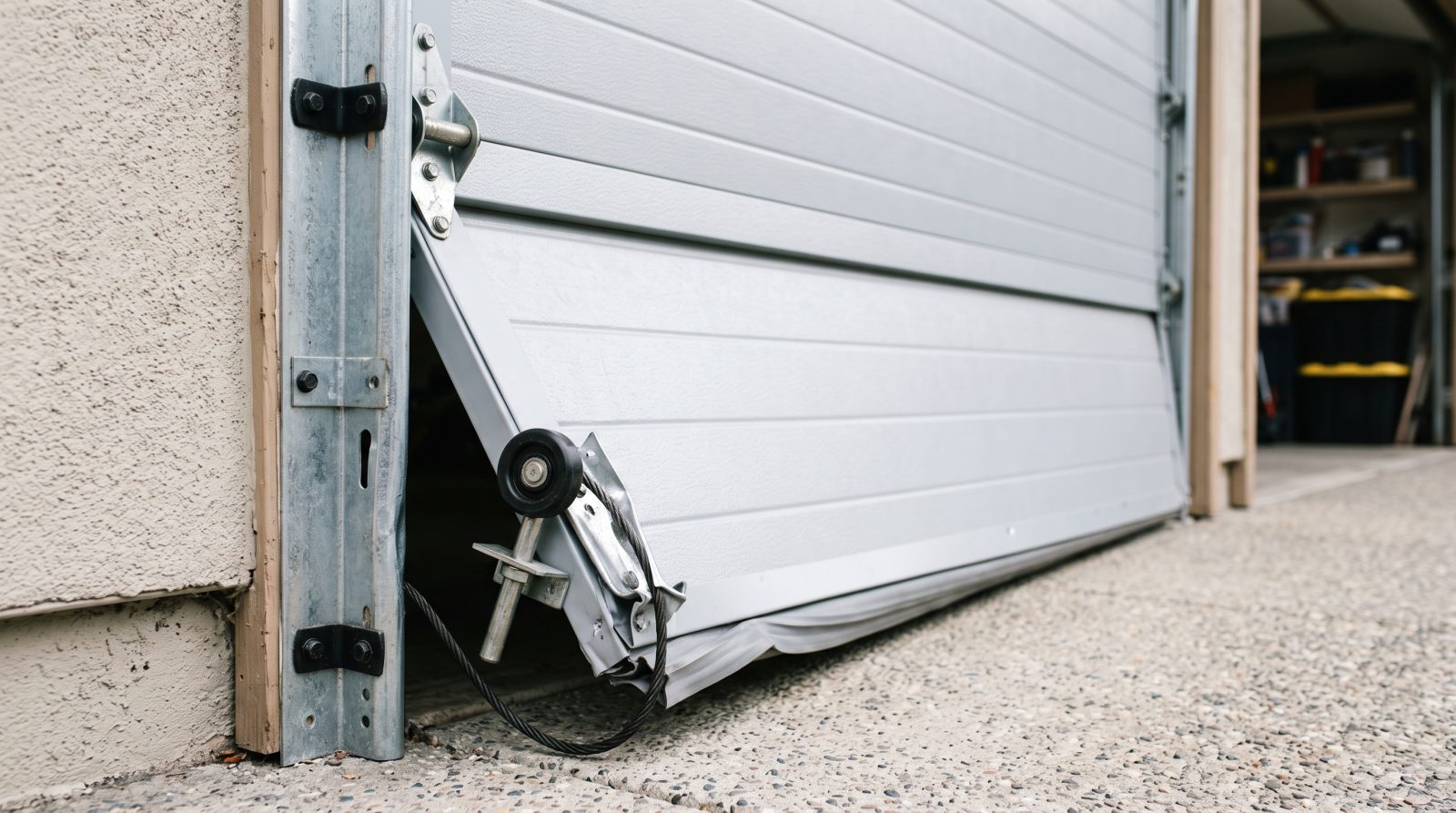
A sectional garage door rides up and down on rollers that sit inside two vertical and two horizontal steel tracks, one on each side. When the door is "off track," one or more of those rollers has come out of its channel. The result is a door that tilts, jams diagonally in the opening, leaves a gap on one side, or stops partway and won't budge in either direction. In the worst cases a whole section is pinched between the track and the frame, holding the door in a half-open, unstable position.
It's important to understand that the tracks themselves don't hold the door's weight — the springs and cables do. The tracks only guide the door's path. That distinction matters because when a roller leaves the track, the carefully balanced system that supports the door's weight can be thrown off, putting uneven strain on cables, hinges, and the remaining rollers. What looks like a simple 'pop it back in' situation is often a door whose load is no longer distributed the way it was engineered to be.
- Door hangs crooked or visibly leans to one side
- A roller or section sits outside the track channel
- The door binds, scrapes, or stops partway and won't reverse
- A gap appears along one edge where the door meets the frame
- Loud bang or grinding noise right before the door stuck
Why Garage Doors Come Off Their Tracks
Off-track failures almost never come out of nowhere. They are usually the final result of wear, impact, or a maintenance issue that has been building for a while. Understanding the cause matters, because it determines whether you're looking at a quick fix or a symptom of a door that's reaching the end of its service life.
The single most common trigger nationwide is a vehicle bumping the door — even a light tap while it's partway open can knock a section out of alignment or bend the track. After impact, the leading causes are worn or broken rollers, a snapped or frayed lift cable, loose or bent track hardware, and obstructions left in the door's path. Climate plays a quiet role too: in cold-winter regions, hardened grease and brittle nylon can let rollers seize and jump out, while in coastal and humid areas, corrosion eats at tracks, brackets, and cable strands until something gives.
- Vehicle impact — the most frequent single cause of bent tracks and dislodged sections
- Worn, cracked, or broken rollers that no longer seat in the track
- A broken or frayed lift cable, which lets one side drop and pull free
- Loose lag bolts or bent track brackets that widen the channel
- Objects in the path — a ladder, trash can, or debris the door rides over
- Corrosion in humid/coastal climates or seized rollers in freezing climates
- An aging door with cumulative wear across hinges, rollers, and tracks
Why You Should Never Force an Off-Track Door
When a door is off track, it is no longer balanced, and that's exactly what makes it dangerous. A standard double garage door weighs in the rough range of 150 to 250 pounds, and that weight is held in check by springs under extreme tension. If a cable is already compromised or a section is pinched, prying the door back into its track can release that energy suddenly — sending cables whipping, slamming the door down, or trapping fingers and hands in the gap between sections.
There's also the matter of making the damage worse. A door that's off track on one side can usually be realigned cleanly by a technician who first relieves the tension and supports the weight. A homeowner who forces it tends to bend the track, crease a panel, or strip hinges — turning a quick repair into a panel or full-door replacement. The safest immediate steps are simple: stop using the door, pull the manual release only if the door is fully down and stable, keep people and vehicles clear, and call for a professional assessment rather than improvising.
If your opener is still trying to drive a stuck door, disconnect its power. Continuing to run the motor against a jammed door can burn out the opener and deepen the damage to the door itself.
- The door is unbalanced — forcing it can release spring/cable tension violently
- Pinch points between sections can cause crush injuries to hands and fingers
- Prying bends tracks and creases panels, escalating cost and scope
- Never adjust or disconnect springs or cables yourself — that's pro-only work
- Cut power to the opener so it stops driving against the jam
What a Professional Off-Track Repair Involves
A proper off-track repair is methodical, not a quick yank. A technician first secures the door and relieves spring tension so nothing is under dangerous load, then inspects the full system — rollers, cables, hinges, tracks, and brackets — to find not just where the door came off, but why. Treating only the symptom (re-seating the roller) without addressing the cause (a worn roller, a frayed cable, a bent track) usually means the door comes off again within weeks.
From there the repair typically includes re-aligning or replacing the affected track section, fitting the door back onto its rollers, and replacing any worn or damaged components found along the way. The technician then re-balances the door so the springs hold it properly at every position, tests the opener's auto-reverse safety, and confirms smooth travel through several full cycles. Minor off-track events caught early are often a same-day fix; if a panel is creased or a track is severely bent, the conversation shifts toward replacement.
- Secure the door and relieve spring tension before any handling
- Full inspection of rollers, cables, hinges, tracks, and brackets
- Re-align or replace damaged track and re-seat the door on its rollers
- Replace worn rollers/cables so the failure doesn't repeat
- Re-balance the door and verify opener safety reverse
- Test multiple full cycles to confirm smooth, even travel
Repair It — or Plan a Replacement?
Because this site is built around helping homeowners make smart new-door decisions, it's worth being honest: an off-track event is sometimes the moment a tired door tells you it's done. A single roller that popped out on an otherwise solid, recent door is a clear repair. But when off-track problems are recurring, when panels are bent or rusted, when the door is a decade-plus old and rollers/cables are all wearing together, you may be repeatedly paying to patch a system that keeps failing.
The replacement question isn't only about cost — it's about value. A new garage door is consistently one of the highest-return home improvements in terms of resale value and curb appeal, and a modern door brings benefits an old one can't be repaired into: better insulation (meaningful in both hot-summer and cold-winter regions), quieter nylon rollers and reinforced tracks, stronger wind and impact resistance, and safer, smarter openers. As a rough planning guide, off-track repairs commonly fall in the low-to-mid hundreds depending on parts and severity, while a full replacement door typically ranges from roughly a thousand to several thousand dollars depending on material, insulation, style, and installation — these are typical industry estimates that vary by door, region, and scope, not a quote.
A practical rule of thumb: if the repair cost approaches a meaningful fraction of a new door and the existing door is old or has failed repeatedly, put that money toward a replacement that improves insulation, security, and curb appeal rather than into another temporary fix. A technician can give you both options side by side so you can decide with real numbers.
- Repair makes sense: recent door, isolated cause, no panel/track damage
- Lean replacement: recurring off-track issues, bent/rusted panels, 10+ years old
- New doors add insulation, security, quieter operation, and curb appeal
- A new garage door is among the top home improvements for resale value
- Get repair vs. replace numbers side by side before deciding