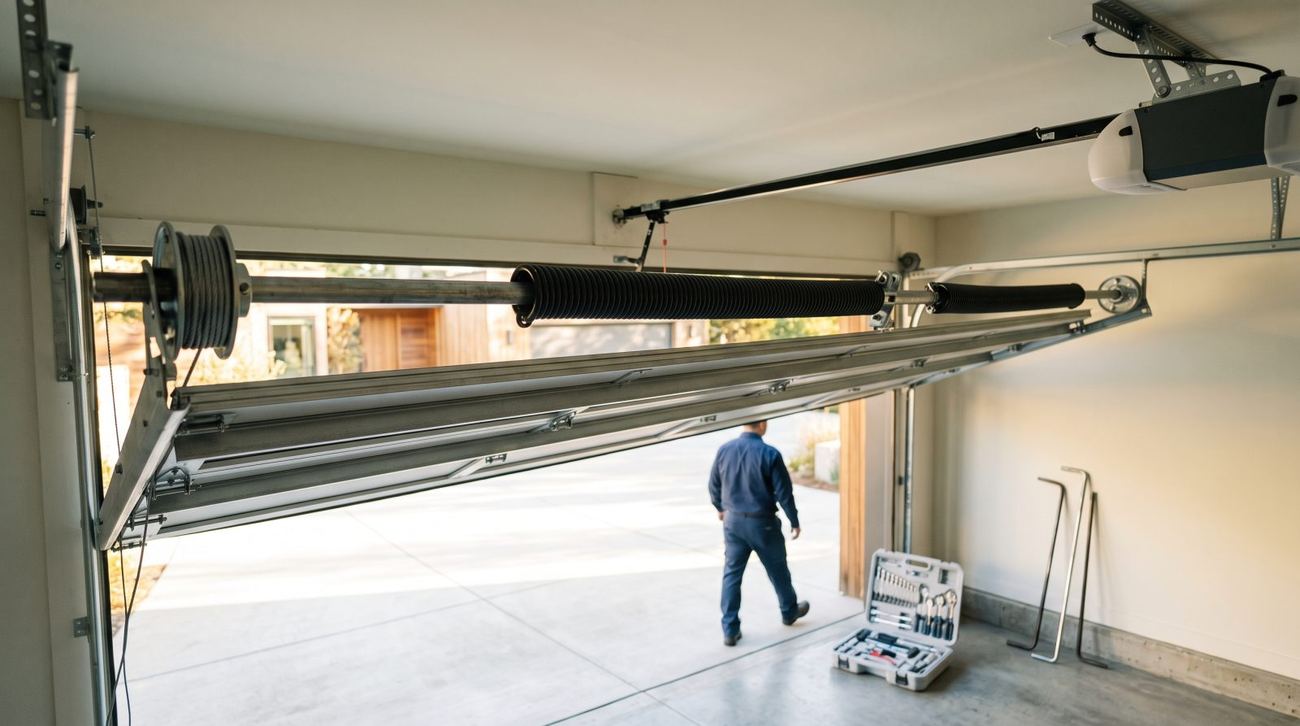
The Most Common Garage Door Problems (and What Causes Them)
Garage doors fail in predictable ways, and understanding the root cause helps you judge whether a repair is routine or a warning sign of bigger wear. The vast majority of service calls come down to the spring system, the opener, the cables and drums, the tracks and rollers, or the safety sensors. Each of these parts has a finite lifespan measured in cycles (one open plus one close), and a door used several times a day ages far faster than one used occasionally.
Climate plays a real role nationwide. In cold and coastal regions, moisture and road salt accelerate corrosion on springs, cables, and hardware, while extreme heat and UV exposure in southern and desert climates can warp non-insulated steel and dry out weatherstripping. Humidity swings cause wood doors to expand and contract, loosening joints and finishes over time. None of this means a door is defective; it means the components are doing exactly what physics dictates, and maintenance or replacement timing should reflect your local conditions.
- Broken torsion or extension springs, usually the single most common failure and the reason a door suddenly feels impossibly heavy
- Opener problems: worn gears, failed logic boards, dead remotes, or a unit that simply hums without lifting
- Frayed or snapped lift cables, which can let the door drop or hang crooked
- Off-track doors caused by a broken cable, a hard impact, or bent track
- Worn rollers, hinges, and bearings that create grinding, squealing, or jerky travel
- Misaligned or blocked photo-eye safety sensors that prevent the door from closing
- Failed weatherstripping and bottom seals that let in air, water, pests, and debris
Garage Door Springs: The Repair to Take Seriously
Springs do the heavy lifting, literally. A torsion spring (mounted on a bar above the door) or a pair of extension springs (running alongside the tracks) counterbalances the door's weight so the opener, or your arm, only has to manage a fraction of it. When a spring breaks, the door becomes dangerously heavy and the opener can be damaged trying to lift dead weight. This is the repair where do-it-yourself enthusiasm causes the most injuries, because a wound torsion spring stores enormous energy and can release violently.
Springs are rated by cycle life, commonly in the range of roughly 10,000 cycles for standard springs, with higher-cycle springs available that last considerably longer. A door opened four to six times a day can reach the end of a standard spring's life in well under a decade. When one spring on a two-spring system breaks, replacing both at the same time is standard best practice, because the second spring has the same age and wear and will likely fail soon after, meaning a second service call and another trip charge.
As a planning figure, professional spring replacement commonly falls in a typical range of roughly $200 to $500 installed, varying by spring type, door size and weight, single versus dual springs, and your region; high-cycle upgrades cost more but extend life. Treat that as an industry estimate, not a quote. If your door already has multiple aging issues alongside a broken spring, that repair cost is worth weighing against the value of a new door.
- Have springs serviced by a professional; the energy stored in a wound torsion spring makes this genuinely hazardous to handle alone
- Replace both springs together on dual-spring systems to avoid a near-term repeat failure
- Ask about higher-cycle springs if your door sees heavy daily use, as the longer lifespan often justifies the modest upcharge
- If a broken spring coincides with worn cables, rollers, and an aging opener, request a candid repair-versus-replace comparison
Openers, Cables, Tracks, and the Noises That Signal Trouble
Beyond springs, the opener and the door's moving hardware account for most remaining service calls. A modern opener is a small machine with a motor, gears or a belt, a logic board, and safety electronics. Common failures include stripped drive gears, a failing circuit board, dead remote or keypad batteries, and misaligned photo-eye sensors near the floor that, by safety design, stop the door from closing if they sense an obstruction or fall out of alignment. Many no-close complaints are simply a sensor knocked askew or a lens clouded by dust.
Cables and tracks fail more quietly until they don't. Lift cables fray strand by strand before snapping, and a door that looks crooked or hangs unevenly is a red flag to stop using it. Bent tracks, loose mounting brackets, and dry or cracked rollers produce grinding and shuddering travel. Noise is diagnostic: a rhythmic squeak often points to dry rollers and hinges that need lubrication or replacement, while a loud bang frequently means a spring just broke, and grinding from the opener head can indicate worn gears.
A note on safety claims and timing: reputable service is fast, often same-day, but be skeptical of anyone promising an exact arrival minute or guaranteeing a flat price sight-unseen, because real diagnosis depends on the specific door. The honest approach is an inspection, then a clear written estimate before any work begins.
- Opener won't lift but motor hums: often a stripped gear or a broken spring overloading the motor
- Door reverses before closing or won't close: usually misaligned or obstructed safety sensors
- Crooked or uneven door: stop operating it; a cable or drum problem can worsen quickly
- Grinding or squealing during travel: dry, worn rollers, hinges, or bearings due for lubrication or replacement
- Loud single bang from the garage: very commonly a spring failure, even if the door still appears intact
Repair or Replace? How to Make the Smart Call
Because this site focuses on new doors and replacement, we hold ourselves to an honest standard: not every problem warrants a new door, and many are genuinely worth repairing. A single broken spring on an otherwise solid, well-insulated door is a clear repair. A dead opener on a structurally sound door is a clear repair or simple opener swap. The calculus changes when failures start clustering, when the door panels are dented, rusted, rotting, or delaminating, or when you're pouring repeated repair dollars into a thin, non-insulated door that performs poorly anyway.
A useful rule of thumb is to compare the cost of the proposed repair against the value and condition of the door itself. If repairs in a short span approach a meaningful share of a new door's installed cost, or if the door is more than fifteen to twenty years old with multiple worn systems, replacement usually delivers more: lower energy loss through an insulated door, quieter and smoother operation with modern hardware, better security, and a noticeable lift in curb appeal. Industry remodeling data has long ranked garage door replacement among the strongest projects for recouped value at resale, which is part of why it's such a compelling upgrade rather than a grudging expense.
Climate should inform the choice nationwide. In cold or coastal regions, an insulated steel or composite door with quality weather seals pays back in comfort and corrosion resistance; in hot, sunny regions, insulation and UV-stable finishes protect both the garage and any attached living space above or beside it. If you're already facing a significant repair, it's the natural moment to price a replacement and compare total value, not just the bill in front of you.
- Lean toward repair: one isolated failure (a spring or opener) on a sound, well-insulated door
- Lean toward replacement: clustered failures, cosmetic damage, rot or rust, or a door past roughly 15-20 years
- Compare repair cost to door value, not just to your immediate inconvenience
- Factor in energy savings, quieter operation, security, and curb appeal that a new door adds
- Use a major repair as the trigger to get a replacement estimate and weigh both options side by side
Preventing the Next Repair: Maintenance That Actually Helps
Most garage door repairs are not random; they're the late stage of wear that simple, periodic maintenance can slow. A door is a system under tension, and keeping it balanced, lubricated, and clean meaningfully extends the life of springs, opener, and hardware. A twice-yearly routine, ideally at the change of seasons, catches small problems before they become emergency calls and helps an older door reach replacement on your timeline rather than at the worst possible moment.
A few checks make the biggest difference. Test the door's balance by disconnecting the opener and lifting the door halfway by hand; a properly balanced door should hold roughly in place rather than slamming down or shooting up, and a door that won't hold balance is straining the opener and springs. Lubricate metal rollers, hinges, and the spring with a proper garage door lubricant (not a thin degreasing spray). Keep the tracks clear, tighten loose hardware, and wipe the photo-eye lenses. Test the auto-reverse safety feature by placing a solid object in the door's path to confirm it reverses on contact, and confirm the photo-eyes reverse the door when the beam is broken.
- Inspect and lubricate rollers, hinges, and springs about twice a year with a garage-door-rated lubricant
- Test door balance with the opener disconnected; a balanced door holds position when lifted halfway
- Test both safety features: contact auto-reverse and the photo-eye sensors near the floor
- Tighten loose nuts, bolts, and brackets, and keep tracks clean and free of debris
- Replace worn weatherstripping and bottom seals to protect against air, water, and pests
- Schedule a professional tune-up if the door is noisy, heavy, or noticeably slower than it used to be