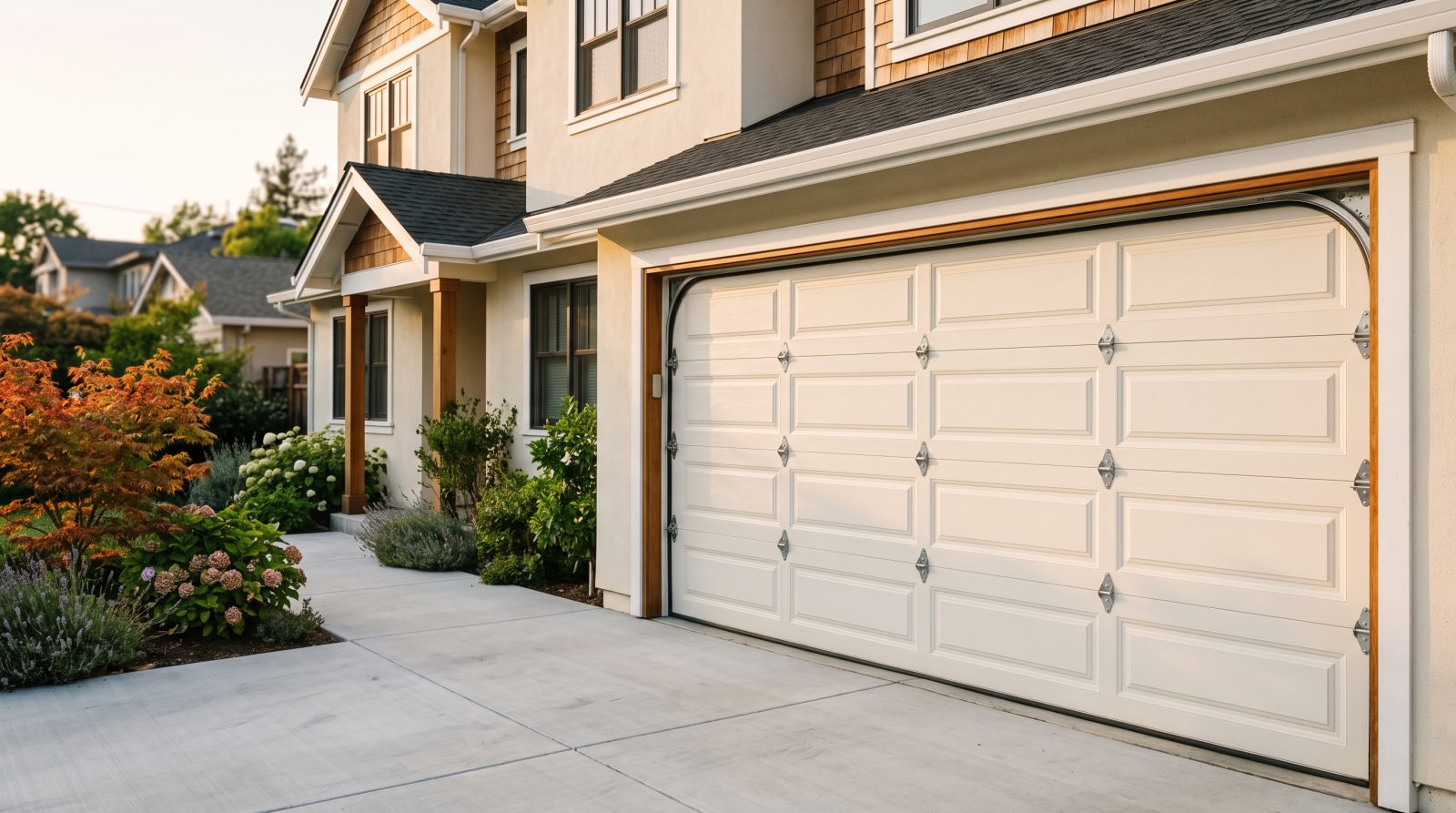
What a Sectional Garage Door Is (and Why It Became the Standard)
A sectional garage door is made of several horizontal panels, usually four or five, hinged together so the whole assembly behaves like a flexible curtain. When you open the door, those panels roll up and back along a pair of curved tracks, then sit nearly flat against the garage ceiling. When closed, the panels stack vertically into the opening and press against weatherstripping on all four sides. That panel-and-track design is the single feature that sets sectional doors apart from older one-piece tilt-up doors and from single-curtain roll-up doors, and it is the reason sectional became the dominant residential format across nearly every region of the country.
The format wins on three practical fronts. First, space: because the door travels up and overhead rather than swinging outward, you can park right up to it and you never lose driveway clearance. Second, sealing: independent panels meeting a continuous perimeter seal handle wind, rain, and temperature swings far better than a single rigid slab, which matters whether you are dealing with Gulf Coast humidity, Midwest cold, or desert dust. Third, flexibility: the panel structure can be built from steel, aluminum, wood, composite, or glass, and finished in dozens of styles, so a sectional door can look like a carriage house, a flush modern slab, or a traditional raised-panel door without changing how it operates.
For a homeowner shopping for a replacement, the takeaway is that sectional is almost certainly your starting point, and the real decisions are about what that door is made of, how well it is insulated, and how it is finished. Those choices, covered below, are where the meaningful differences in price, durability, and everyday experience actually live.
- Built from 4-5 hinged horizontal panels that roll overhead on curved tracks
- Maximizes usable space inside and outside the garage compared with swing-out designs
- Seals on all four sides, performing well across cold, hot, humid, and dusty climates
- Available in steel, aluminum, wood, composite, and glass, in nearly any style
- The default residential format, so it has the widest selection of parts, openers, and accessories
How the Panels and Hardware Actually Work
Understanding the mechanism helps you buy intelligently, because the hardware quality often matters as much as the panel itself. Each panel is connected to the next by hinges along its top and bottom edges, which let the door flex from vertical to horizontal as it travels. On the sides, rollers ride inside the tracks; better doors use sealed nylon or higher-bearing-count rollers that run noticeably quieter and last longer than basic steel rollers. The tracks themselves transition from a vertical run at the opening to a horizontal run under the ceiling, with a curved section that lets the panels make the turn.
The part that does the heavy lifting is the spring system, and it is worth knowing which type a quoted door uses. Most quality residential sectional doors use a torsion spring mounted on a shaft above the opening; it winds and unwinds to counterbalance the door's weight, which makes the door feel light and reduces strain on the opener. Lower-cost setups sometimes use extension springs running along the horizontal tracks. Torsion systems are generally smoother, longer-lived, and safer, and spring lifespan is commonly rated in cycles, where one cycle is a single open-and-close. A typical builder-grade spring might be rated around 10,000 cycles while upgraded springs can be rated far higher, so if your household opens the door many times a day, asking for a higher-cycle spring is one of the smartest upgrades you can specify.
The opener is technically a separate purchase from the door, but it is part of the same buying conversation. Sectional doors work with chain, belt, or screw-drive openers, and increasingly with wall-mounted jackshaft openers that mount beside the door rather than on the ceiling. Belt-drive and jackshaft units run the quietest, which is a real consideration for any garage that sits under or beside a bedroom. When you replace a door, it is a natural moment to evaluate whether the existing opener still has the lifting capacity, safety sensors, and quiet operation you want.
- Hinges between panels let the door flex from vertical to horizontal travel
- Rollers ride in the tracks; sealed nylon rollers run quieter and last longer
- Torsion springs (above the opening) are smoother and more durable than extension springs
- Spring life is rated in cycles; high-cycle springs suit heavy daily use
- Belt-drive and jackshaft openers are the quietest pairing, ideal near living spaces
Choosing a Material: Steel, Aluminum, Wood, Composite, and Glass
Material is the biggest single driver of how a sectional door looks, performs, and costs, so it deserves the most attention in your decision. Steel is by far the most common choice and the value benchmark. It is strong, low-maintenance, resists warping, and is usually available with foam insulation sandwiched inside the panels. Steel doors come in a wide range of gauges and finishes, including textured surfaces that convincingly imitate wood grain. The main thing to watch is dent resistance and corrosion: thicker-gauge steel resists dents better, and in coastal or high-salt regions, a quality factory finish and corrosion-resistant hardware are worth prioritizing.
Aluminum and glass doors occupy the modern and architectural end of the market. Aluminum frames are lightweight and naturally rust-resistant, which makes them popular in humid and coastal climates, and they pair beautifully with full-view glass panels for a contemporary look. Glass options range from clear to frosted to tinted, balancing daylight against privacy and heat gain. These doors make a striking design statement, but they generally cost more, insulate less than a foam-core steel door unless you specify insulated glass, and the glass adds weight and cleaning to the equation.
Wood and wood-composite doors are about warmth and authenticity. Real wood, often built as carriage-house or custom designs, offers a richness no imitation fully matches, but it asks for periodic refinishing and is more sensitive to moisture swings, so it suits drier or milder climates better than constantly wet ones. Composite and faux-wood doors aim to deliver the wood look with far less upkeep, using engineered or steel-backed panels with a wood-grain face. For many buyers who love the carriage-house aesthetic but not the maintenance, a composite or textured-steel door is the sweet spot.
- Steel: the value standard, strong and low-maintenance, available foam-insulated and wood-look
- Aluminum + glass: modern, rust-resistant, light-filling, higher cost and lower insulation unless specified
- Wood: authentic and warm, needs periodic refinishing, best in milder or drier climates
- Composite / faux-wood: the carriage-house look with much lower upkeep
- In coastal or high-salt areas, prioritize corrosion-resistant finishes and hardware
Insulation, R-Value, and Why Climate Changes the Answer
Insulation is the upgrade homeowners most often underestimate and later wish they had taken seriously. Sectional doors are commonly offered as single-layer (non-insulated steel), double-layer (steel skin with foam backing), or triple-layer (steel-foam-steel sandwich, the most insulated and most rigid). Insulation is described with an R-value, where higher means more resistance to heat transfer. Just as important, an insulated sandwich-construction panel is stiffer and quieter, and the inner steel skin protects the foam and looks cleaner from inside the garage.
Whether insulation pays off depends heavily on where you live and how you use the garage. In hot southern and southwestern climates, an insulated door slows the afternoon heat soak that turns a garage into an oven and bleeds into adjacent rooms. In northern and mountain climates, it helps hold warmth and reduces the cold that radiates off a bare metal slab. If your garage is attached, shares a wall with a bedroom or bonus room, or doubles as a gym, workshop, or home office, insulation moves from nice-to-have to genuinely worth the upgrade. If the garage is fully detached, unconditioned, and purely for storage, a lighter-insulated or non-insulated door can be a reasonable way to save money.
Two related details round out the thermal picture. First, weatherstripping and the bottom seal matter as much as the panel R-value, because air leaks around the perimeter undermine even a well-insulated door, so look for quality seals on all four sides. Second, glass reduces insulation, so if you want windows or a full-view door in a demanding climate, ask specifically about insulated or low-emissivity glass rather than single-pane. The right insulation specification is one of the few door choices that quietly pays you back every month in comfort and energy.
- Single-layer = least insulated; double-layer adds foam; triple-layer (steel-foam-steel) insulates most and is most rigid
- Higher R-value means more resistance to heat transfer and usually a quieter, sturdier door
- Insulation matters most for attached garages and rooms above or beside the garage
- Hot climates benefit from reduced heat soak; cold climates from retained warmth
- Don't overlook perimeter weatherstripping and insulated glass, which protect the door's overall performance
Cost, Curb Appeal, and Return on a Replacement
Pricing a sectional door means thinking in ranges rather than a single number, because the final figure depends on size, material, insulation level, windows, hardware quality, and your region's labor rates. As a broad industry estimate, a basic single-car non-insulated steel sectional door installed often falls in the lower four figures, a mid-range insulated steel double-car door typically lands in the mid four figures, and premium wood, full-view glass, or custom carriage-house doors can reach well into the upper four or five figures. These are typical ranges to help you budget, not a quote; the only accurate number is a measured estimate for your specific opening and selections.
Several factors push an estimate up or down, and knowing them helps you control the spend. Door size and whether you have one wide opening or two separate doors, the material and insulation tier, the number and type of windows, decorative hardware, upgraded springs and rollers, and whether an opener is included all move the price. Removal and disposal of the old door, any reframing of the opening, and regional labor costs round out the total. Getting an itemized estimate lets you see where your money is going and decide which upgrades are worth it.
It is worth weighing cost against return, because a garage door is unusually visible. On many homes the door occupies a large share of the street-facing facade, so replacing a dated or damaged one is one of the most cost-effective ways to refresh curb appeal, and national remodeling cost-versus-value studies have consistently ranked garage door replacement among the projects that tend to recoup a high share of their cost at resale. Beyond resale, a new sectional door delivers everyday gains: quieter operation, better sealing, improved security from modern hardware, and the comfort benefits of insulation. When you are ready to put real numbers to your project, request a free quote and have a professional measure your opening and confirm the right specification before you buy.
- Treat all figures as typical industry ranges, not a guaranteed quote; only a measured estimate is accurate
- Price drivers: size, material, insulation tier, windows, hardware, opener, and regional labor
- Old-door removal, disposal, and any reframing add to the total
- Garage doors are highly visible, so replacement is among the strongest curb-appeal upgrades
- A new door also pays back daily in quieter operation, better sealing, security, and comfort