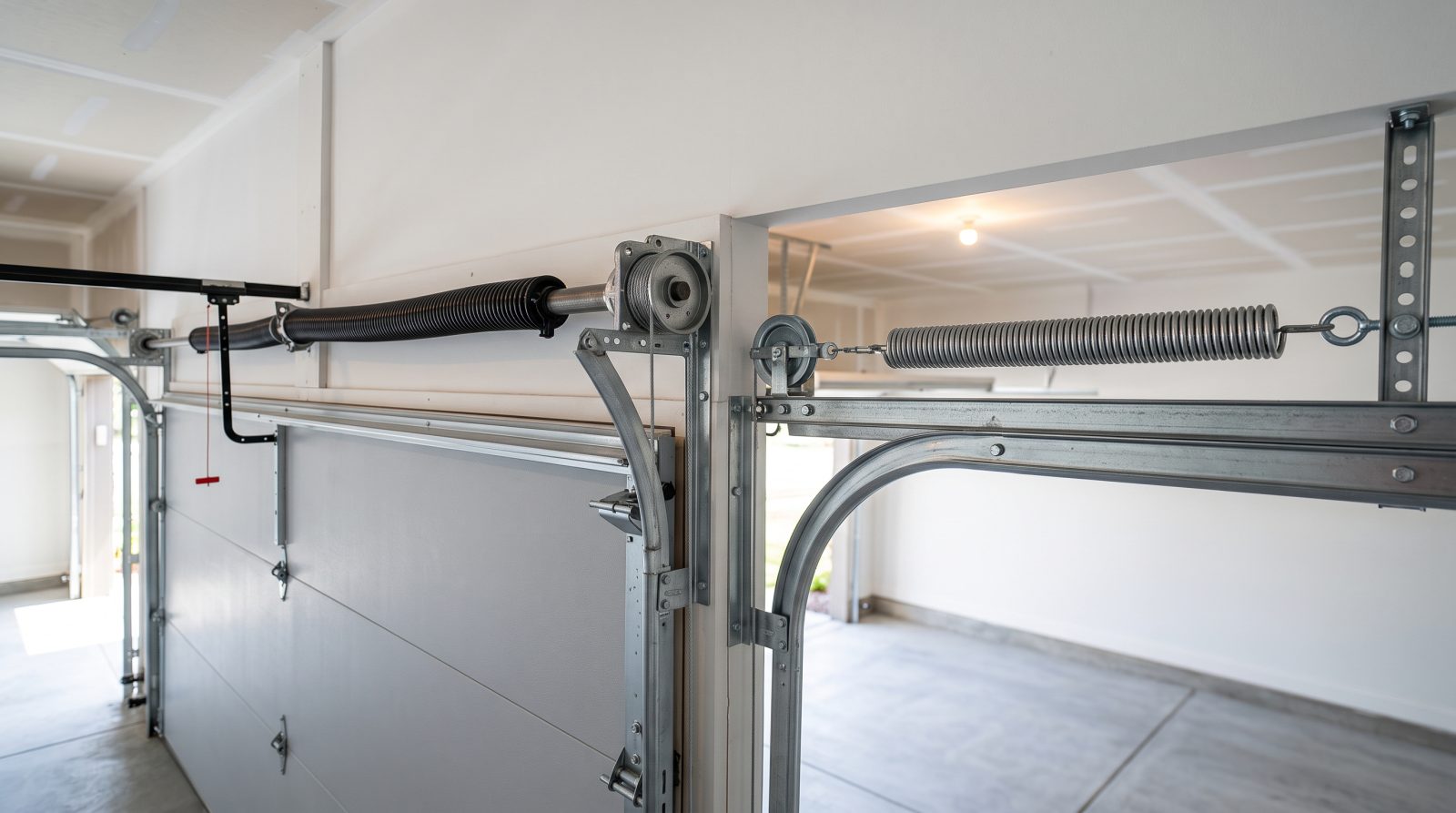
How garage door springs actually work (counterbalance, not lifting)
A garage door spring does not lift the door the way a winch lifts a load. It stores energy and gives it back at exactly the right rate to counterbalance the door's weight. When the door is closed, the springs are fully loaded with tension. As the door rises, that stored energy is released to offset gravity, so a well-balanced door feels nearly weightless through its whole travel and will hold steady, roughly halfway open, with no help. That balance is the whole job. The opener motor is comparatively weak; it is really just there to nudge a counterbalanced door up and down and to provide automatic control. The springs do the heavy work.
This is why spring condition affects far more than whether the door opens. When springs are correctly sized and healthy, every other component lives longer: the opener draws less current, the rollers and tracks see less load, the cables stay seated, and the door does not bind. When springs are undersized, worn, or out of adjustment, the opener compensates by straining, the door becomes hard to lift by hand, and wear accelerates across the whole system. A balanced door is the foundation of a quiet, long-lasting installation, and it is the first thing a good technician sets after hanging a new door.
There are two ways manufacturers achieve that counterbalance, and they define the two spring types. Torsion systems use a tightly wound spring mounted on a shaft that turns to lift the door. Extension systems use long springs that stretch and contract along the horizontal tracks. Both can balance a door well; they simply do it with different geometry, different safety characteristics, and different cost.
- Springs counterbalance weight; the opener mostly provides control and a final nudge.
- A balanced door holds position around halfway open and feels light by hand.
- Healthy springs extend the life of the opener, cables, rollers, and tracks.
- Two families exist: torsion (wound on a shaft) and extension (stretched along the tracks).
Torsion springs: the modern standard and why most new doors use them
A torsion spring is a heavy coil mounted horizontally on a steel shaft above the door opening, usually centered over the door or, on wide or heavy doors, split into two springs. When the door closes, cables wound onto drums at each end of the shaft pull the spring into tension; as the door opens, the spring unwinds and turns the shaft, which feeds the cables back and raises the door evenly on both sides. Because the lifting force is delivered through a central shaft to both ends at once, torsion systems tend to open and close smoothly, with less side-to-side sway and noticeably less noise than extension setups.
Torsion is the system most professionals specify on new and replacement doors, and for good reasons beyond smoothness. The force is contained and controlled, which makes the system safer and more durable. Torsion springs are also more easily matched to a door's exact weight, which produces better balance and longer life across all the moving parts. On a standard residential door you will typically see a torsion lifespan rated in cycles, often around 10,000 cycles for a builder-grade spring, which works out to roughly seven to twelve years for an average household that opens the door a few times a day. High-cycle torsion springs rated for 20,000 cycles or more are available and are worth specifying if you use the garage as your main entrance or live somewhere the door runs constantly.
The trade-off is cost and complexity. Torsion springs cost more than extension springs, and they hold enormous stored energy, so replacement and adjustment are genuinely dangerous tasks that call for the right winding bars and training. This is not a recommended do-it-yourself repair. When you replace a door, choosing a torsion system, and paying a little extra for a higher cycle rating, is usually the better long-term investment, especially in cold climates where doors are heavy and used hard through winter.
- Mounted on a shaft above the door; lifts both sides evenly through cables and drums.
- Smoother, quieter, and longer-lasting than extension systems on most doors.
- Common cycle ratings: ~10,000 (standard) up to 20,000+ (high-cycle) — pick by usage.
- More expensive and stores high energy; adjustment and replacement are a pro job.
- The default choice on most new and replacement doors, especially heavy or insulated ones.
Extension springs: how they differ and where you still see them
Extension springs are the long, lighter-gauge springs you see running parallel to the horizontal tracks, one on each side, above the upper sections of the door. Instead of winding, they work by stretching: when the door closes, the springs extend and store energy; as the door opens, they contract and pull the door up via a system of pulleys and cables. They are an older, simpler, and less expensive approach, and they were the standard on a great many homes built decades ago, so you still find them across the country, particularly on lighter single-car doors.
The functional differences matter. Because each spring works independently on its own side, extension systems can lift slightly unevenly and tend to be noisier and bouncier than torsion. More importantly, an extension spring under load is a stretched piece of steel storing a lot of energy in a straight line. If it breaks, the pieces can launch with real force. For that reason, safety cables, a thin cable threaded through the center of each spring, are essential on extension systems; they catch a broken spring and contain it. If you have extension springs without safety cables, that is a hazard worth correcting regardless of the spring's age.
Extension springs are not wrong, and on a light door in a low-traffic garage they can serve perfectly well at a lower price point. But when you are replacing a door, or replacing failed extension springs on a heavier or insulated door, many technicians will recommend converting to a torsion system for the quieter operation, better balance, and improved safety. Whether that conversion is worthwhile depends on the door's weight, your headroom above the opening, and how heavily you use the garage; it is a reasonable thing to ask about when you request a quote.
- Run along the horizontal tracks; stretch and contract to raise the door via pulleys.
- Cheaper and simpler, common on older homes and lighter single-car doors.
- Noisier and can lift unevenly; each side works independently.
- Safety cables are essential to contain a broken spring — non-negotiable on extension setups.
- Often worth converting to torsion when replacing a heavier door or insulated panel.
Sizing, lifespan, and the cost of replacement
Springs are not one-size-fits-all; they are engineered to a specific door. The correct spring depends on the door's exact weight, its height, the diameter of the cable drums, and the wire gauge, inside diameter, and length of the spring itself. A thicker, heavier, insulated door needs a stronger spring than a thin uninsulated one, and a tall door needs a longer spring than a short one. This is why a spring that 'looks the same' is not necessarily the right replacement, and why guessing leads to a door that is poorly balanced from day one. Matching the spring to the door is precise work, and it is the difference between a door that lasts and one that wears out early.
Lifespan is best understood in cycles rather than years, because one open-and-close equals one cycle and households use their doors very differently. A standard spring rated near 10,000 cycles might last over a decade for a light user or only a few years for a family that runs the door six or eight times a day. Climate plays a role too: in cold regions, steel is more brittle in deep winter and doors are heavier with ice and weatherstripping, so springs that are already near the end of their life tend to fail on the coldest mornings. If you live somewhere with hard winters or you use the garage as your primary door, specifying high-cycle springs on a new installation is a small upgrade that pays off.
On cost, treat any figure as a typical industry range that varies by door, spring type, region, and scope, not a quote. Replacing a pair of torsion springs commonly falls in roughly the $200 to $500 range installed for a standard residential door, with extension spring replacement often somewhat less and oversized, high-cycle, or two-spring heavy doors running higher. A good installer will usually replace springs in matched pairs even when only one has broken, because the second spring has the same age and cycle count and will usually fail soon after; replacing both at once avoids a second service visit and keeps the door balanced. If you are weighing repair against a full replacement, remember that a new door comes with a new, correctly sized spring system already matched to it.
- Correct spring depends on door weight, height, drum size, and wire gauge/length — it is engineered, not generic.
- Think in cycles, not years; one open + close = one cycle, and usage varies enormously.
- Cold climates and heavy use shorten spring life and concentrate failures in winter.
- Typical torsion replacement runs roughly $200–$500 installed (an estimate that varies by door, region, and scope).
- Replace springs in matched pairs to preserve balance and avoid a quick repeat failure.
Safety, warning signs, and why this is not a DIY repair
Garage door springs store a tremendous amount of energy, and that energy does not care whether the door is moving. A loaded torsion spring on a shaft, or a stretched extension spring, holds enough force to cause serious injury if it slips, is released improperly, or breaks during handling. This is the core reason spring replacement and adjustment belong to trained technicians with the correct winding bars, clamps, and procedure. Cables are under similar tension. Replacing a panel or a roller is one thing; touching a tensioned spring system without training is how people get badly hurt, and it is the one repair we consistently advise leaving to a professional.
You can, however, safely watch for the warning signs that springs are failing so you can call before a full break leaves your car trapped. A loud bang from the garage, often heard as a single sharp pop, is the classic sound of a torsion spring snapping. A door that suddenly feels extremely heavy, will not stay open partway, opens crookedly, or jerks and stops is showing balance problems. With the door closed and the opener disconnected via the red release cord, a healthy door lifts smoothly by hand and holds around chest height; one that drops or fights you almost certainly has a spring issue. A visible gap in the coil of a torsion spring is a clear sign it has broken. In all of these cases, stop using the opener, which can strain or damage it trying to move an unbalanced door, and have it inspected.
When the time comes to replace the springs, or the whole door, the smart move is to use it as a decision point rather than a like-for-like swap. Ask whether high-cycle springs make sense for how you use the garage, whether converting an older extension system to torsion is worthwhile, and whether the existing door is even worth re-springing versus replacing with a better-insulated, quieter model that adds curb appeal and value. A good installer will balance the new door precisely, add safety cables where needed, and leave you with a system that runs smoothly for years. If your door is showing any of the warning signs above, request a free quote and have the spring system evaluated before it fails completely.
- Springs and cables store dangerous tension — replacement and adjustment are a pro-only job.
- Warning signs: a loud bang, a door that feels heavy or won't hold position, crooked or jerky travel.
- A visible gap in a torsion coil means the spring has broken — stop using the opener.
- Don't keep running the opener on an unbalanced door; it can damage the motor.
- Use a spring failure as a moment to consider high-cycle upgrades, a torsion conversion, or a new door.