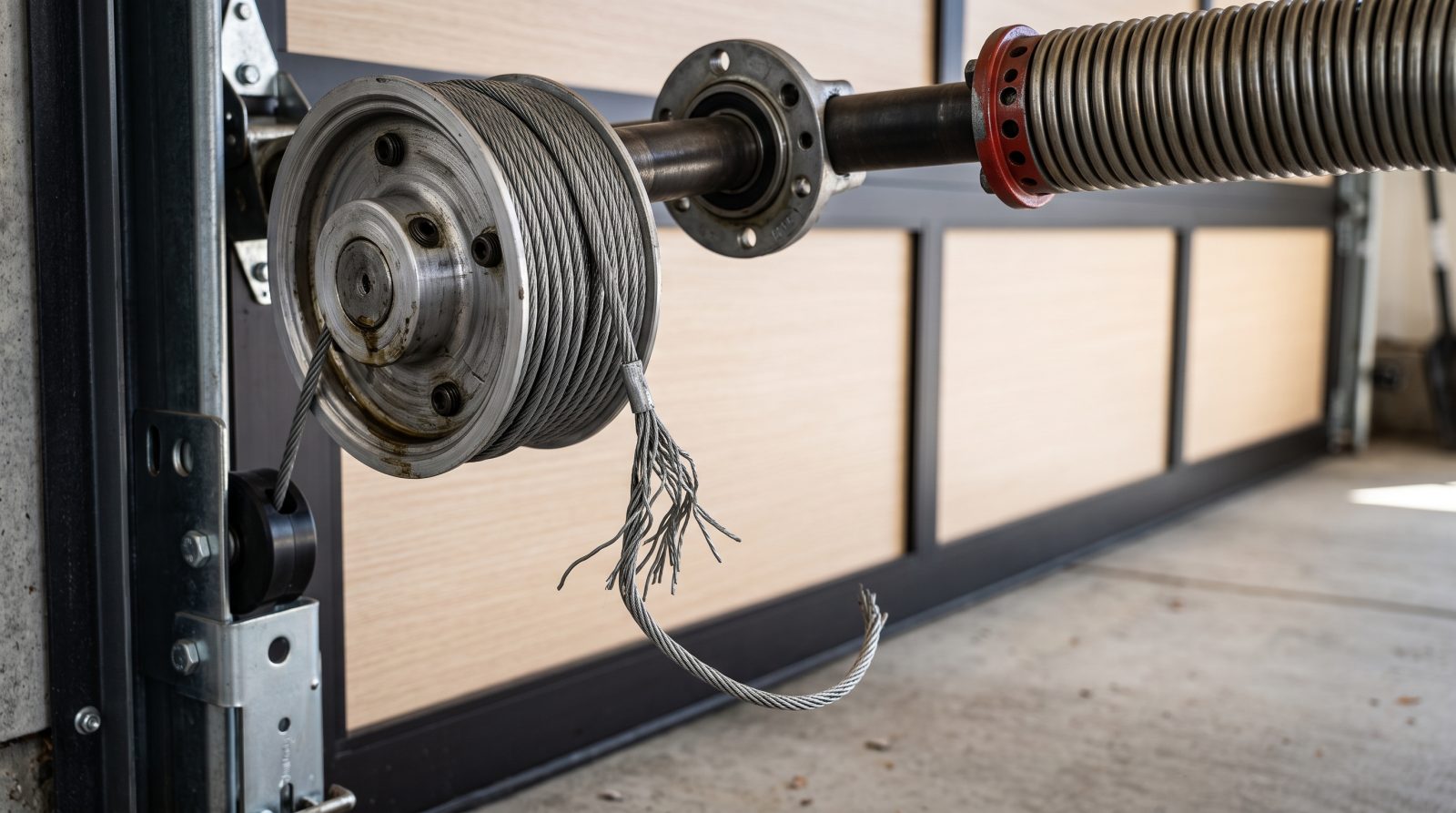
What garage door lift cables actually do
On a standard sectional garage door, a pair of galvanized aircraft-grade steel cables runs from the bottom bracket of the door up to the spring system. They don't lift the door on their own — the springs store and release the energy that does the heavy work — but the cables are what physically transfer that force to the door and keep it balanced as it travels up and down the tracks. In effect, the springs are the muscle and the cables are the tendons.
There are two main configurations. With torsion springs (the assembly mounted on a shaft above the door), the cables wind onto grooved drums at each end of the shaft as the door rises. With extension springs (the long springs running parallel to the horizontal tracks), the cables run through a pulley system and a safety cable typically threads through the spring itself. Knowing which system you have matters, because the failure modes, tension, and repair approach differ.
Cables are deliberately sized with a safety margin above the door's weight, but they are still consumable parts. They live in a high-cycle, high-tension environment, often exposed to moisture, road salt, and temperature swings, so they wear out on a predictable curve rather than lasting the life of the home.
- Cables carry load; springs supply the lifting force — the two are a matched system
- Torsion setups wind cables onto drums; extension setups route them through pulleys
- Most residential lift cables are 1/8-inch galvanized steel rated well above the door weight
- A door should feel balanced and stay put at waist height when working correctly
Why cables fray, slip, or snap
Cable failure is usually the end result of a slow process, not a single random event. The most common cause is plain fatigue: every open-and-close cycle flexes the cable over the drum or pulley, and after thousands of cycles the individual strands begin to fray. You'll often see a frayed cable start to 'fuzz' or unravel before it ever breaks completely — that's your warning window.
Moisture and corrosion accelerate everything. In coastal and snowbelt regions, salt air and road salt attack the galvanizing and rust the cable from the inside out, so the same door that lasts 12–15 years on cables in a dry climate may need them sooner near the ocean or in areas that salt their roads heavily. Hard freeze-thaw cycles add stress as components contract and expand.
Mechanical problems are the other big driver. A worn or seized pulley, a damaged drum, or tracks that are out of alignment will chew through a cable far faster than normal wear. Cables can also jump off the drum if the door is forced, if it comes off the track, or — critically — if a spring breaks. When a spring fails, the cable system is suddenly asked to handle forces it was never meant to carry alone, and a snapped or unwound cable frequently follows.
- Metal fatigue from repeated cycling — the most common, age-related cause
- Corrosion from coastal salt air, road salt, and humidity (faster failure in those climates)
- Worn pulleys, damaged drums, or misaligned tracks abrading the cable
- A broken spring overloading the cables, causing them to slip off or snap
- Improper past adjustment or DIY tinkering that left the door out of balance
The danger: why this is not a casual DIY job
Garage door cables are under extreme tension because they are tied directly to the spring system, which can store a tremendous amount of energy. A cable or spring releasing that energy unexpectedly can whip, strike with serious force, and cause severe injury — this is consistently cited as one of the most dangerous parts of garage door servicing. The bottom of a heavy door also becomes a crushing hazard the moment the lift system loses integrity.
When one cable fails, the load shifts unevenly. The door commonly hangs at an angle, binds in the tracks, or comes partly off the track entirely. At that point the second cable, the rollers, and the brackets are all carrying loads they weren't designed for, which is why a single frayed cable can cascade into a much bigger, more expensive failure if the door keeps being used.
The safe response is to stop using the door immediately, avoid pulling the manual-release cord on a door that is up (it can drop), and keep people and vehicles clear until it's inspected. Adjusting or replacing cables means relieving and re-setting spring tension safely with the right tools and technique — work that an experienced technician should handle.
- Cables and springs store enough energy to cause serious injury if released suddenly
- A heavy door with a failed lift system is a real crushing hazard
- Don't operate a door with a frayed, loose, or snapped cable — stop using it
- Don't release a raised door from the opener; secure it and call a pro
- Proper repair requires safely managing spring tension — leave it to a technician
Warning signs you should act on now
Cables usually telegraph trouble before they fail outright. Catching the signs early turns a straightforward repair into the difference between a planned service visit and an emergency — and sometimes between repairing and being forced into a rushed full replacement. Make a habit of glancing at both cables when you walk past the door.
Visually, look for fraying or 'fuzzing' where strands are starting to separate, rust or discoloration, and any kinks or flat spots. Functionally, the door may look crooked or sit unevenly at the bottom, jerk or hesitate as it moves, get noticeably louder, or struggle to stay in position when stopped halfway. A cable hanging loose off its drum, or a door that won't open at all, means the failure has already happened.
- Visible fraying, rust, kinks, or flattened sections on either cable
- The door hangs crooked, sits unevenly, or one side lags the other
- Jerking, hesitation, grinding, or new loud noises during travel
- The door won't stay put when stopped partway open
- A cable that's gone slack, jumped the drum, or is dangling — stop using the door
How a proper cable repair is done
A correct repair starts with a full-system inspection, not just swapping the broken part. A good technician relieves spring tension safely, then replaces both cables as a matched pair even if only one has failed — the surviving cable is the same age and is next in line, and matched cables keep the door balanced. They'll also inspect the springs, drums, pulleys, rollers, and tracks, because cables rarely fail in isolation.
New cables are sized to the door's height and weight and seated properly on the drums or pulleys. The technician then re-tensions the system, levels the door, and cycle-tests it several times, checking that it travels smoothly, stays balanced at multiple positions, and that the opener's safety reverse still works. A quality repair leaves the door quieter and noticeably smoother than the failing one.
Cost is best understood as a typical industry range rather than a fixed figure, because it depends on your door's size and weight, the cable type, your region, and whether related parts (springs, drums, pulleys) also need attention. As a rough national estimate, cable replacement commonly falls in the low-to-mid hundreds of dollars, with the total rising when worn springs or hardware are addressed at the same time. Any number for your specific door should come from an on-site assessment — treat online figures as estimates that vary, never a guaranteed quote.
- Inspect the whole system first; relieve spring tension safely
- Replace cables in matched pairs to keep the door balanced
- Check springs, drums, pulleys, rollers, and track alignment at the same time
- Re-tension, level, and cycle-test, then confirm the opener's safety reverse works
- Pricing is a typical range that varies by door, parts, and region — get an on-site quote
Repair the cable, or replace the door? The honest call
This is where our replacement focus earns its keep. A frayed cable on an otherwise sound, modern door is almost always a clear repair — fix it and move on. But cable failure is frequently a symptom of a door that's simply getting old, and it's worth using the moment to look at the bigger picture before pouring money into piecemeal fixes.
Lean toward repair when the door is relatively young, the panels and hardware are in good shape, and this is the first major issue. Lean toward considering a replacement when the door is well into its second decade, when you're stacking repairs (cables, then springs, then rollers, then a panel) within a short span, when panels are dented, rusted, or rotting, or when the door is thin and uninsulated and you've been wanting better efficiency, quieter operation, and curb appeal anyway. Repeatedly repairing a tired door can quietly cost more over a couple of years than a new, better-built door that comes with fresh cables, springs, and hardware throughout.
A modern replacement door also resets the entire lift system at once — new cables, springs, rollers, and balanced hardware — and lets you upgrade to a better material, an insulated build suited to your climate, and a quieter, more secure opener. If your cable failure is the third or fourth thing to go, it may be the door telling you it's time. We're happy to help you weigh a clean repair against a replacement honestly; if you'd like that assessment, request a free quote and we'll lay out both paths.
- Repair: newer door, sound panels/hardware, first real issue
- Consider replacing: door 15+ years old, stacking repairs, dented/rusted/rotting panels
- A new door resets cables, springs, rollers, and hardware all at once
- Replacement is the chance to upgrade material, insulation, quiet operation, and curb appeal
- Not sure which makes sense? Request a free quote and compare both options