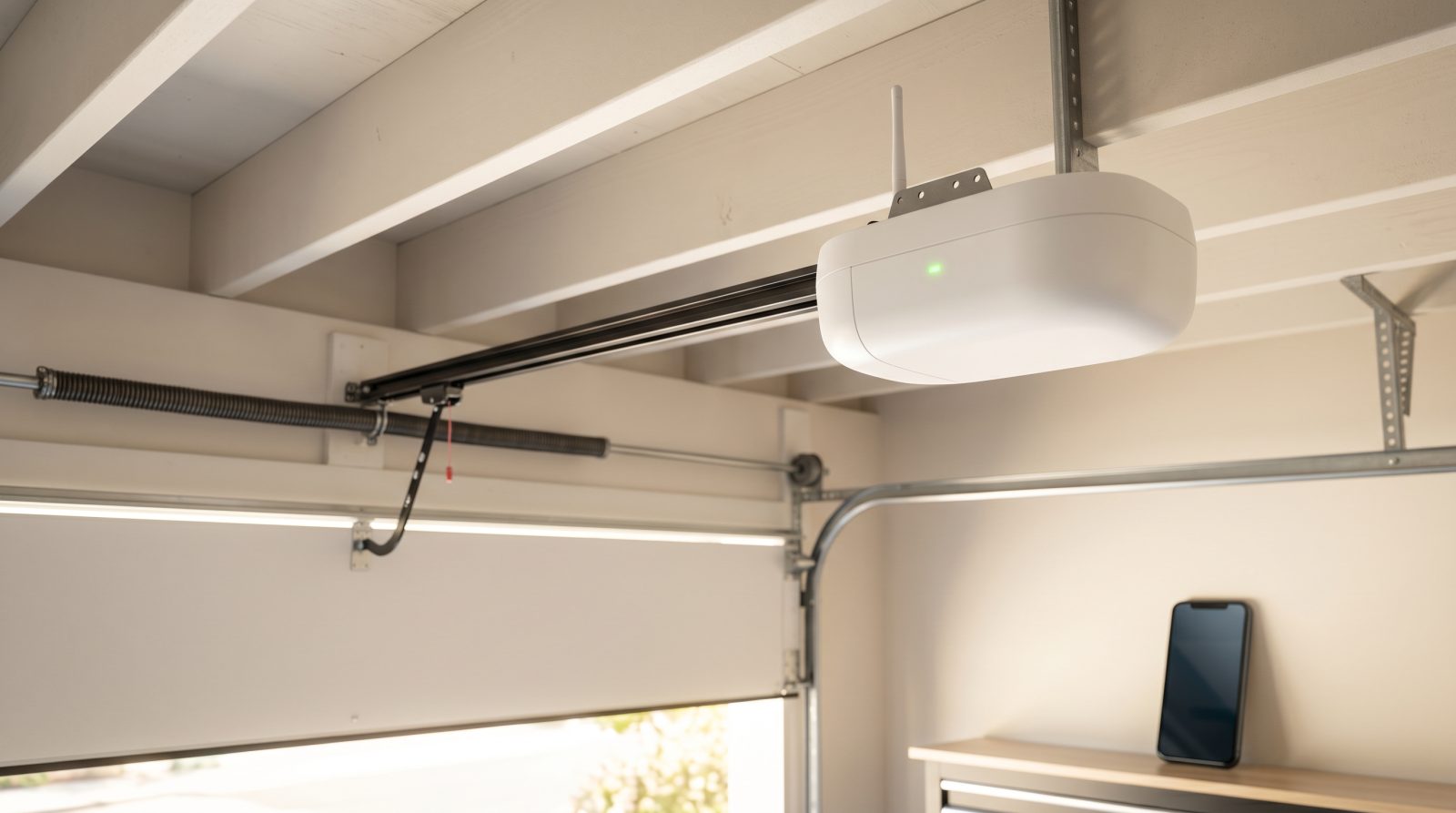
What Makes a Garage Door Opener "Smart"
At its core, a smart garage door opener is a standard opener with built-in Wi-Fi (or an add-on bridge) and a companion app. The app does three things that matter: it lets you operate the door remotely, it shows you real-time status (open or closed) wherever you are, and it sends notifications when the door changes state. That combination turns the garage from a blind spot into something you can see and control from the grocery store, the office, or bed.
Beyond the basics, most current platforms add scheduling (auto-close at a set time or after a set delay), shared access for family members and trusted guests, and an activity log that records who opened the door and when. The better systems integrate with voice assistants and smart-home hubs so the door can react to routines, though voice control of a moving door is typically gated behind a PIN or confirmation for safety.
It helps to separate two paths to "smart." The first is a new opener with native Wi-Fi built in, which is the cleanest option when you're already replacing the door and opener together. The second is a retrofit controller that clamps onto an existing opener and reports the door's position with a tilt sensor, useful if your current opener is healthy and you only want connectivity. When you're buying a whole new system, native is usually the better long-term choice because the security, status sensing, and app are designed to work as one.
- Remote open, close, and live status from a phone app, anywhere with signal
- Push alerts when the door opens, closes, or is left open too long
- Auto-close schedules and timers so the door is never forgotten overnight
- Shared access and an activity log for family, guests, or service visits
- Two routes to smart: native Wi-Fi opener (cleanest with a new door) or a retrofit controller on a healthy existing unit
Motor and Drive Types: Matching the Opener to Your New Door
Smart features sit on top of a mechanical drive system, and the drive type affects noise, smoothness, and which doors it suits best. The four common types are chain drive, belt drive, screw drive, and the wall-mounted (jackshaft) drive. Choosing here matters most when the garage shares a wall or ceiling with a bedroom or living space, which is increasingly common in newer and renovated homes nationwide.
Chain drives are the workhorse: durable and lower cost, but the loudest, so they're best for detached garages or where noise above the door isn't a concern. Belt drives use a reinforced rubber belt instead of a chain and run noticeably quieter and smoother, which makes them the popular pick for attached garages and rooms over the garage. Screw drives have fewer moving parts and can be efficient, though some are more sensitive to temperature swings, worth weighing in regions with hot summers or hard winters.
Wall-mounted jackshaft openers mount on the wall beside the door instead of on the ceiling, freeing up overhead space and running very quietly. They pair especially well with high-lift or vaulted-ceiling installations and with heavier insulated doors, and they're a strong match when curb appeal and a clean ceiling matter to you. Whatever the drive, also size the motor (horsepower or equivalent DC rating) to the door: heavier insulated steel, solid wood, or oversized doors need more lifting power than a light single-panel door, and undersizing shortens the system's life.
- Chain drive: durable and economical, but loudest, best for detached garages
- Belt drive: quieter and smoother, the common choice for attached garages and rooms over the garage
- Screw drive: fewer moving parts; check temperature tolerance in extreme-climate regions
- Wall-mounted (jackshaft): frees ceiling space, very quiet, great for high-lift, vaulted, or heavy insulated doors
- Match motor power to door weight; insulated, wood, or oversized doors need more lift
Security, Privacy and Reliability
Connecting a garage door to the internet raises fair questions, and the good news is that mainstream smart openers are built with this in mind. The foundation is rolling-code technology, where the code transmitted between remote and opener changes every use, preventing a captured signal from being replayed. On the app side, look for encrypted connections and the option for two-factor authentication on your account, since the app is effectively a key to your home.
Treat access like you'd treat house keys. Use a strong, unique password, enable two-factor authentication if offered, and review the shared-access list when family situations change or after a service visit. Many systems let you grant temporary or scheduled access rather than permanent control, which is safer for deliveries, dog walkers, or contractors. The activity log is your audit trail; check it if anything seems off.
Reliability comes down to two things: signal and power. The opener needs a stable Wi-Fi signal in the garage, which is often the far edge of a home network, so a mesh node or extender near the garage can prevent dropped connections and missed alerts. For power, a battery backup is invaluable because it keeps the door operable during an outage, a feature that is legally required for new residential openers in some states and simply smart to have everywhere, especially in storm- and outage-prone regions.
- Rolling-code transmission stops captured signals from being replayed
- Use a strong unique password and enable two-factor authentication on the app
- Grant temporary or scheduled access for guests and service visits, then review the access list
- A solid garage Wi-Fi signal (often a mesh node) prevents dropped connections and missed alerts
- Battery backup keeps the door working in an outage and is required for new openers in some states
Smart-Home Compatibility and Integrations
If you already use a smart-home ecosystem, compatibility should shape your shortlist. Many openers work with major voice assistants for status checks and routines, and some integrate with broader home platforms so the garage door can participate in scenes, such as turning on lights when the door opens after dark. Before buying, confirm the specific opener model supports the assistant or hub you actually use, since support varies by model and can change over time.
Geofencing is one of the most genuinely useful integrations: the app uses your phone's location to remind you to close the door as you drive away, or to prompt it open as you arrive. Camera and lighting integrations are increasingly common too, letting you see the garage and light it from the same app. A few platforms also work with connected vehicles and in-car controls, which can be convenient if your car supports it.
Two practical cautions. First, some advanced features (like remote control through certain third-party platforms, video history, or extended notifications) may sit behind an optional subscription, so check what's free versus paid before you commit. Second, ecosystems evolve, and an integration available today may be revised later, so favor an opener whose core app is strong on its own, with integrations as a bonus rather than the whole reason you buy.
- Confirm the exact model supports the voice assistant or hub you actually use
- Geofencing reminds you to close (or opens on arrival) based on your phone's location
- Camera and lighting integrations let you see and light the garage from one app
- Check which features are free versus behind an optional subscription
- Favor an opener with a strong standalone app so you don't depend on any single integration
Cost, Installation and Choosing It With Your New Door
As a planning estimate that varies by region, brand, and features, a smart Wi-Fi opener unit typically runs in the low-to-mid hundreds of dollars, with quieter belt-drive and wall-mounted jackshaft models toward the higher end, and a simple retrofit controller for an existing opener costing less. Professional installation adds labor that depends on whether wiring, an outlet, or rail assembly is needed. These are typical industry ranges to budget against, not a quote; the real number depends on the opener, the door's weight, and your specific garage.
The smartest savings often come from bundling. When you replace the door, installing the new opener at the same time means the door and opener are balanced and programmed together, the safety sensors and force settings are tuned to the new door's weight, and you avoid a second service trip. It's also the right moment to choose a drive type and motor power that genuinely match the door you picked, rather than reusing an old opener that may be underpowered for a heavier insulated panel.
Installation itself is precise work: the opener must be anchored correctly, the door balanced so the motor isn't straining, and the photo-eye safety sensors and auto-reverse force calibrated so the door stops and reverses on contact. These are the systems that protect children, pets, and vehicles, so they're worth getting right. If you're already investing in a new door for curb appeal and home value, completing it with a properly matched smart opener is the finishing piece, and a professional can make sure the whole system is safe, quiet, and dialed in. When you're ready, request a free quote to scope the door and opener together.
- Smart Wi-Fi opener units typically cost low-to-mid hundreds; quiet belt and wall-mount models cost more (estimates, not quotes)
- Retrofit controllers for an existing opener are the lower-cost path to connectivity
- Bundling opener with a new door balances and programs them together and avoids a second trip
- Pick drive type and motor power to match the new door's weight, especially heavier insulated panels
- Proper install means tuned safety sensors and auto-reverse, the systems that protect people and vehicles