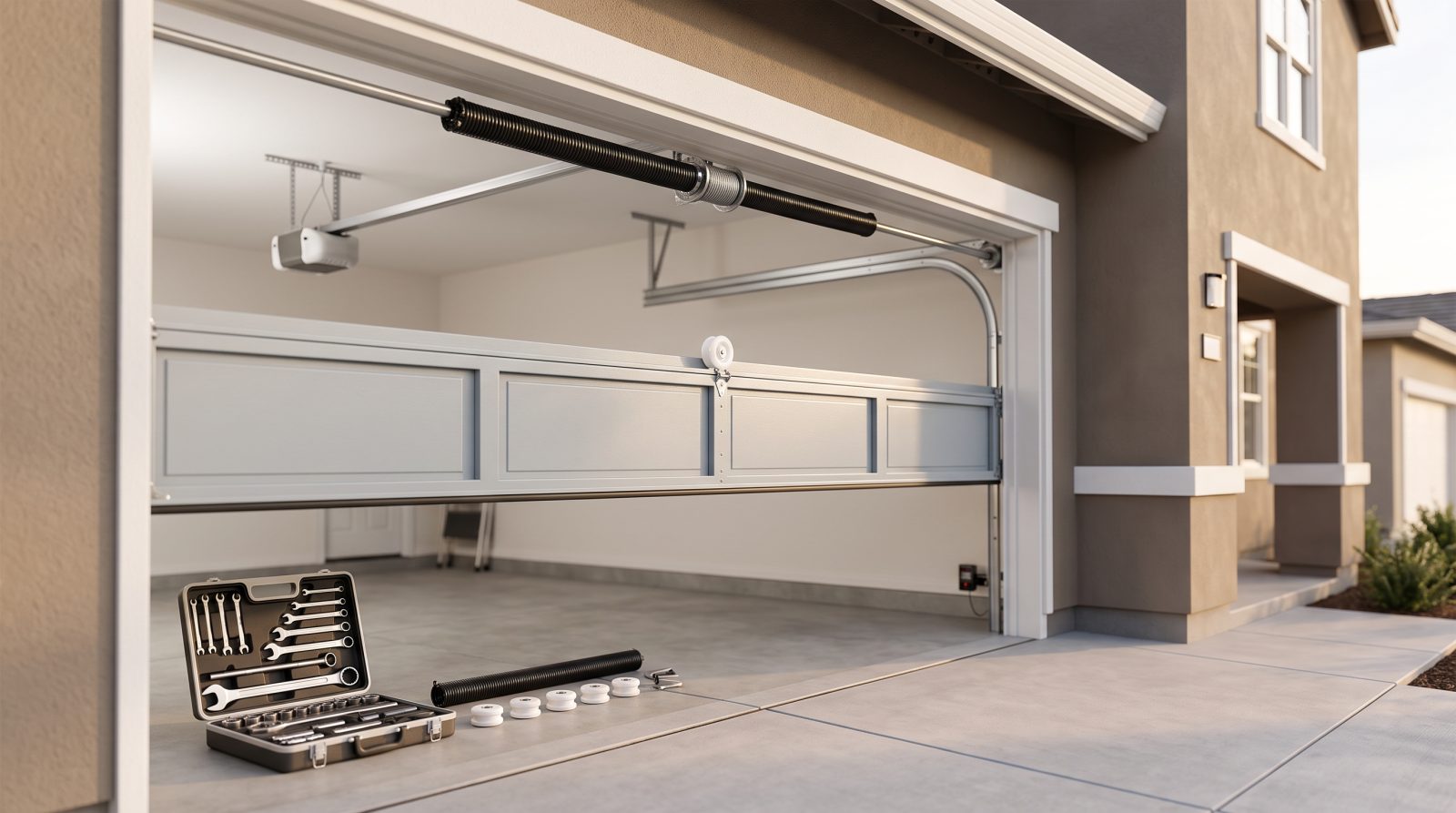
What Garage Door Repair Typically Costs
Most homeowners do not need a complete door, they need one part fixed, and the price depends almost entirely on which component failed and how hard it is to reach. A single, common repair usually lands in a low-to-moderate range, while jobs that involve heavy hardware under tension, full panel replacement, or specialty doors sit higher. The ranges below are typical industry estimates that vary by door size, material, brand, region, and the scope of the work once a technician inspects it in person.
It also helps to understand how repair pricing is built. A quote generally combines a service or trip component, the cost of the parts themselves, and the labor to install them safely. Because some repairs share the same service visit, bundling related fixes during one appointment is often more economical than calling back for each issue separately. Treat the figures here as planning ranges so you can sanity-check a quote, not as a fixed price for your specific door.
- Spring replacement: a frequent repair, typically in the low-to-mid hundreds depending on torsion vs. extension springs and whether one or both are replaced
- Opener repair or replacement: from a modest range for a part like a gear or circuit board up to several hundred for a new opener unit with installation
- Cables, rollers, and hinges: usually among the more affordable repairs when handled on their own
- Track realignment or replacement: moderate, rising if the track is bent or the door came off its tracks
- Panel or section replacement: often the most expensive repair, sometimes approaching the cost of a partial replacement
- Sensor, weatherstripping, and minor hardware: typically the lowest-cost fixes
Cost Breakdown by Repair Type
Springs do the heavy lifting on every garage door, counterbalancing hundreds of pounds so the opener and your hand only move a fraction of the real weight. They are also the part under the most tension, which is why spring work is a leading repair and why it should be left to a professional. Torsion springs (mounted on a bar above the door) generally cost more than extension springs but last longer, and replacing springs in matched pairs is common practice because the second is usually close behind the first.
Openers fail in two ways: a single component goes (a gear, a logic board, a sensor, a remote) or the motor unit reaches the end of its life. Component-level fixes are typically the cheaper path, while a full opener swap costs more but can add quieter operation, battery backup, and smartphone control. Cables, rollers, and hinges are wear items that are comparatively inexpensive on their own, but when they fail they can let the door bind, drift, or come off its tracks, which turns a small fix into a larger one if ignored.
Panels and sections are where repair costs climb fastest. A dented or cracked section often has to be matched to your door's exact model and finish, and on older or discontinued doors a true match can be hard to source. When more than one or two sections are damaged, the part-and-labor total can approach the lower end of a new-door investment, which is exactly the moment to weigh replacement instead of patching.
- Torsion springs: longer-lasting, higher cost than extension springs; replacing in pairs is standard
- Extension springs: lower cost, common on older or lighter single doors
- Logic board / circuit board: a mid-range opener repair that restores a unit that otherwise works
- Rollers and hinges: low-cost wear parts, often replaced as a set for smooth, quiet travel
- Lift cables: affordable but safety-critical; frayed cables should be addressed promptly
- Single panel/section: variable and sometimes high, driven by color match and model availability
What Changes the Price (Region, Climate, and Scope)
The same repair can carry a noticeably different price depending on where you live. Labor rates track local cost of living, so metro and coastal markets tend to run higher than rural areas. Climate plays a quieter but real role too: homes near the coast deal with salt-air corrosion on springs, cables, and hardware, while regions with hard freezes and heavy snow load see more strain on springs and more weather-seal wear, which can mean parts wear faster and get replaced more often over a door's life.
Scope is the other big lever. The door's size and weight matter, a heavy insulated two-car door puts more load on every part than a light single door, and material matters too, since steel, wood, aluminum, and composite doors use different hardware and finishes. High-lift or commercial-style tracks, custom colors, glass inserts, and hard-to-source parts on older doors all push a quote up. Accessibility counts as well: a door wedged off its tracks or a unit in a tight, cluttered garage simply takes longer to service safely.
Finally, timing affects price. Standard scheduling is usually the most economical, while urgent same-day or after-hours help generally carries a premium because of the convenience and dispatch involved. Choosing a normal appointment when the situation allows is one of the simplest ways to keep a repair affordable.
- Local labor rates: higher in major metros and coastal regions, lower in rural areas
- Coastal salt air: accelerates rust on springs, cables, and hardware
- Freeze/snow climates: more spring strain and weather-seal wear over the door's life
- Door size, weight, and material: heavier insulated and custom doors cost more to service
- Part availability: older or discontinued doors can be pricier to match
- Scheduling: routine appointments cost less than urgent or after-hours service
Repair vs. Replace: When New Is the Smarter Spend
Because choosing the right new door is what this site is built around, the most useful cost question is not just what a repair costs today, it is whether that repair is the best use of your money. A reliable rule of thumb is the math of frequency and proportion: if repairs are stacking up, or a single repair approaches a meaningful share of what a comparable new door would cost, replacement usually wins on a multi-year basis. A new door resets the clock on springs, rollers, panels, and insulation all at once, instead of you paying piecemeal as each aging part fails.
Door age and design also point the way. Doors past roughly 15 to 20 years often combine worn hardware, dated styling, and little or no insulation, so repairing one part rarely fixes the underlying decline. Replacing gives you a chance to upgrade insulation (helpful for attached garages and living space above them), improve security and quiet operation, and modernize curb appeal, an upgrade that buyers and appraisers notice. A new garage door is consistently one of the better-returning exterior home improvements, so the spend does double duty as comfort and resale value.
If you are on the fence, a good technician can give you both numbers, the honest repair estimate and a replacement range, so you can compare them side by side rather than guessing. That transparency is the whole point: fix it when fixing it is genuinely the better value, and replace it when a new door will cost less over time and look and perform far better while it lasts.
- Repairs are recurring or escalating, suggesting the door is near end of life
- A single repair approaches a meaningful share of a comparable new door's cost
- The door is roughly 15-20+ years old with dated styling and minimal insulation
- You want better insulation, quieter operation, or improved security
- Curb appeal and home value matter, replacement is a strong-returning upgrade
- Parts for your model are discontinued or hard to match
How to Get an Accurate Quote (and Avoid Overpaying)
No honest pro can give you a final price sight unseen, because the cost hinges on the exact part, the door's condition, and access. The ranges in this guide are for planning, an on-site look is what turns a range into a real number. To compare quotes fairly, ask each provider to itemize parts versus labor, confirm whether the price includes the service or trip component, and clarify the warranty on both the part and the workmanship.
A few habits protect your wallet. Be wary of a price that seems far below everyone else, on safety-critical work like springs and cables, the cheapest bid sometimes reflects lower-quality parts or rushed installation that costs more later. Bundle related fixes into one visit when you can, and ask whether a slightly larger repair now (for example, replacing both springs or a full set of rollers) prevents a repeat call soon. And if the repair estimate is climbing toward replacement territory, ask for the new-door range so you can make the call with both numbers in front of you.
When you are ready, the fastest way to a precise figure is a free, no-obligation assessment of your specific door, so the issue can be diagnosed, the repair quoted honestly, and a replacement option shown if a new door would serve you better. Request a free quote and we will help you decide whether to fix it or upgrade it, with no pressure either way.
- Insist on itemized parts and labor, plus whether the service/trip fee is included
- Confirm warranty coverage on both the part and the installation
- Treat unusually low bids on springs/cables with caution
- Bundle related repairs into one visit to save on service costs
- Ask for a replacement range whenever a repair nears new-door pricing
- Get an on-site assessment, the only way to turn a range into a real quote