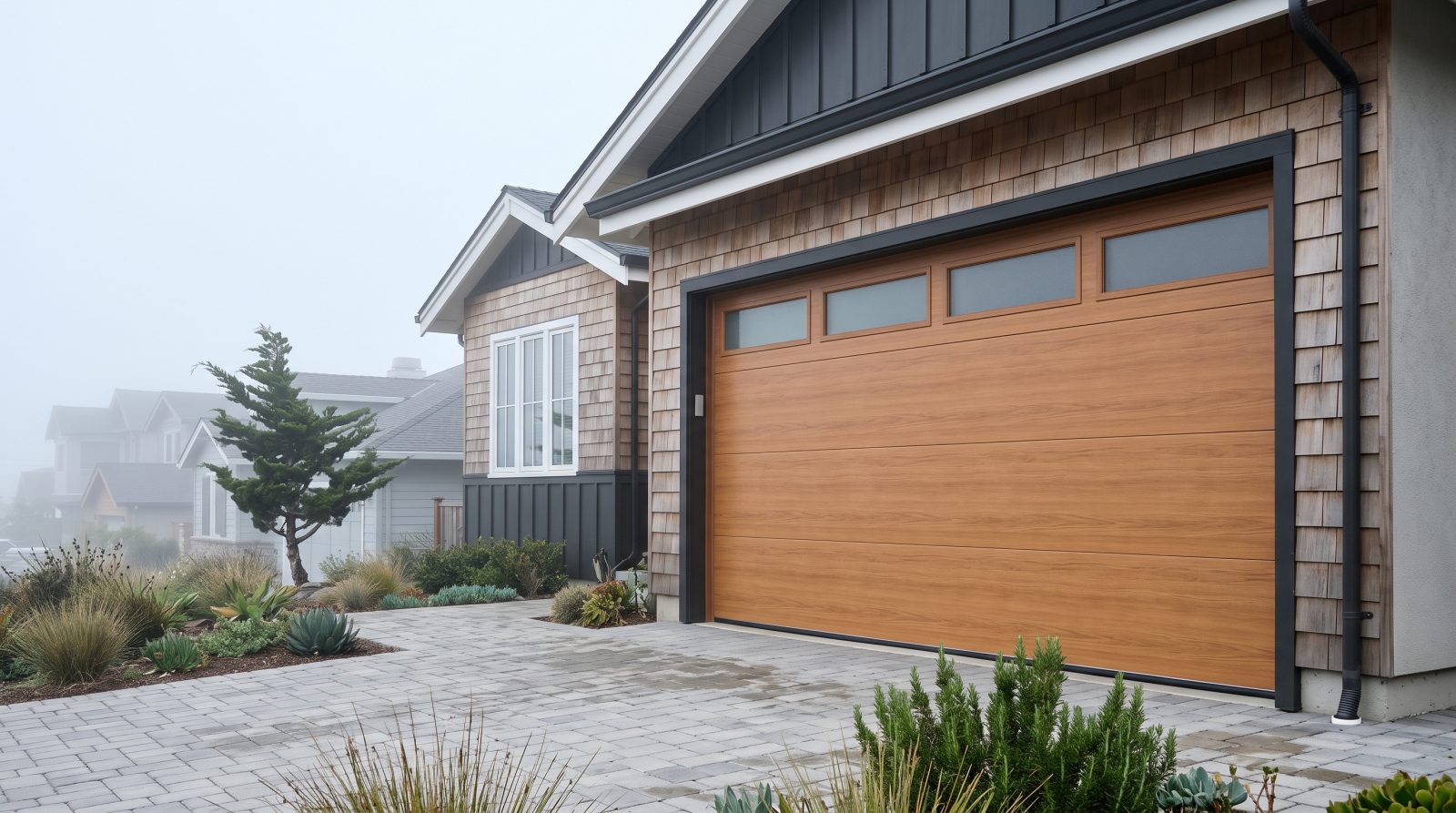
What a Fiberglass Garage Door Actually Is
The term "fiberglass garage door" can be slightly misleading, because almost none of these doors are pure fiberglass. In nearly all cases, fiberglass refers to the door's exterior skin or cladding, while the structural core and frame are built from other materials. Understanding that layered construction is the key to buying well, because the parts you can't see determine how the door performs in heat, cold, wind, and humidity.
A typical fiberglass door uses molded fiberglass-reinforced or composite panels bonded to a frame, often aluminum or a rigid composite, with an insulating core such as polyurethane or polystyrene foam sandwiched between the front and back faces. The fiberglass face is what gives the door its signature traits: it can be molded with a deep, realistic wood-grain texture, it accepts stains and finishes that imitate species like cedar or mahogany, and it resists the dents and corrosion that affect metal doors.
Because the fiberglass is the visible, weather-facing layer and not the structural backbone, build quality varies enormously. Premium doors use thicker, UV-stabilized fiberglass faces, fully insulated cores, weather-tight section joints, and corrosion-resistant hardware. Budget doors may use thin single-layer skins with little or no insulation and lower-grade tracks and springs. When you compare quotes, you are really comparing these hidden specifications, not just the look.
- Fiberglass is usually the exterior skin, not the whole door, bonded to a composite or aluminum frame
- Insulated models include a foam core (polyurethane or polystyrene) for thermal performance and rigidity
- Molded wood-grain texture lets fiberglass convincingly imitate real wood at a lower maintenance burden
- Quality varies widely; skin thickness, core insulation, UV stabilization, and hardware grade matter most
Why Fiberglass Shines in Coastal and Humid Climates
Fiberglass earns its reputation in exactly the environments where other materials struggle. Along the coast, salt-laden air is relentlessly corrosive. Steel doors, even when galvanized and well painted, can eventually show rust at cut edges, fasteners, and scratches if the protective layers are compromised. Fiberglass does not rust, which is its single biggest advantage near salt water. The face won't corrode, and when paired with stainless or corrosion-resistant hardware, the whole assembly holds up far better to a marine environment.
In humid and rainy regions, wood is the material most at risk. Real wood doors can absorb moisture, swell, warp, and eventually rot or develop mildew without diligent refinishing. Fiberglass is dimensionally stable and does not absorb water the way wood does, so it resists warping and swelling through wet seasons and big swings in humidity. For homeowners who love the look of a wood door but dread the upkeep in a damp climate, a wood-grain fiberglass door is often the most practical compromise.
Fiberglass also tolerates temperature swings and intense sun reasonably well, though this is where quality matters. Lower-grade fiberglass can become brittle and fade or chalk after years of harsh UV exposure, while premium UV-stabilized faces hold color and flexibility much longer. In very hot, sun-baked regions, choosing a quality door with a UV-resistant finish and a lighter color is a sensible hedge. As always, this is a general pattern rather than a guarantee for a specific product, so confirm the manufacturer's climate ratings for your area.
- Does not rust, the decisive edge over steel in salt-air coastal zones
- Resists the warping, swelling, and rot that threaten wood in humid, rainy regions
- Dimensionally stable through humidity swings and wet seasons
- Pair with corrosion-resistant or stainless hardware to protect the whole assembly near salt water
- Choose UV-stabilized faces in high-sun regions to limit fading and brittleness over time
Fiberglass vs. Steel vs. Wood for Replacement
When you're replacing a garage door, fiberglass is best understood in contrast to its two main competitors. Steel is the most popular material nationwide because it is durable, affordable, low-maintenance, and available insulated; its main weaknesses are denting from impacts and the potential for rust where coatings fail, which makes it less ideal directly on the coast. Wood offers unmatched authentic beauty and customization but demands ongoing refinishing and is vulnerable to moisture, making it high-commitment in humid climates.
Fiberglass slots in as a specialty choice that solves specific problems. Against steel, fiberglass wins on corrosion resistance and on realistic wood-look texture, and it generally won't dent the way a thin steel skin can. Against wood, fiberglass wins decisively on maintenance and moisture stability while approximating the appearance. Its trade-offs are real, though: lower-grade fiberglass can crack on sharp impact or in extreme cold, and the very cheapest fiberglass doors are poorly insulated and can look plasticky compared with quality steel.
For most inland homeowners in moderate climates, well-insulated steel remains the value leader and the default recommendation. Fiberglass becomes the smarter buy when you have a clear reason: a coastal or salt-air location, a humid climate that punishes wood, a desire for a low-maintenance wood look, or a need for a lighter-weight door. Framing your decision around your specific climate and priorities, rather than chasing a single "best" material, is how you avoid overpaying for features you don't need or under-buying for the conditions you face.
- Steel: best all-around value inland; durable and low-maintenance but can dent and may rust at the coast
- Wood: most authentic and customizable but high-maintenance and moisture-sensitive
- Fiberglass: the corrosion-proof, low-maintenance wood-look specialist, ideal near salt air and in humid regions
- Watch-outs for fiberglass: cheap versions can crack on impact or in deep cold and may be poorly insulated
Insulation, Styles, and What to Specify
Insulation is one of the most important and most overlooked specifications on any replacement door, and it applies to fiberglass too. If your garage is attached, finished, used as a workshop or gym, or sits below living space, an insulated door helps moderate temperature, reduce noise, and improve energy efficiency. Insulation is commonly described by R-value, which estimates resistance to heat flow; higher numbers indicate better insulating performance. Treat any single R-value as a comparative guide rather than a precise promise, since installation quality, weather sealing, and the rest of the garage affect real-world results.
On style, fiberglass is most often chosen for its wood-look molded textures, which range from rustic carriage-house designs to clean contemporary flush panels. You can typically specify stain-tone finishes that imitate species like cedar, oak, or walnut, as well as solid paint colors. Window options, decorative hardware, and panel layouts let you tune curb appeal, which matters because the garage door is frequently the single largest visual element on a home's front elevation and a meaningful contributor to perceived value and resale appeal.
Beyond looks, specify the things that govern durability and safety. Ask about the fiberglass skin thickness and whether it is UV-stabilized, the core insulation type and value, the frame material, and the weather sealing at the bottom and between sections. Confirm corrosion-resistant hardware if you're near the coast, and make sure the door is paired with the right spring system and an opener equipped with modern safety sensors. A quality door installed with the wrong supporting hardware will not perform to its potential.
- Choose insulated cores for attached garages, workshops, or rooms above the garage; compare R-values as a guide
- Wood-grain textures and stain-tone finishes deliver the wood look without the wood maintenance
- Windows, panel layouts, and decorative hardware tune curb appeal and front-elevation impact
- Specify skin thickness, UV stabilization, core type, frame material, weather sealing, and corrosion-resistant hardware
- Match the door to the correct spring system and a safety-sensor-equipped opener
Typical Costs and How to Plan Your Replacement
Pricing for fiberglass garage doors varies widely based on size, insulation, skin quality, window and hardware options, finish, and your region, so any figure should be treated as a typical industry estimate rather than a quote. As a rough national guide, fiberglass doors often land in a mid-to-upper range compared with basic steel, frequently overlapping with mid-grade steel and premium composite doors, while authentic wood doors generally sit at the top of the market. A single-car door costs less than a two-car or oversized door, and added insulation, windows, custom stains, and upgraded hardware each raise the total.
Professional installation is a separate and important line item. A correct install includes accurate measurement, removal and disposal of the old door, balancing the springs, aligning tracks, sealing against weather, and testing the opener and safety sensors. Because garage door springs are under high tension and can cause serious injury, spring and full-door installation is genuinely not a DIY project for most homeowners. Costs for installation vary by region and complexity, and difficult openings or structural adjustments add to the figure.
To plan well, measure your opening, decide whether you need insulation, and prioritize the climate-driven features that justify fiberglass in the first place, especially corrosion resistance near salt air and moisture stability in humid regions. Then gather multiple itemized estimates so you can compare doors on the same specifications rather than headline price alone. When you're ready, you can request a free quote to get accurate, location-specific pricing for your home and to confirm the right configuration for your climate.
- Treat all figures as typical estimates that vary by size, insulation, options, finish, and region, never a fixed quote
- Fiberglass commonly sits in a mid-to-upper range, overlapping mid-grade steel and below authentic wood
- Insulation, windows, custom stains, and upgraded hardware each increase the total
- Budget for professional installation, including old-door removal, spring balancing, sealing, and safety testing
- Compare itemized estimates on identical specs, and prioritize the climate features that justify fiberglass for your home