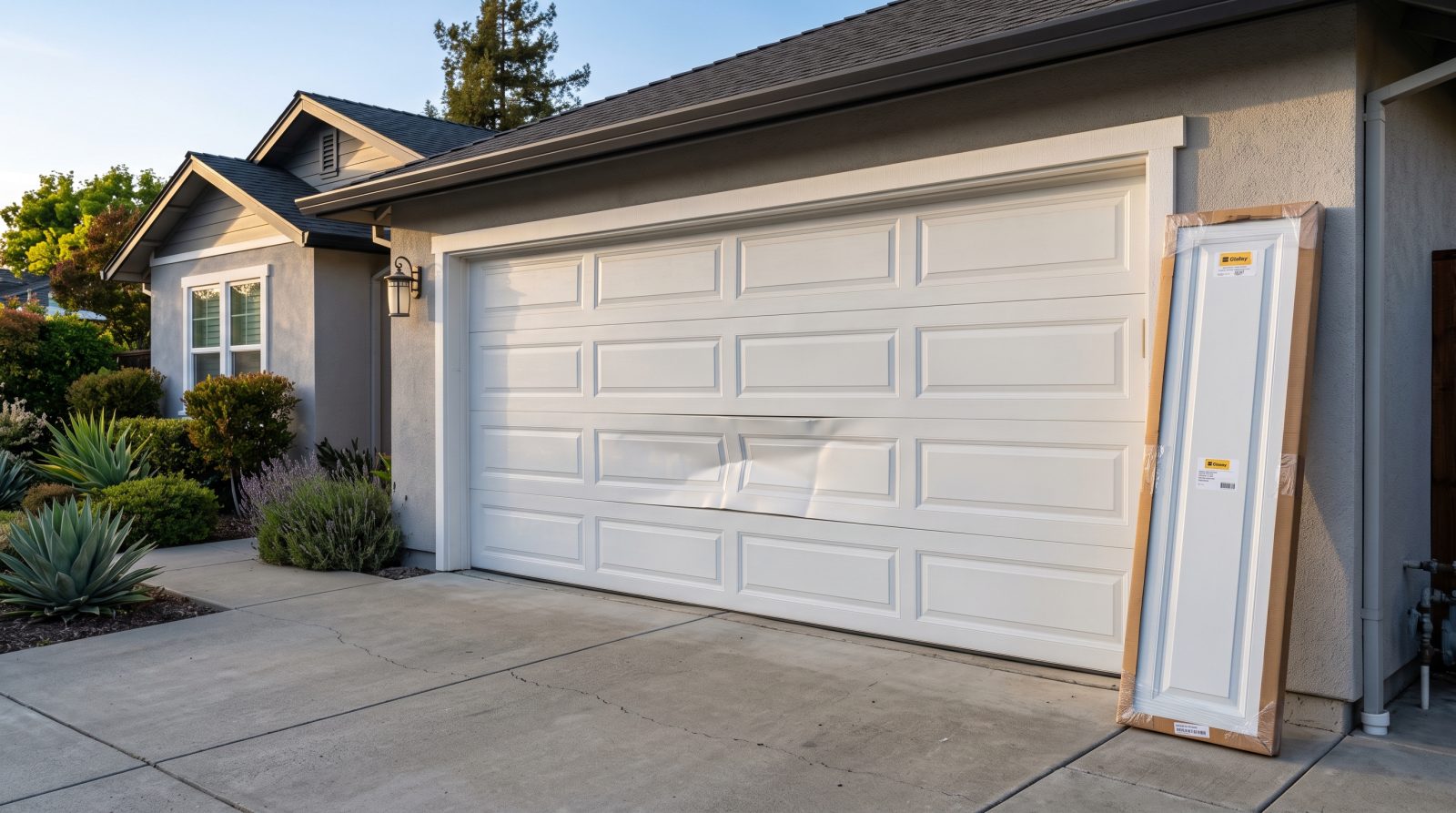
What a Garage Door Panel Actually Is — and Why One Section Can Fail
A sectional garage door — the standard style on the vast majority of American homes — is built from horizontal sections, usually four or five, hinged together so the door can roll up along a curved track. Each of those horizontal sections is a "panel." When people say they need a "panel replacement," they almost always mean swapping out one or two damaged sections rather than the full stack.
Panels take damage in predictable ways. The bottom section absorbs most car contact and is the single most commonly replaced panel in the country. Wind events can bow or crease the upper sections on doors without reinforcement struts. In coastal and humid regions, steel skins can rust from the inside out along the bottom edge, while in northern climates repeated freeze-thaw and road salt accelerate the same corrosion. Wood doors warp, rot, or delaminate; older aluminum-and-glass full-view doors can have a single dented frame or a cracked acrylic insert.
The good news: because the door is modular, a clean single-panel swap is genuinely possible and often the most cost-effective fix. The catch — and it's a real one — is that the replacement section has to match the rest of the door in profile, color, and construction, which is where most decisions actually turn.
When a Single-Panel Replacement Makes Sense
Replacing one section is usually the right move when the rest of the door is in genuinely good shape and the damage is isolated. Think of a five-year-old insulated steel door where a delivery truck creased the bottom panel but the springs, rollers, tracks, and other sections are all sound. Swapping that one panel restores the door for a fraction of a full replacement.
A few conditions make a panel swap a strong candidate:
When those boxes are checked, a panel replacement is typically the lower-cost, lower-disruption path and keeps a perfectly good door in service.
- The door is relatively new (roughly under 8–10 years) and the same model and panel design are still in production
- Only one, or at most two, sections are damaged, and the rest of the door is structurally clean with no widespread rust or rot
- The damage is cosmetic or localized — a dent, crease, or cracked window insert — rather than a bend that's thrown the whole door out of square
- The existing color is a stock finish you can match, or you're prepared to repaint the new panel to blend it
- The door's hardware (springs, cables, rollers, opener) is healthy, so you're not stacking a panel cost on top of imminent hardware repairs
When You're Better Off Replacing the Whole Door
The honest truth most homeowners aren't told: a single-panel swap can quietly cost more than it should, and sometimes more than a full door is worth. Several situations tip the math decisively toward full replacement.
The biggest one is matching. Manufacturers revise panel embossing, woodgrain texture, and color formulas constantly, and they discontinue models after a few years. If your door is more than about a decade old, there's a real chance the exact panel no longer exists — meaning a "matching" section will be visibly off in profile or sheen, leaving you with a door that looks patched. At that point you're paying a meaningful sum for a result you won't love.
Other strong signals to replace the entire door:
A useful rule of thumb: if a panel replacement would run somewhere north of roughly half the cost of a comparable new door, replacing the whole door almost always delivers more value — a uniform look, a fresh warranty on the full assembly, and an upgrade opportunity you'd otherwise miss.
- Multiple sections are damaged, or the door is bent/twisted enough that it no longer seals or tracks straight
- The door is single-layer (non-insulated) and you'd benefit from upgrading to an insulated door for energy and noise — a panel swap can't deliver that
- There's widespread rust, rot, or delamination, which signals the rest of the door is near end of life anyway
- The opener, springs, and hardware are also aging — bundling everything into one replacement is cleaner and often more economical than a string of separate repairs
- You're preparing to sell, and a fresh, modern door materially improves curb appeal and is one of the most consistently high-return exterior upgrades a home can make
What Panel Replacement Actually Costs (Typical Industry Ranges)
Costs vary widely by door material, panel size, insulation, finish, and your region, so treat the following as typical industry estimates rather than a quote — your actual numbers depend on the specific door and local labor. A standard single steel panel, supplied and installed, commonly falls somewhere in the low-to-mid hundreds of dollars, with insulated and premium-finish panels running higher. Custom, carriage-house, wood, or full-view glass-and-aluminum sections can climb well above that because the materials and matching are more involved.
By comparison, a full new garage door — door, hardware, and installation — typically spans a broad range from the mid hundreds for a basic single-layer steel door up into the thousands for insulated, custom, wood, or designer doors. That gap is exactly why the panel-versus-whole-door decision matters so much financially.
A few cost factors people underestimate: panel availability surcharges or freight on discontinued sections; the labor to disassemble and reassemble the door safely (sections are under tension as a system); paint-matching if the finish is non-stock; and the possibility that opening up a damaged panel reveals bent hinges, rollers, or struts that should be addressed at the same time. A reputable provider will inspect the whole door before quoting, not just the dented section.
The Panel Replacement Process — and Why It's Not a True DIY Job
Replacing a section looks simple from the driveway, but a sectional door is a tensioned system, and that's where the danger lives. The torsion or extension springs that counterbalance the door store enough energy to cause serious injury, and the door must be properly supported and the spring tension managed before any section comes apart. This is the main reason panel replacement is best left to trained technicians with the right tools.
A typical professional panel replacement runs roughly like this:
A careful tech also takes the opportunity to check the rest of the door while it's apart — worn rollers, stretched cables, tired springs — so you're not back in a month for a separate fix. If matching turns out to be impossible or the underlying door is worse than it looked, a good provider will tell you honestly that full replacement is the better spend rather than forcing a mismatched patch.
- Inspect and confirm the door make, model, and exact panel spec, and verify the replacement section is a true match before any work begins
- Safely secure the door and relieve spring tension as needed so sections can be separated without sudden movement
- Remove the damaged section by detaching hinges, rollers, and any struts connecting it to the adjacent panels
- Fit the new panel, reattach hardware, install or transfer reinforcement struts, and realign rollers in the track
- Rebalance the door, test spring tension, cycle the opener, check the bottom seal, and confirm the door travels smoothly and seals flush
Making the Decision: A Quick Framework
When you're weighing one panel against a whole door, run through four questions in order. First, can the exact panel still be matched in profile, texture, and color? If not, lean strongly toward full replacement. Second, how old is the door and how healthy is everything else — springs, rollers, tracks, opener? An aging system argues for replacing it all at once. Third, would a new door let you upgrade something that matters to you, like insulation, quieter operation, security, or curb appeal? A panel swap can't give you those. Fourth, what does the money say — if the panel fix approaches half the cost of a comparable new door, the new door usually wins on value.
If the answers point to a clean, matchable, single-section fix on an otherwise solid and reasonably new door, a panel replacement is the smart, economical choice. If matching is shaky, the door is older, or you'd genuinely benefit from an upgrade, a full replacement protects you from paying twice and gives you a uniform door, a fresh warranty, and a real boost in appearance and home value.
Not sure which way your door leans? The most reliable next step is an honest, on-site assessment of the full door — not just the dent — so you can compare a matched-panel estimate against a new-door estimate side by side and choose with clear eyes. Request a free quote and get both numbers before you commit.