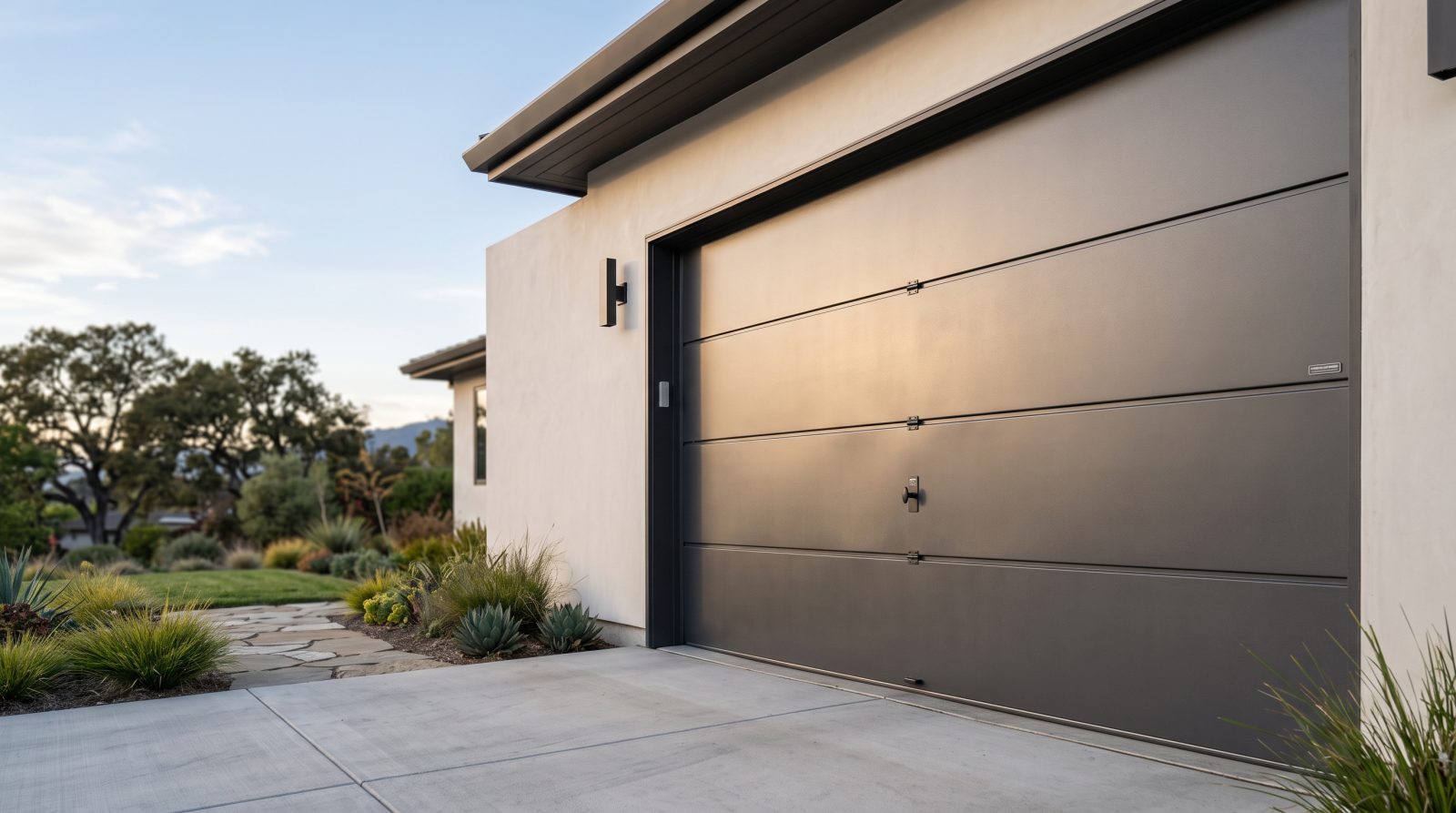
Why Steel Dominates the Replacement Market
When homeowners across the country shop for a new or replacement garage door, steel is the default choice in most price brackets, and it earns that position by doing several things well at once. It resists the rot, warping, and insect damage that can plague wood. It holds paint and factory finishes for years. It can be insulated to genuinely useful levels. And it can be engineered for impact and wind resistance where weather demands it. For a part of your home that is the single largest moving object on the property and often the most visible element of your facade, that combination is hard to beat.
Steel also scales well across budgets. At the entry level you can get a clean, single-layer steel door that simply works. Step up and you add insulation, a tougher multi-layer sandwich construction, and finishes that mimic wood grain convincingly. That flexibility means a steel door can suit a rental property, a primary residence, or a high-end custom home, which is part of why it's the workhorse of the replacement industry.
Because a garage door can account for roughly a third of a home's street-facing surface, replacing a tired door with a well-chosen steel model is one of the more reliable curb-appeal and resale upgrades available. Industry cost-versus-value studies consistently rank garage door replacement among the home improvements with strong cost-recouped percentages, and steel is the material doing much of that heavy lifting.
- Low maintenance: no sanding, sealing, or repainting cycles the way wood requires
- Dimensionally stable: it won't swell, warp, or rot with humidity swings
- Insulatable: available in configurations that meaningfully cut heat transfer
- Secure and strong: multi-layer construction resists impacts and pry attempts
- Wide price range: options from budget-friendly to premium architectural styles
Understanding Steel Gauge and Construction Layers
The single most important spec when comparing steel doors is the gauge of the steel, which describes its thickness. Counterintuitively, a lower gauge number means thicker, stronger steel. Most residential garage doors fall in the range of roughly 24 to 27 gauge. A 24- or 25-gauge door uses noticeably heavier steel and resists dents and weather better, while a 27-gauge or thinner door costs less but is more prone to denting from a bumped basketball, hail, or a careless bumper. If your door faces a busy driveway, active kids, or severe weather, paying up for a heavier gauge is usually money well spent.
Just as important is how the door is built up. Single-layer (single-skin) doors are one sheet of steel with no insulation, which makes them the lightest and cheapest but also the noisiest, least energy-efficient, and most dent-prone. Two-layer doors add an insulation board, typically polystyrene, bonded to the back of the steel skin, improving rigidity and temperature control. Three-layer (sandwich) doors enclose an insulation core, usually polyurethane or polystyrene, between two steel skins, producing the strongest, quietest, and best-insulated steel doors available.
If you're choosing a steel door you intend to keep for the long haul, especially on an attached garage or a home in a demanding climate, a three-layer insulated door is generally the sweet spot. It feels solid, dampens road and weather noise, runs quieter on the opener, and holds up to daily use far better than a thin single-skin panel.
- Gauge: lower number equals thicker steel; 24 to 25 gauge is sturdier than 27
- Single-layer: cheapest, lightest, no insulation, most prone to dents and noise
- Two-layer: a steel skin plus a bonded insulation board for added rigidity
- Three-layer (sandwich): two steel skins around an insulated core, the strongest and quietest build
- Heavier, multi-layer doors also tend to operate more smoothly and last longer
Insulation, R-Value, and Climate Considerations
Insulation is where the steel-door decision gets genuinely regional. A door's thermal performance is described by its R-value, where a higher number means better resistance to heat flow. Single-skin doors offer essentially no insulation. Insulated steel doors commonly land anywhere from a modest R-6 or so up through the high teens, with premium polyurethane sandwich doors reaching the upper end. Be aware that manufacturers may quote a center-of-panel R-value rather than a whole-door figure, so compare on the same basis when you can.
Whether you need a high R-value depends heavily on where you live and how you use the space. If your garage is attached to the house, shares a wall with a bedroom or living area, or sits below conditioned rooms, better insulation pays off in comfort and reduced energy loss in both hot and cold climates. In northern regions with long, cold winters, a well-insulated door helps keep the garage and adjacent rooms warmer and reduces strain on heating. In the South and Southwest, that same insulation slows solar heat gain and keeps a garage workshop or gym more tolerable through brutal summers.
If your garage is detached, unconditioned, and used only for parking, you can reasonably prioritize budget over a high R-value, though even modest insulation adds rigidity and quietness. The honest takeaway: don't pay for the highest R-value available out of reflex. Match the insulation level to your climate, your garage's relationship to your living space, and how you actually use the room. Polyurethane cores generally insulate better per inch and bond more tightly than polystyrene boards, which is why they dominate premium tiers.
- R-value measures heat resistance; higher is better, but compare whole-door vs center-of-panel figures
- Attached garages and shared walls with living space benefit most from higher insulation
- Cold-climate homes gain winter comfort and heating efficiency from insulated doors
- Hot-climate homes use insulation to fight solar heat gain in garages used as workspaces
- Polyurethane cores typically outperform polystyrene boards on R-value and rigidity
Styles, Finishes, and Curb Appeal
One of steel's underrated strengths is how good it can look. Modern steel doors come in traditional raised-panel and flush designs, carriage-house styles with decorative hardware, and contemporary flat or grooved panels, often with optional glass window sections to bring light into the garage. Factory finishes range from simple solid colors to convincing wood-grain textures that capture the warmth of wood-look styling without the upkeep wood demands. For homeowners chasing curb appeal on a budget, a steel carriage-house door is one of the higher-impact, lower-fuss choices available.
When you're selecting a finish, think about how the door reads against your home's exterior. A color that complements your trim, front door, and siding ties the facade together, while window inserts and hardware accents can echo your home's architectural style. Because the garage door is such a large visual element, getting the proportions and style right does more for curb appeal than almost any other single exterior swap.
It's worth being realistic about finishes over time. Factory-applied coatings are durable, but a south-facing door under intense sun, or a coastal door exposed to salt air, will benefit from periodic cleaning and may show wear sooner than a sheltered, north-facing door. Darker colors absorb more heat, which is a minor consideration for an insulated door but worth noting in very hot, sunny regions. None of this is a dealbreaker; it's simply part of choosing a finish that will look right for your location for years.
- Designs include raised-panel, flush, carriage-house, and contemporary flat or grooved looks
- Wood-grain steel finishes deliver wood styling without sanding, sealing, or repainting
- Optional window sections add daylight and architectural character
- Coordinate door color and hardware with trim, siding, and your front door
- Sun exposure and coastal salt air affect how finishes age, so factor in your environment
What a Steel Garage Door Typically Costs
Costs vary widely, so treat any figure as a typical industry estimate rather than a quote. As a rough national guide, a basic single-layer steel door for a standard single-car opening tends to fall in the lower hundreds of dollars for the door itself, while insulated two- and three-layer doors climb into the higher hundreds to low thousands depending on construction, insulation, and finish. Double-car doors, premium sandwich construction, wood-grain finishes, windows, and decorative carriage-house hardware all push the price up. Your actual cost depends on door size, gauge, insulation level, style, finish, and your region.
Professional installation is a separate and important line item. Installation typically adds a few hundred dollars and can be more for double doors, complex openings, or jobs that require removing and disposing of an old door, reworking the opening, or addressing damaged framing. A correct installation, with the door balanced and the high-tension springs set properly, is not a DIY-friendly job: garage door springs store enormous force and cause serious injuries every year when handled by the unprepared. For a replacement, hiring a qualified installer is the safe and sensible path.
When you're budgeting, weigh the upfront price against the long-term value. A heavier-gauge, well-insulated steel door costs more today but tends to dent less, operate more quietly, last longer, and contribute more to comfort and resale than a thin builder-grade panel. Many homeowners find that stepping up one tier in construction is the best value decision in the entire purchase. If you'd like help sizing up the right door for your home and getting a clear, itemized number, request a free quote and have the specifics priced for your exact opening and climate.
- Door price (estimate): basic single-skin doors run lower; insulated multi-layer doors cost more
- Upgrades that raise cost: larger size, heavier gauge, polyurethane insulation, windows, wood-grain finish
- Installation usually adds a few hundred dollars, more for double doors or old-door removal
- Spring tensioning is dangerous; replacement installation should be done by a qualified pro
- Stepping up one construction tier is often the strongest long-term value