Why an Annual Tune-Up Matters (Especially on a New Door)
Most garage doors cycle thousands of times a year. Every open-and-close puts load on springs, rollers, hinges, cables, and the opener, and that wear accumulates quietly until something fails, usually on the coldest morning or right when you're trying to leave. An annual tune-up resets the clock: it catches loose hardware, fading lubrication, and early spring fatigue while they're still cheap fixes rather than emergency repairs.
If you've just replaced your door, maintenance matters even more, not less. A new door is a real investment in curb appeal, insulation, and home value, and the fastest way to undermine that investment is to ignore it. The same components that make a new insulated steel or wood-composite door operate smoothly, balanced springs, quiet rollers, properly tensioned cables, all depend on periodic attention. Skipping maintenance on a new door can also matter for any manufacturer or installer warranty, many of which assume reasonable upkeep.
There's a comfort and energy angle too. A well-maintained door seals tightly against its frame and floor, which keeps conditioned air in and weather out. In hot southern climates and cold northern ones alike, a door that closes square and seals cleanly helps your insulation actually do its job, something homeowners who upgraded specifically for an insulated door don't want to lose to a sagging weatherstrip or a door that no longer sits level.
- Extends the usable life of springs, rollers, cables, and the opener
- Catches small, inexpensive issues before they become emergency repairs
- Protects the comfort, sealing, and energy benefits of a new insulated door
- Supports warranty expectations that assume reasonable upkeep
- Keeps the door quiet, smooth, and looking the way it did on install day
What a Complete Tune-Up Actually Covers
A thorough garage door tune-up is more than a quick spray of lubricant. It's a head-to-toe inspection of every moving part plus the safety systems that protect your family. Knowing what's involved helps you understand the value of a professional service visit and gives you a checklist if you want to handle the lighter tasks yourself.
The core of a tune-up is mechanical: tightening hardware that vibrates loose over a year of cycling, inspecting rollers and hinges for wear, checking cables for fraying, examining the springs for gaps or rust, and lubricating the right components with the right product. On top of that sits the safety layer, the photo-eye sensors, the auto-reverse function, and the door's balance, which together determine whether the door stops when it should and how hard the opener has to work.
A professional will also look at the things homeowners tend to miss: the condition of the bottom weather seal, the alignment and security of the track, the tightness of the opener's drive system, and whether the door sits square in its opening. On a newer door, this is also the moment to confirm everything installed correctly has settled in properly during its first year of use.
- Tighten all hardware: hinges, roller brackets, track bolts, and fasteners
- Inspect rollers and hinges for wear, cracking, or excessive play
- Check cables and springs for fraying, gaps, rust, or fatigue
- Lubricate hinges, rollers, springs, and the opener chain or screw
- Test door balance and the opener's force and travel settings
- Verify photo-eye sensors, auto-reverse, and emergency release
- Inspect weatherstripping, bottom seal, and track alignment
Lubrication Done Right
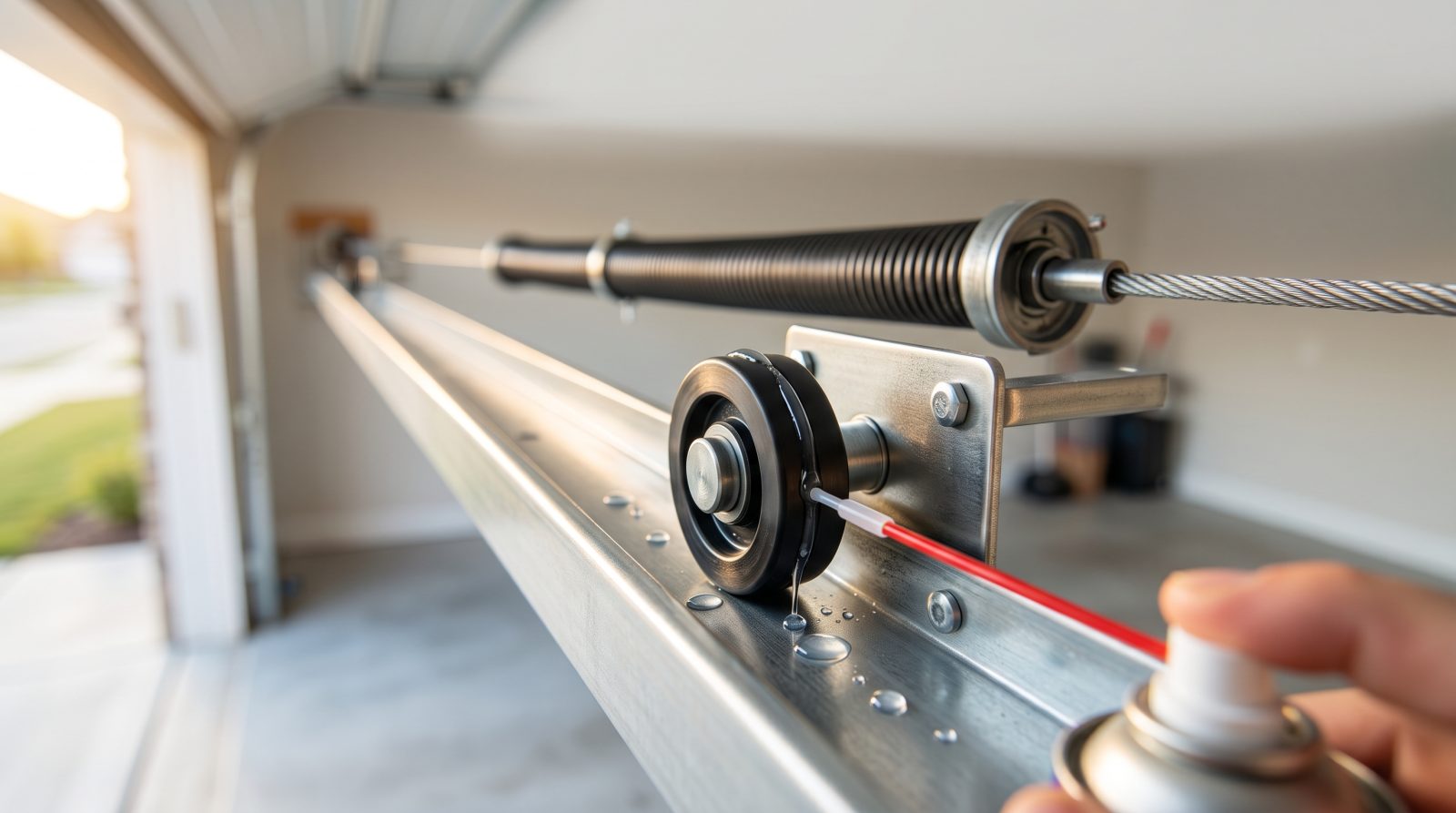
Lubrication is the single most impactful maintenance task a homeowner can do, and also the one most often done wrong. The goal is to reduce friction and noise on the moving metal-on-metal contact points without attracting the grit and dust that gum up a door over time. Done a couple of times a year, good lubrication keeps a door quiet and noticeably reduces strain on the opener.
Use a product made for garage doors, typically a silicone-based or lithium-based spray, rather than a general-purpose penetrating oil. Penetrating oils are designed to break loose stuck parts, not to lubricate long-term, and they tend to leave a sticky film that collects debris. A purpose-made garage door lubricant clings to the part, resists temperature swings, and won't drip onto your vehicle.
Apply lightly to the hinges, the roller bearings (not nylon roller wheels themselves), the springs, the bearing plates, and the opener's chain or screw drive. Wipe away the excess so it doesn't drip or attract dust. One thing to avoid entirely: never lubricate the track. The rollers are meant to roll along a clean, dry track, and adding grease there causes slipping, buildup, and uneven travel. In dusty or coastal regions, you may want to lubricate a bit more often, since airborne grit and salt accelerate wear.
- Use silicone or lithium garage door lubricant, not a general penetrating oil
- Target hinges, roller bearings, springs, bearing plates, and the drive
- Apply lightly and wipe away excess to avoid attracting dust
- Never lubricate the track, keep it clean and dry instead
- Lubricate more often in dusty, sandy, or coastal climates
Spring Balance and Safety Checks You Shouldn't Skip
Balance is the heart of a healthy door. A properly balanced door is held in equilibrium by its springs, so the opener only has to overcome friction, not lift the full weight of the door. You can test balance yourself safely: with the door closed, pull the emergency release to disconnect the opener, then lift the door manually to about waist height and let go. A balanced door will mostly stay put. If it slams down or shoots up, the spring tension is off, and the opener is being forced to compensate, which shortens its life.
Spring adjustment itself, however, is where DIY stops. Torsion and extension springs store an enormous amount of energy under tension and are responsible for the most serious garage door injuries when handled without the right tools and training. Adjusting, repairing, or replacing springs should always be left to a professional. The same caution applies to the lift cables, which are under matching tension. If your balance test fails, that's a signal to call for service, not to start turning hardware.
Two safety systems deserve a monthly check, not just an annual one. First, the photo-eye sensors near the floor: wave an object through the beam as the door closes and it should immediately reverse. Second, the mechanical auto-reverse: place a sturdy object (like a roll of paper towels) flat under the door, and when the door contacts it, it should reverse rather than keep pressing down. If either test fails, stop using the automatic opener until it's corrected, these are the systems that protect children and pets. Also locate and test your emergency release cord so you know how to operate the door by hand during a power outage.
- Test balance with the opener disconnected, the door should hold at waist height
- Never adjust, repair, or replace springs or cables yourself
- Monthly: confirm photo-eye sensors reverse the door when the beam is blocked
- Monthly: confirm auto-reverse triggers when the door meets an obstruction
- Know how to use the emergency release for power outages
DIY vs. Professional, and When Maintenance Points to Replacement
A sensible split keeps you safe and your door healthy. Homeowners can comfortably handle visual inspections, tightening accessible bolts, cleaning tracks, lubricating moving parts, and running the monthly safety tests. Anything involving spring tension, cable replacement, track bending, or opener force recalibration is professional territory, both for safety and because correct adjustment requires experience and the right tools.
Costs for a professional tune-up vary by region, door type, and scope. A standard maintenance visit is typically among the lower-cost services in the trade, with parts like rollers, hinges, or seals added only if they need replacing. Any figures you see are typical industry ranges and estimates that vary by door, materials, and local market, not a fixed quote. The value is in catching the expensive failures, a broken spring, a worn-out opener, a frayed cable, before they leave you with a door stuck shut.
Maintenance is also an honest checkpoint for a bigger decision. If a tune-up keeps surfacing the same problems, repeated spring failures, sagging panels, an opener that strains, rust eating into sections, or a door that no longer seals or insulates well, those are signs that ongoing repairs may be approaching the cost of a new door. For an older, uninsulated, or damaged door, replacement often delivers better day-to-day performance, lower energy loss, stronger curb appeal, and a meaningful bump in perceived home value, frequently making more sense than continuing to patch it. If your annual service is starting to read like a list of what's failing next, it's worth comparing the long-term cost of upkeep against a modern, insulated replacement before you sink more into the old door. To explore your options or schedule a maintenance visit, request a free quote and we'll help you weigh tune-up versus replacement for your specific door.
- DIY-friendly: inspections, tightening bolts, cleaning tracks, lubrication, safety tests
- Professionals only: springs, cables, track repair, opener force calibration
- Tune-up pricing is typically among the lower-cost services; parts added only as needed (estimates vary)
- Repeated spring, panel, or opener issues can signal it's time to compare replacement
- An aging, uninsulated door often replaces more cost-effectively than it repairs