When It's Time to Replace (Not Repair) Your Garage Door
Plenty of garage door problems are genuine repairs: a snapped spring, a worn roller, a misaligned sensor, or a tired opener. But there is a point where pouring money into an aging door stops making sense, and replacement becomes the smarter financial decision. The clearest signals are structural and cumulative rather than a single dramatic failure.
If the door has rotted or rusted panels, repeated dents that compromise the sections, sagging that throws off the balance, or you are facing a third or fourth significant repair in a short span, a new door usually wins on both cost and peace of mind. Single-layer steel doors from decades past also offer almost no insulation and little security by modern standards, so replacement buys you efficiency and curb appeal at the same time. A door that has clearly outlived its design life is rarely worth another expensive band-aid.
Safety is the other deciding factor. Doors installed before modern standards may lack the auto-reverse photo-eye system that stops the door when something crosses its path. If your opener predates that feature or the door's hardware is brittle and original, replacement is the responsible call, especially in a household with kids or pets.
- Rotted, rusted, or repeatedly dented panels that can't be cleanly repaired
- Sagging or off-balance sections that strain the opener and springs
- A pattern of recurring repairs that's approaching the price of a new door
- Thin, single-layer construction with poor insulation and weak security
- Missing modern safety features such as auto-reverse photo-eye sensors
- A remodel or repaint where the old door no longer matches the home
Choosing the Right Material: Steel, Aluminum & Glass, Wood, and Composite
Material is the single biggest decision you will make, because it drives durability, maintenance, insulation potential, appearance, and price all at once. There is no universally best material; there is the right material for your climate, your budget, and the look you want. Understanding the honest trade-offs is what keeps you from overspending or buying something that won't hold up where you live.
Steel is the most popular choice nationwide for good reason. It is strong, low-maintenance, available in insulated multi-layer constructions, and offered in a wide range of finishes including convincing wood-grain textures. Coastal and high-salt-air regions need quality coatings to resist rust, but for most of the country steel delivers the best balance of value and longevity. Aluminum with glass panels leans modern and contemporary, is naturally rust-resistant and lightweight, and floods the garage with light, though large glass sections cost more and insulate less unless specified carefully.
Real wood offers warmth and a premium, custom look that nothing else fully matches, but it demands ongoing refinishing and reacts to humidity swings, so it suits drier or milder climates and owners willing to maintain it. Composite and faux-wood (wood-look steel or fiberglass) products aim to capture that warmth with far less upkeep, resisting moisture, dents, and fading better than the genuine article. Fiberglass and vinyl options also exist and can excel in specific conditions such as high humidity or coastal salt, but availability and performance vary by manufacturer, so match the spec to your environment rather than the brochure photo.
- Steel: best all-around value, low maintenance, available well-insulated; specify good coatings near the coast
- Aluminum and glass: modern look, rust-resistant, light-filled, higher cost and lower insulation in large glass areas
- Wood: warmest, most premium, custom look; needs regular refinishing and suits drier or milder climates
- Composite and faux-wood: wood aesthetics with far less upkeep and better dent and moisture resistance
- Match the material to your regional climate (salt air, humidity, freeze-thaw, intense sun) rather than looks alone
Insulation and R-Value: Why It Matters More Than Most Buyers Think
Insulation is the upgrade homeowners most often underestimate and later wish they had prioritized. A garage door's insulation is rated by R-value, where a higher number means better resistance to heat transfer. Single-layer doors have minimal R-value; double- and triple-layer doors sandwich polystyrene or polyurethane foam between steel skins, with polyurethane generally delivering higher R-value per inch and adding rigidity and quietness as a bonus.
How much insulation you actually need depends on your climate and how you use the space. In regions with cold winters or punishing summer heat, an insulated door helps moderate garage temperature, which matters enormously if the garage is attached and shares a wall with living space, if you have rooms above the garage, or if you use the garage as a gym, workshop, or hangout. In milder coastal climates the energy argument softens, but insulated doors are still quieter, sturdier, and more resistant to denting, so many buyers choose them regardless.
Be a careful reader of R-value claims. Some manufacturers quote the rating of the foam core in isolation rather than the whole assembled door, so two doors advertising similar numbers can perform differently in practice. Look for whole-door or calculated-section ratings, and weigh insulation alongside weatherseals and bottom astragals, which control the drafts and water intrusion that an insulated panel alone won't stop.
- R-value measures resistance to heat transfer; higher is better, and construction layers matter as much as the number
- Polyurethane foam typically out-insulates polystyrene and adds strength and sound dampening
- Prioritize insulation for attached garages, rooms above the garage, and harsh hot or cold climates
- Even in mild regions, insulated doors run quieter and resist dents better
- Verify whether a quoted R-value is for the foam alone or the whole door, and don't overlook good weatherseals
Style, Curb Appeal, and Home Value
Because the garage door is so visually dominant from the street, style is not a cosmetic afterthought; it is a core part of the buying decision and a major driver of why replacement pays off. The right door reads as intentional and well-matched to the home, while the wrong one quietly dates the whole facade. Replacing a tired door is one of the most reliable curb-appeal investments available, and industry remodeling research consistently ranks garage door replacement among the top projects for recovered value at resale relative to cost.
Design comes down to a few choices working together. Panel design sets the personality: traditional raised or recessed panels suit classic and colonial homes, clean flush or modern flat panels fit contemporary builds, and carriage-house styles bring a warm, barn-inspired look that works on craftsman, ranch, and farmhouse exteriors. Windows add character and daylight, with placement and grille patterns tuned to the home's existing windows. Hardware accents like decorative handles and hinges reinforce a carriage-house or rustic theme, and color, whether a coordinating neutral or a confident contrast, ties the door to trim, roof, and front door.
The most successful replacements echo the architecture rather than competing with it. Pull cues from your roofline, window shapes, and material palette so the new door looks original to the house. When in doubt, restraint reads as quality: a clean design in a well-chosen finish almost always outperforms a busy door fighting the rest of the facade.
- Garage door replacement is a top-performing project for recovered value at resale
- Match panel style to architecture: raised/recessed for traditional, flush for modern, carriage-house for craftsman and farmhouse
- Use windows and grille patterns to echo the home's existing windows and add daylight
- Decorative hardware and a coordinated color tie the door into trim, roof, and entry
- Aim for a design that looks original to the house, not bolted on
The Installation Process and What to Budget
A professional garage door replacement is a same-day job for most standard single- and double-car installations, though custom, oversized, or specialty doors can take longer. The crew measures the opening and confirms the spec, removes the old door and hardware, and inspects the tracks, framing, and header. They then install the new sections, tracks, rollers, and spring system, set and balance the springs, mount and program the opener if it is being replaced, and finish with weatherseals, safety-sensor alignment, and an auto-reverse safety test before walking you through operation.
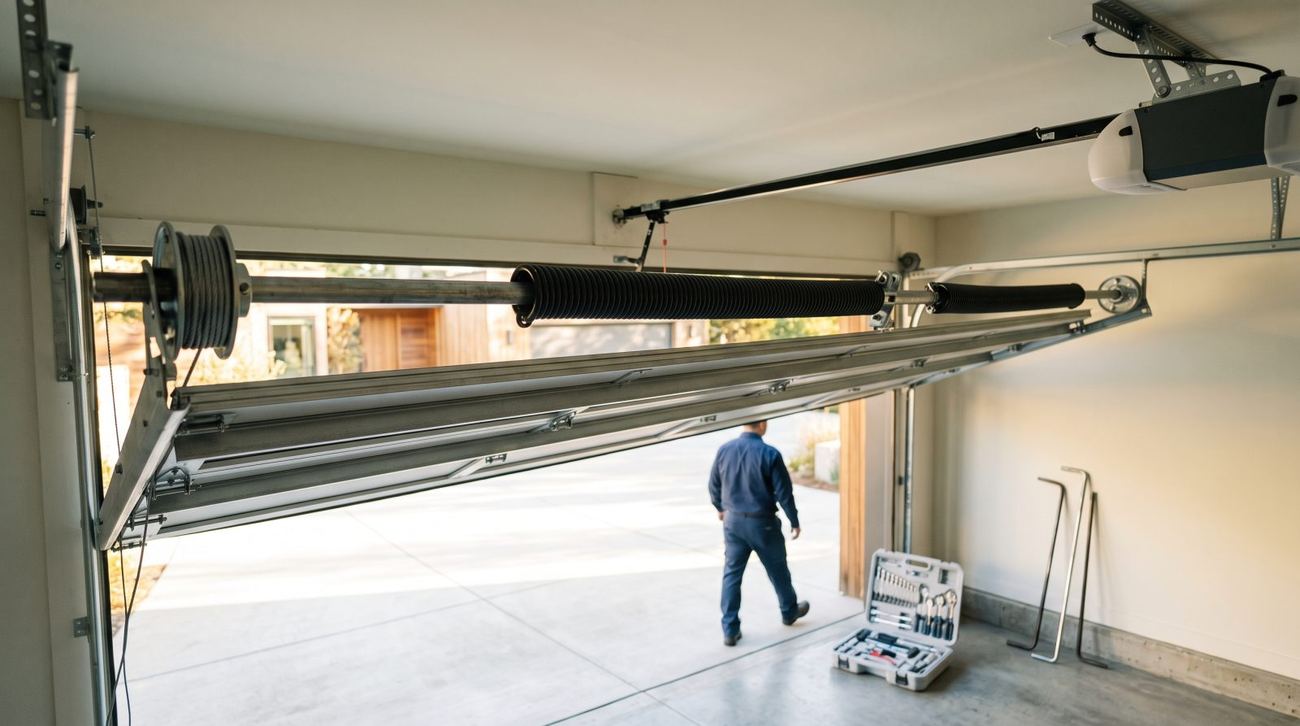
Spring systems deserve special mention. Torsion springs, mounted on a bar above the door, are the more durable and balanced choice for most replacements, while extension springs running along the tracks are an older, lower-cost approach. Spring work is also the part of a garage door that is genuinely dangerous to attempt yourself because the components are under extreme tension, which is a major reason replacement is best left to trained installers.
On budget, treat any figure as a typical industry estimate that varies by door material, size, insulation, window and hardware options, spring system, opener, and your region's labor rates, not a fixed quote. As a planning range, a basic single-layer steel door commonly lands in the lower hundreds of dollars installed, mid-range insulated steel doors often fall in the four-figure range, and premium wood, full-view glass, or custom carriage-house doors can run well into the thousands. Adding or upgrading an opener, reframing a non-standard opening, or choosing high-end glass and hardware pushes the total higher. The reliable way to know your number is a measured, written estimate for your exact opening and selections.
- Most standard replacements are completed same-day; custom and oversized doors may take longer
- Professional install includes removal, new sections and tracks, spring setup and balancing, sensor alignment, and a safety test
- Torsion springs are generally more durable and balanced than extension springs
- Spring tension makes DIY installation genuinely hazardous, favor trained installers
- Costs are estimates that vary widely by material, size, insulation, options, and region, never a fixed guarantee
- Get a measured, written estimate for your exact door and opening to know your real number