The Big Picture: A Counterbalanced System, Not a Lifted One
The most common misconception about garage doors is that the opener lifts the door. It does not. In a properly set-up system, the springs counterbalance almost the entire weight of the door, so the opener only needs to overcome friction and start the door moving. That is why a balanced door, disconnected from its opener, will hold its position when you stop it halfway and can be raised with very little effort. The opener is essentially a positioning motor, not a winch.
This matters enormously when you are choosing a new door. A heavier door, such as a multi-layer insulated steel or solid wood model, needs springs sized specifically to its weight, and an opener matched to that load. When a replacement door is installed, the springs and opener should be selected for the exact door you bought, not reused from the old one. A spring left over from a lighter single-layer door will fail early under a heavier insulated section, and an underpowered opener will strain against a door it was never rated to move.
Everything else in the system, the tracks, rollers, cables, hinges, and weatherseal, exists to keep that counterbalanced slab moving smoothly along a fixed path and to seal the opening when it is closed. Understanding each component in that context makes it far easier to evaluate door quality and to recognize the difference between a budget build and a door engineered to last.
- Springs carry the weight; the opener mostly guides and positions the door
- A balanced door stays put when stopped halfway with the opener disconnected
- Spring size and opener power must be matched to the specific door's weight
- Heavier insulated or wood doors require correspondingly heavier-duty hardware
The Door Itself: Sections, Materials, and Why Construction Matters
A residential garage door is almost always a sectional door: four or five horizontal panels connected by hinges so the door can bend as it travels from vertical (closed) to horizontal (open) overhead. Each section is a structural element, and how those sections are built is the biggest single driver of a door's weight, insulation value, durability, and feel.
Construction generally falls into three tiers. Single-layer doors are a single skin of steel or aluminum with no insulation, the lightest and least expensive option. Two-layer doors add a layer of polystyrene or polyurethane insulation behind the skin. Three-layer (sandwich) doors place insulation between an outer and an inner skin of steel, producing the most rigid, quietest, and best-insulated door, and also the heaviest. Materials range across steel (the most common, durable and low-maintenance), aluminum with glass (light, modern, corrosion-resistant), wood and wood-composite (premium appearance, more upkeep), and fiberglass or vinyl (impact- and dent-resistant, useful in certain climates).
Insulation is described by R-value, and its importance varies by region and by how the garage is used. In hot southern and southwestern climates, an attached garage that shares walls with living space benefits from insulation that slows heat transfer; in northern climates, insulation helps in attached or heated garages and improves comfort in any space used as a workshop or gym. A three-layer door is also dramatically quieter and more rigid, which reduces flex, rattle, and long-term wear on the hardware. When comparing replacement doors, the layer count and material tell you more about real-world performance than the marketing name on the model.
- Sectional doors use 4-5 hinged panels that bend as the door travels overhead
- Single-layer (no insulation), two-layer (insulated), and three-layer (sandwich) define the quality tiers
- Steel, aluminum/glass, wood/composite, and fiberglass/vinyl each suit different priorities and climates
- R-value matters most for attached, heated, or conditioned garages and for noise reduction
The Counterbalance: Torsion Springs vs. Extension Springs
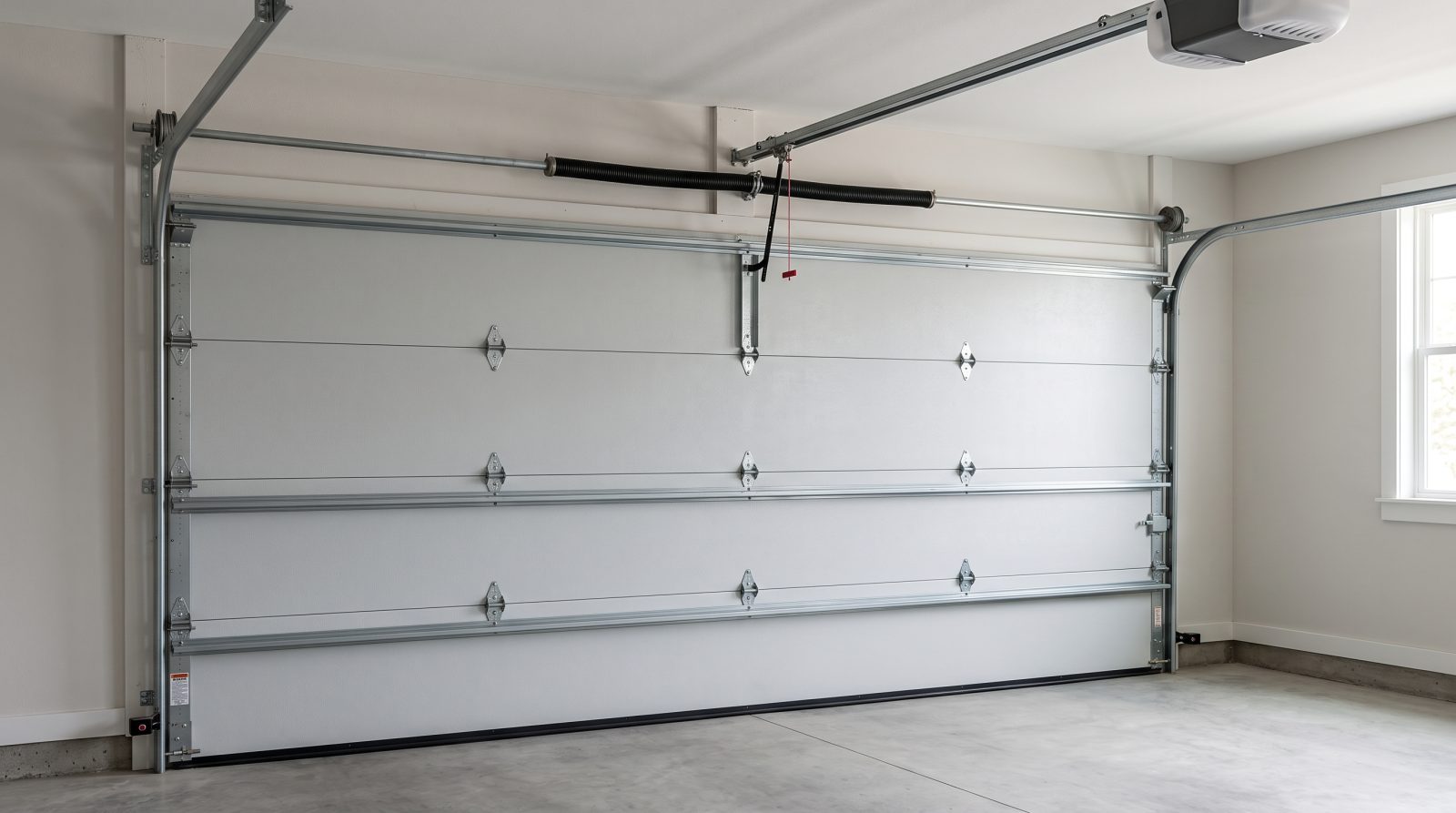
The counterbalance system is the heart of the door and the part most worth understanding before you buy. There are two main types. Torsion springs mount on a metal shaft above the door opening and store energy by twisting; as the door closes, cables wind onto drums at each end of the shaft and load the springs, and that stored torque does the lifting when the door opens. Extension springs run along the horizontal tracks on each side and stretch as the door closes, releasing their tension to assist opening.
Torsion systems are generally regarded as the better engineering: they are more durable, lift the door more smoothly and evenly, are quieter, and tend to last longer. Extension springs are more common on older or budget installations and are more prone to uneven lift if the two sides fall out of balance. Spring life is commonly rated in cycles, with one cycle being one full open-and-close. Standard springs are often rated in a typical range of roughly 10,000 to 15,000 cycles, while high-cycle springs can be specified for far more, which is worth considering for a busy household where the garage door is the main entrance.
Because springs are under extreme tension, they are the one component homeowners should never attempt to adjust or replace themselves; a failing or improperly handled spring can cause serious injury. When you replace a door, this is also where build quality quietly hides: ask whether the new door comes with torsion springs sized to its weight and what cycle rating they carry. Two doors that look identical on the outside can have very different lifespans depending on the springs behind them.
- Torsion springs mount on a shaft above the door; extension springs run along the side tracks
- Torsion systems are smoother, quieter, more durable, and balance both sides evenly
- Spring life is measured in cycles; standard springs commonly fall in a typical 10,000-15,000 cycle range
- Springs are under high tension and should only be serviced by a trained professional
Tracks, Rollers, Cables, and Hinges: The Path and the Load Path
Once the springs handle the weight, the rest of the hardware controls the door's motion and ties the system together. Vertical tracks on each side of the opening guide the door as it rises, then curve into horizontal tracks that carry it back along the ceiling when open. Rollers, small wheels at the edge of each section, ride inside these tracks; nylon rollers run more quietly and need less maintenance than basic steel ones, and sealed ball-bearing rollers are a meaningful upgrade in smoothness and longevity.
Lift cables are a critical and often overlooked safety component. On a torsion system they connect the bottom of the door to the drums on the spring shaft, transferring the springs' stored energy into lifting force. These cables are under continuous load and are a frequent point of wear; frayed or rusted cables are a sign that service is overdue. Hinges connect the sections and let the door articulate as it changes from vertical to horizontal, and the bottom bracket, where the cable attaches at the lowest section, is under particularly high tension.
When evaluating a replacement door, the quality of this hardware separates a door that stays quiet and smooth for years from one that begins to rattle and bind within a season. Better installations use heavier-gauge tracks, quality rollers, and properly sized cables, and they fasten the tracks securely to the framing. None of this is visible in a photo of the door's exterior, which is exactly why understanding the mechanics helps you ask the right questions and compare quotes on substance rather than just appearance.
- Vertical and horizontal tracks define the door's travel path overhead
- Nylon and sealed ball-bearing rollers run quieter and last longer than basic steel rollers
- Lift cables carry the spring force to the door and are a common, safety-critical wear point
- Heavier tracks, quality rollers, and proper fastening distinguish a durable install from a budget one
The Opener and Its Safety Systems
The opener is the motorized unit on the ceiling that drives the door open and closed and holds it shut. Drive types are the main distinction: chain drives are durable and economical but noisier; belt drives use a reinforced rubber belt for noticeably quieter operation, ideal when the garage sits below or beside a bedroom; screw drives use a threaded steel rod and are less common; and direct-drive and wall-mounted (jackshaft) units move the motor off the ceiling and can be very quiet. Motor strength is rated in horsepower or its equivalent, and it should be matched to the door's weight, again reinforcing why a heavier insulated door needs a properly sized opener.
Modern openers include essential safety features mandated for residential use. Photo-eye sensors near the floor on each side project an invisible beam across the opening; if anything breaks the beam while the door is closing, the door reverses. Auto-reverse force detection senses if the door meets resistance and reverses to prevent crushing. A manual release cord disconnects the door from the opener so it can be operated by hand during a power outage. These systems should be tested periodically, and they are a key reason a very old opener is often worth replacing alongside a new door.
Many current openers add convenience and security features such as smartphone control, battery backup for power outages (required by law in some states), rolling-code remotes that prevent code theft, and motion-activated lighting. When you replace a door, it is usually the right moment to evaluate the opener too, because matching a quiet, properly powered, safety-equipped opener to a new door completes the system and protects your investment in the door itself.
- Chain, belt, screw, and direct/jackshaft drives trade off cost, noise, and ceiling space
- Opener power should be matched to the door's weight, especially for insulated doors
- Photo-eye sensors, auto-reverse, and a manual release cord are core safety systems to test regularly
- Battery backup, rolling-code remotes, and smartphone control are common modern upgrades
Sealing the Opening and How It All Works Together in Motion
A garage door is also part of the home's exterior envelope, and several components handle sealing. The bottom seal, a flexible strip along the lowest section, compresses against the floor to block water, drafts, dust, and pests, and it is one of the first parts to wear out. Perimeter weatherstripping around the sides and top, plus the stop molding on the jambs, closes the gaps along the frame. In regions with blowing rain, snow, or fine dust, the quality and condition of these seals has a real effect on garage comfort and on keeping moisture away from stored items and vehicles.
Putting the full cycle together: when you press the remote, the opener disengages its hold and begins moving the trolley along the rail, which gently pushes or pulls the top section. The springs immediately take over most of the weight, the rollers track the sections up the vertical rails and around the curve into the horizontal tracks, the cables unwind from the drums as the torsion springs release their energy, and the hinges let each section pivot as the door folds overhead. Reverse the process to close, and the springs reload, the seal compresses against the floor, and the safety sensors stand guard against anything in the path.
Understanding this interplay is the real payoff for a homeowner considering a replacement. It explains why a quality door is a matched system rather than a single product: the right section construction for your climate, springs sized and cycle-rated for that door's weight, smooth rollers and solid tracks, an opener powerful and quiet enough for the load, and seals suited to your region. A door specified this way feels effortless, runs quietly, and lasts; one assembled from mismatched parts announces itself with noise, drift, and early repairs. If you are weighing a new or replacement door, request a free quote from a qualified installer who will assess your opening and specify the whole system, not just the panel on the front.
- Bottom seal, perimeter weatherstripping, and stop molding keep out water, drafts, dust, and pests
- Seal quality matters most in climates with blowing rain, snow, or fine dust
- A full cycle is the opener, springs, cables, rollers, hinges, and sensors working in sequence
- A great door is a matched system, section build, springs, hardware, opener, and seals chosen together