Start With the Door, Not the Opener
The single most common mistake when buying an opener is shopping for the motor first. The opener exists to move a specific door, so the door's weight, size, material and balance should drive every spec you choose. A lightweight single-car aluminum door and a wide, two-car insulated steel door with custom glass have very different needs, and an opener sized for one will struggle or wear early on the other.
If you're replacing your door at the same time, this is actually an advantage: you can spec the door and opener together so the system is balanced from day one. Heavier doors (thick insulated steel, solid wood, or large two-car panels) generally call for more lifting power and a more robust drive, while standard non-insulated doors are far more forgiving. The opener should never be doing the heavy lifting alone, either. A properly tensioned spring system carries the door's weight so the opener only guides it. If your old opener strained, the real culprit is often worn springs or a door that's out of balance, not an underpowered motor.
Also confirm the practical fit before you buy: standard residential openers are built for doors up to roughly 7 feet tall, while 8-foot and taller doors usually need an extension kit or a taller rail. High-lift and cathedral-ceiling garages, low-headroom setups, and one-piece tilt doors all have specific opener requirements worth verifying up front.
- Match opener power to door weight and size, not to a bigger-is-better instinct
- Replacing the door too? Spec door and opener together for a balanced system
- Confirm door height (7 ft standard vs. 8 ft+ needing an extension kit)
- Worn springs, not the motor, are the usual reason an old opener struggles
- Special setups (low headroom, high lift, one-piece doors) need matched hardware
Drive Types Explained: Belt, Chain, Screw and Direct Drive
The drive is how the opener actually moves the door, and it's the choice you'll notice every single day, mostly through noise. There are four main types, each with a clear personality. Understanding the trade-offs lets you weigh quiet operation against cost and maintenance for your specific garage.
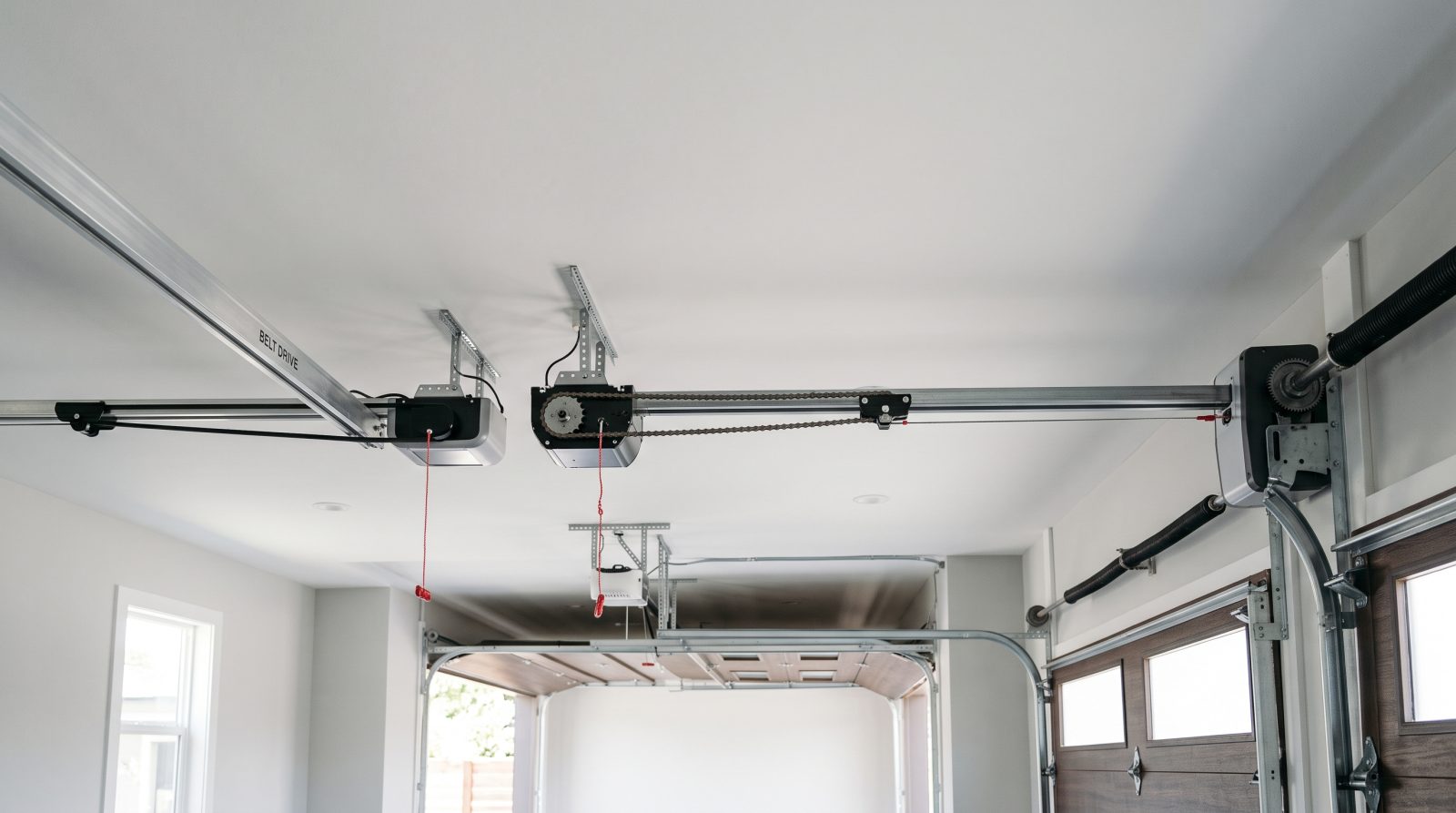
Belt drive uses a reinforced rubber belt and is the quietest mainstream option. It's the go-to when the garage sits under or next to a bedroom, a home office or a finished living space, because it dramatically cuts the vibration that travels through the house. Belts run smooth and need little maintenance, at a modestly higher price than chain. Chain drive uses a metal chain, like a bicycle, and is the workhorse: durable, proven, the most affordable, and well suited to detached garages or shops where a little extra noise doesn't matter. It needs occasional lubrication and is noticeably louder than a belt.
Screw drive moves a trolley along a threaded steel rod. It has fewer moving parts and a middle-of-the-road noise level, and modern versions handle temperature swings far better than older units once did, though extreme heat and cold can still affect performance, which is worth weighing in regions with harsh summers or winters. Direct drive (also called jackshaft when wall-mounted) is the newest category. Wall-mount direct-drive openers bolt beside the door and drive the torsion shaft directly, freeing up your ceiling entirely, running very quietly, and excelling in garages with high, vaulted or obstructed ceilings, or where you want overhead storage. They sit at the premium end of the price range.
- Belt drive: quietest, low maintenance, best under or beside living space
- Chain drive: most affordable and durable, louder, ideal for detached garages and shops
- Screw drive: fewer parts, mid-range noise; modern units handle climate better but still react to extreme temps
- Direct/jackshaft drive: wall-mounted, very quiet, frees the ceiling, premium price
- Noise tolerance and ceiling layout usually decide the drive type as much as budget
How Much Horsepower (or Power) You Actually Need
Horsepower is the spec buyers obsess over and most often get wrong. More power doesn't make a door open faster or last longer; it simply gives the opener headroom to move heavier doors comfortably. The goal is enough power for your door with a little margin, not the biggest number on the shelf.
As a general guide, lighter single doors and standard non-insulated doors are well served by entry-level power (often expressed as 1/2 HP or its equivalent). Standard two-car doors and most insulated steel doors are a comfortable fit for mid-tier power (around 3/4 HP equivalent), which is the most popular choice for typical homes. Heavy doors, large oversized doors, solid wood, and full glass-and-aluminum doors are where higher power (1 to 1.25 HP equivalent) earns its keep by lifting smoothly without strain.
One important note: many modern openers, especially DC-motor and battery-backup models, are rated in newton-meters of force or with proprietary power classes rather than traditional horsepower. These DC motors offer soft start and soft stop, quieter operation and slower wear, and a 'horsepower equivalent' or force rating that maps cleanly to door weight. Don't compare a DC force rating to an old AC horsepower number directly. Instead, match the manufacturer's recommended door weight or size range to your door and you'll land in the right place.
- More HP means more headroom for heavy doors, not faster or longer-lasting operation
- Light/standard single doors: entry-level power (about 1/2 HP equivalent)
- Standard two-car and insulated steel doors: mid-tier (about 3/4 HP equivalent) is the popular sweet spot
- Heavy wood, oversized or full-glass doors: higher power (1 to 1.25 HP equivalent)
- DC motors are rated by force, not classic HP; match the door-weight range the maker lists
Safety Features and Code Requirements You Can't Skip
Some opener features are conveniences. Others are non-negotiable safety hardware, and a few are required by federal law on residential openers. Knowing the difference protects your family and keeps your installation compliant.
Photo-eye safety sensors are mandatory on residential garage door openers manufactured for U.S. sale. Mounted a few inches off the floor on each side of the door, they project an invisible beam; if anything breaks it while the door is closing, the door automatically stops and reverses. Auto-reverse force sensing is the second safety layer: if the door contacts an object on the way down, it reverses on its own. These systems are why a modern opener is dramatically safer than units from decades past, and they're a core reason to replace a very old opener rather than nurse it along. Test both functions periodically by waving an object through the beam and by placing a board flat under the door.
Rolling-code technology is a security feature that's now standard: the remote and opener generate a new code every time you use them, so the signal can't be intercepted and replayed to break in. Battery backup is increasingly common and, in some states, required for new installations so the door still opens during a power outage, which matters most in areas prone to storms or grid interruptions and in any home where the garage is the main entrance. Finally, a manual release cord lets you disengage the opener and operate the door by hand in an emergency; make sure everyone in the household knows where it is and how it works.
- Photo-eye sensors are federally required on residential openers and stop a closing door
- Auto-reverse force sensing reverses the door if it hits an object
- Rolling-code remotes generate a fresh code each use to prevent signal theft
- Battery backup keeps the door working in outages and is required in some states
- Always know your manual release cord; test safety reverse periodically
Smart and Convenience Features Worth Paying For
Today's openers are connected devices, and the smart layer is where personal preference and lifestyle come in. None of it is required, but a handful of features genuinely change how the garage works day to day, and they're easiest to get when you're already buying a new unit.
Built-in Wi-Fi and a companion app let you open, close and check your door from your phone, get an alert if it's left open, and grant access remotely, useful for letting in family, a dog walker or a delivery. Many systems now integrate with in-garage package delivery and with smart-home platforms so the door can work alongside lights, locks and voice assistants. Motion-activated lighting brightens the garage automatically as you walk in, and brighter integrated LED lighting is a small but appreciated upgrade over a single dim bulb.
Practical hardware choices matter too. A wireless keypad on the exterior lets family or guests enter with a code, no remote or phone needed. Extra remotes and a wall-mounted control panel with a lock feature round out access. If you value quiet most, remember that the smart features stack on top of the drive type, so a Wi-Fi belt-drive unit gives you the quietest experience with full app control. Weigh these against budget: a fully loaded opener costs more up front, but it's a one-time decision you live with for many years, and adding features later is rarely as clean as buying them built in.
- Wi-Fi and an app: open, close, monitor and get left-open alerts from anywhere
- Smart-home and in-garage delivery integration for lights, locks and voice control
- Motion-activated and brighter LED lighting improve everyday visibility
- Exterior wireless keypad gives keyless, phone-free entry for family and guests
- Smart features layer onto the drive type; pair Wi-Fi with belt drive for quiet plus control
Budget, Installation and Buying It Once
Opener pricing spans a wide range, and it helps to think in tiers. The figures below are typical industry ranges and estimates only; actual cost varies by drive type, power, features, your door, your region and the complexity of the install, so treat them as planning numbers rather than a quote.
For the opener unit itself, a basic chain-drive model typically falls at the lower end of the range, mid-tier belt and screw drives sit in the middle, and premium wall-mount direct-drive units with battery backup and full smart features land at the top. Professional installation is commonly billed separately and adds to the total; it covers mounting, balancing the door to the opener, wiring the safety sensors correctly, programming, and hauling away the old unit. A new opener is also frequently bundled into a full door-replacement project, which is often the most cost-effective time to upgrade because much of the labor overlaps.
While professional installation isn't strictly required for every model, it's strongly worth it: incorrect sensor placement, an unbalanced door, or improper spring tension can be dangerous and can void warranties. A pro also right-sizes the opener to your door and confirms code-required safety and backup features are in place. The bottom line for replacement buyers is simple: choose the drive type that matches your noise tolerance and ceiling, the power that matches your door weight, and the safety and smart features you'll actually use, then buy a quality unit once rather than replacing a cheap one in a few years. When you're ready to size the right opener for your door, request a free quote and get a recommendation tailored to your setup.
- Treat all prices as typical industry ranges and estimates that vary by door, features and region
- Unit cost rises from basic chain drive to premium wall-mount direct drive with battery backup
- Professional installation is usually billed separately and covers balancing, wiring and programming
- Bundling the opener into a full door replacement is often the most cost-effective time to upgrade
- Buy a quality, correctly sized unit once instead of replacing a budget opener in a few years