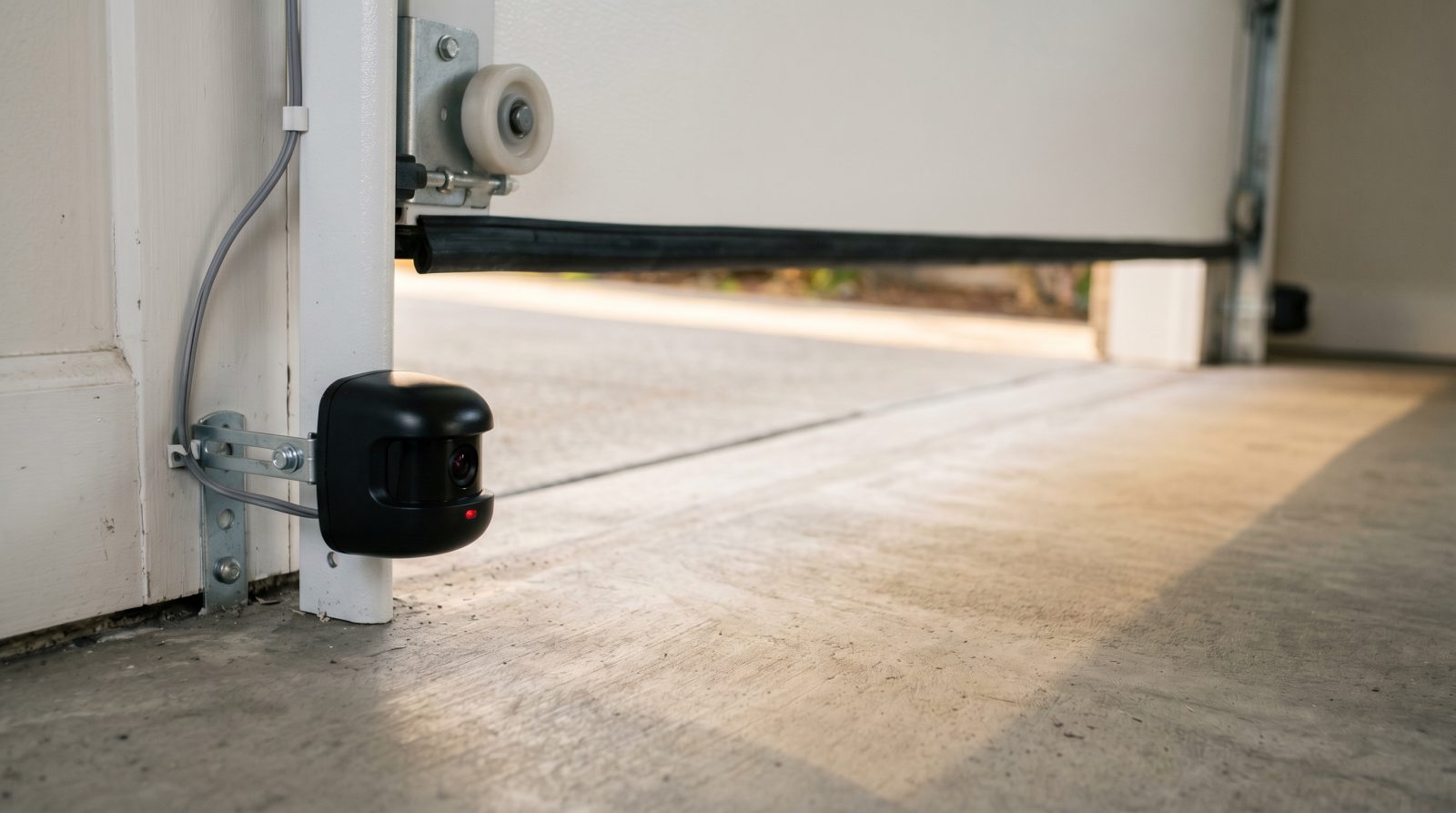
What Photo-Eye Safety Sensors Are and How They Work
A garage door safety sensor system is a matched pair of photoelectric devices mounted on either side of the door opening, typically four to six inches above the floor. One unit is the sending eye, which projects a focused infrared beam straight across the threshold. The other is the receiving eye, which constantly watches for that beam. As long as the receiver sees the beam, the door is allowed to close. The moment anything interrupts the beam, a child, a pet, a bicycle, a trash can, the opener immediately halts the door and reverses it back to fully open.
This is a non-contact safety system, meaning the door does not need to physically touch an object to know it is there. That distinction matters: a closing garage door is the single heaviest moving object in most homes, often weighing well over a hundred pounds for a steel door and far more for solid wood or insulated multi-layer doors. Without a working photo-eye system, that weight comes down regardless of what is underneath it. The sensors exist precisely so it never has to.
Photo-eyes work alongside a second safety mechanism built into the opener itself: mechanical force and contact reversal. If the door does make contact with an obstruction it could not see, the opener is also designed to sense the resistance and reverse. The two systems are complementary, but the photo-eye beam is the primary line of defense because it acts before contact ever happens. When you buy a new garage door and opener, both systems come standard and are calibrated as part of a proper installation.
Why Safety Sensors Matter More Than People Realize
The federal requirement for an external entrapment-protection system, the photo-eye beam, came directly out of a history of serious injuries and child fatalities caused by closing garage doors. Underwriters Laboratories standard UL 325 has governed residential opener safety for decades, and it is why no compliant opener will close on a held-down button alone without the secondary safety in place. This is not a convenience feature. It is a life-safety device that happens to live in your garage.
For families with young children or pets, the photo-eye system is doing quiet, invisible work every single day. Children are naturally drawn to the open space under a closing door, and a toddler can move into that gap in the second it takes a door to descend. The beam is positioned low specifically so that a small child or a pet crawling beneath the door breaks it. Keeping that beam clean, aligned, and unobstructed is one of the highest-value, lowest-effort safety habits a homeowner has.
There is also a property and liability dimension. A door that closes on a vehicle bumper, a parked bike, or a stack of stored items can cause real damage in an instant, and a malfunctioning safety system that injures a guest can carry serious consequences. When evaluating a replacement door, the integrity of the safety package, not just the look of the panels, is part of what you are buying.
Sensor Alignment: The Cause Behind Most Door Problems
If your garage door starts to close and then reverses on its own, refuses to close, or only closes when you hold the wall button down, the culprit is far more often the safety sensors than the opener, the springs, or the remote. Misalignment is by a wide margin the most common reason a healthy door appears to be malfunctioning. The two eyes must point directly at each other so the beam lands cleanly on the receiver. Even a small bump from a leaf blower, a stored bin, or a kid kicking a ball can knock one eye off its aim.
Most sensors include small indicator lights that tell you exactly what is happening. Typically the sending eye shows a steady light to confirm it has power, while the receiving eye shows a steady light only when it is locked onto the beam. A blinking or dark light on the receiving eye is the classic signature of misalignment or a blocked beam. Brands vary in which color means what, so the door owner manual is the authority, but the principle is universal: steady on both eyes means good, flickering means a problem.
Realigning sensors is often a simple task. Loosen the wing nut or bracket screw holding the receiving eye, gently pivot it until the indicator light goes steady, and retighten without nudging it back out of position. Dirt is the other frequent offender; a spider web, road film, or a smear of dust on the lens can scatter the beam enough to stop the door. A soft, dry cloth across both lenses resolves a surprising number of complaints. Loose wiring at the sensor terminals, sun glare hitting the receiver at a low angle, or a sensor mounted too high are the next things to check.
Safety Sensors and a New Garage Door Installation
When you replace a garage door, the safety sensor system is part of the package whether you are buying a complete door-and-opener bundle or keeping a compatible existing opener. A reputable installation includes mounting the photo-eyes at the correct low height, aiming and testing the beam, and verifying both the photo-eye reversal and the contact-force reversal before the job is called finished. This is a step worth confirming is on the installer scope of work, because a beautifully hung new door with a misaligned sensor will frustrate you on day one.
A door replacement is also the natural moment to modernize the opener and its safety electronics. Older openers from the 1990s and early 2000s met the requirements of their day but lack the smoother, more reliable sensing of current models. Newer systems offer better beam stability, clearer diagnostic indicators, battery backup that keeps the safety system working during a power outage, and in many cases smartphone alerts if a door is left open. If your existing opener predates these features, pairing a new door with a new opener is usually the better long-term value.
Heavier door choices interact with the safety system too. A premium insulated steel door or a solid wood carriage-house door weighs considerably more than a basic single-layer panel, which makes the photo-eye reversal even more important and puts more demand on the opener and springs. Matching the opener horsepower and the spring system to the actual weight of your chosen door is part of a correct installation, and it keeps the safety reversal responsive rather than sluggish.
How Climate and Region Affect Sensor Performance
Because the photo-eyes sit just inches off the garage floor and are exposed to whatever comes through the opening, regional climate genuinely affects how they behave. In northern and snow-belt regions, packed snow, slush, and road salt thrown off tires can coat or bury the lower sensors during winter, breaking or weakening the beam until they are cleared and wiped. Homeowners in these areas often find a quick lens wipe is a routine part of winter garage upkeep.
In hot, sun-exposed regions and on west- or east-facing garages, direct low-angle sunlight striking the receiving eye can overwhelm the infrared beam and cause intermittent reversals, usually at the same time of day as the sun lines up with the opening. Repositioning or shading the receiver, or choosing sensors and openers with stronger beam discrimination, addresses this. In coastal and high-humidity areas, salt air and moisture can corrode exposed wiring connections at the sensor terminals over time, so weather-resistant wiring and periodic inspection pay off.
Dust-heavy and rural environments accelerate lens fouling, and areas with frequent insects may see spiders building webs directly across the beam, a remarkably common cause of mystery reversals. None of these conditions are reasons to distrust the system; they are simply reminders that the safety sensors live in the real world. When selecting a new door and opener for a specific climate, it is worth asking your installer how the safety electronics handle local conditions.